Korea Transportation Safety Authority to Establish Autonomous Vehicle Inspection System at Sejong Center by Year-End
Pilot Operation of KADAS to Begin Next Year
Five ADAS Functions to be Inspected with New Test Bench
Laying the Groundwork for Future Traffic Safety and Mobility Rights
An autonomous vehicle inspection system (KADAS, Korea Automated Driving vehicle Assessment System) capable of testing advanced driver assistance system (ADAS) functions will be established by next year.
The Korea Transportation Safety Authority announced on the 13th that it will build a system to inspect five types of ADAS functions at its Sejong Inspection Center in the second half of this year, with plans to begin pilot operations next year. ADAS is a device that enhances driving convenience by recognizing and controlling the distance between vehicles to prevent collisions and respond to emergencies. However, until now, inspections have only been possible at the perception stage, such as diagnosing sensor malfunctions. Since there has been a lack of a systematic inspection system to assess the safety of the decision-making and control stages performed by the vehicle itself, a new system will be introduced.
ADAS functions are already widely used. Their utilization is expected to increase as autonomous driving technology advances and usage conditions change. However, if advanced safety devices do not function properly, they can cause fatal accidents. The Authority stated that an inspection system is needed to determine whether these related devices are functioning as intended and operating normally.
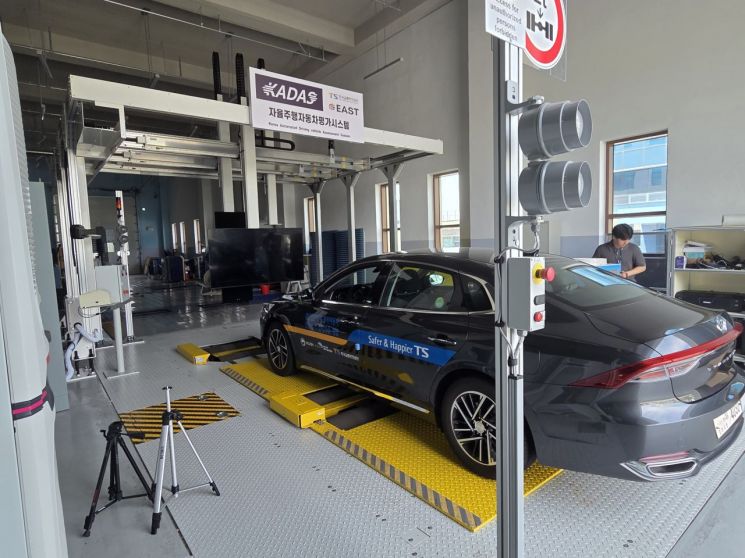 The Korea Transportation Safety Authority autonomous vehicle inspection system (KADAS), consisting of a gantry, simulation programs, and other components for driving simulators and virtual environment implementation. Provided by the Korea Transportation Safety Authority
Within this year, the Authority plans to establish a test bench for the autonomous vehicle inspection system and lay the groundwork for inspection standards and methods. Safety inspections are planned for five ADAS functions: forward distance maintenance, lateral distance safety, lateral distance maintenance, forward collision warning, and emergency automatic braking. The test bench will consist of a steerable front-wheel-drive driving simulator, a gantry for transporting virtual environment implementation equipment, and virtual environment simulation programs.
When a vehicle arrives for inspection, preliminary settings such as wheelbase and vehicle center alignment are performed, followed by function-specific inspection scenarios. The process is carried out in the order of performance evaluation and results notification. Data collected during the inspection can be used by manufacturers or sensor developers for technology development and will also be utilized when revising inspection systems. The Authority expects that, in the mid- to long-term, this will contribute to the commercialization of autonomous vehicles.
Starting next year, the Authority plans to supplement the limitations of the current vehicle inspection system and promote the demonstration of an integrated inspection system based on a regulatory sandbox for the pilot operation of the autonomous vehicle evaluation system. Jeong Yongshik, President of the Korea Transportation Safety Authority, stated, "To ensure the safety of autonomous vehicles, we will secure data-based effectiveness through the test bench and establish an inspection system that meets international standards," adding, "This is a proactive institutional innovation to guarantee future traffic safety and mobility rights."
© The Asia Business Daily(www.asiae.co.kr). All rights reserved.












