Famous as the "Panda Village" with Over 1 Trillion Won Economic Impact for 30 Years
Panda Return Expected to Cause 56.1 Billion Won Loss
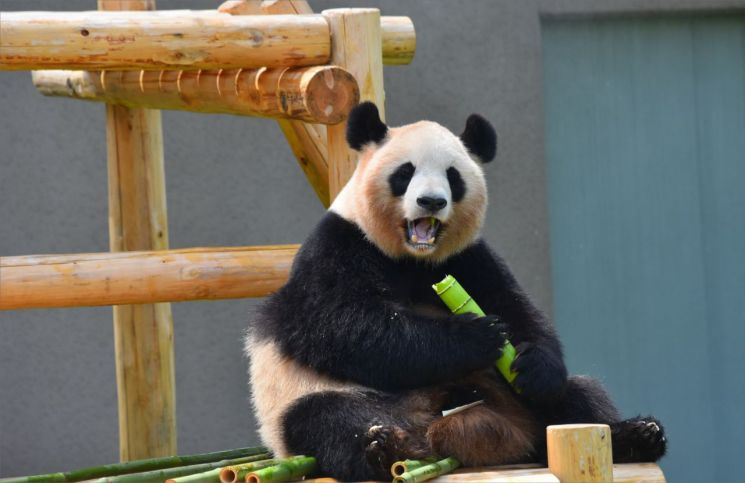
The return of four pandas, which had been symbols of Shirahama in Wakayama Prefecture, western Japan, for over 30 years, to China has deepened concerns in this area, which has been called the "panda village."
According to CNN on July 9 (local time), four pandas that had served as regional symbols and the centerpiece of the tourism industry in Shirahama for the past three decades have been sent back to China.
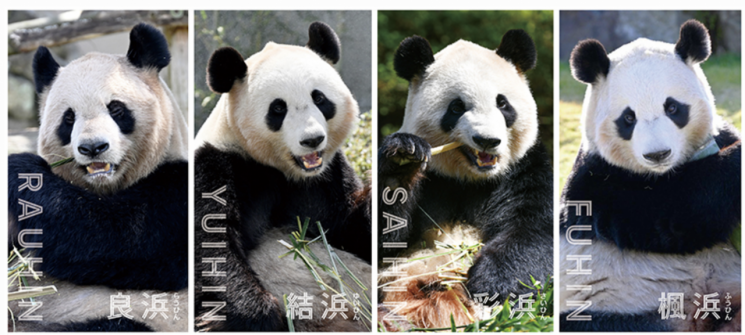
Lauhin (24), who grew up at the theme park Adventure World in Shirahama, along with her daughters Yuihin (8), Saihin (6), and Fuhin (4), were all born in Japan. These pandas have been the symbols of Shirahama, the "panda village," attracting tourists for decades and contributing to the revitalization of the local economy.
However, as the lease agreement was not renewed, the pandas were recently returned to China. Currently, all pandas are owned by the Chinese government.
On the day of their farewell, panda fans gathered in large numbers, dressed in black and white clothing and fur hats, holding panda dolls and banners, waiting in long lines and shedding tears. Shiori Sakurai said, "I really don't want to say goodbye. I will love them every day," as she sobbed. Mihoko Ninomiya, who visited with her daughter and granddaughter, told CNN, "We visited every month for generations. We will miss them so much."
Shirahama, a seaside city with a population of 20,000 located 145 km south of Osaka, has relied on pandas for its tourism industry to the extent that panda images can be found throughout the area. Katsuhiko Miyamoto, professor emeritus at Kansai University, analyzed that the pandas generated an economic effect of about 125.6 billion yen (1.1754 trillion won) in Shirahama over the past 30 years, but their return could result in an annual loss of about 6 billion yen (561 million won). This accounts for 40% of the city's total budget.
Professor Miyamoto also added that the number of annual tourists could decrease by about 200,000, which may lead to a decline in the local population and a worsening of employment. He pointed out that as local jobs decrease, a vicious cycle may accelerate in which younger generations leave the area in search of work.
Satsuki Kitai, who runs a souvenir shop near the train station, said, "Forty percent of our family business's sales came from panda merchandise," and added, "We haven't yet decided whether to keep it as a 'panda memorial hall.'"
In the past, Shirahama was known as a hot spring tourist destination. However, as hot spring tourism lost popularity, the area succeeded in attracting pandas in 1994 and transformed into a panda tourism destination, with Lauhin and Eimei among the attractions. Eimei was a panda with the most successful breeding record outside China, fathering a total of 16 cubs with the female panda Meimei. After returning to China in 2023, Eimei passed away at the age of 32 earlier this year.
Panda leasing is part of China's "panda diplomacy" strategy, and whether to extend the contract is known to depend on diplomatic relations with China. Typically, pandas are leased for 10 years, and cubs born overseas are sent to China before the age of four.
The reason why China refused to extend the panda lease contract with Shirahama is unclear, but there is speculation that diplomatic factors played a role. Masaki Ienaga, associate professor of international relations at Tokyo Woman's Christian University, told CNN, "There may have been political factors involved." Last year, Yasushiro Oe, a politician with a pro-Taiwan stance, was elected mayor of Shirahama. Associate Professor Ienaga pointed out, "This may have angered China," and added, "China considers the Taiwan issue as something it cannot ignore."
In response, Mayor Oe denied the connection, saying, "It is unlikely that China would retrieve the pandas just because I, the mayor of a small city with a population of 20,000, interacted with Taiwan."
The Chinese Ministry of Foreign Affairs stated that the Taiwan issue is a domestic matter and told CNN, "Japanese politicians should be cautious in their words and actions." However, the ministry added that China and Japan are maintaining exchanges related to pandas.
© The Asia Business Daily(www.asiae.co.kr). All rights reserved.













