Hayoungkyun of Energy11 and Lee Dongwook of Ecopro BM
High Energy Density and Stable Supply Chain Are Needed
The sodium-ion battery (SIB), considered a leading "post-lithium" candidate, is quietly preparing for growth in South Korea as well. With expectations that SIBs could capture up to 50% of the global market share by 2035 thanks to their price competitiveness and safety, domestic battery companies are also beginning efforts to establish a Korean SIB ecosystem.
On the 11th, the Korea Institute of Future Technology Education held a seminar on "Current Status of High-Performance Sodium Battery Development and Commercialization Strategies" at the Sapphire Hall on the 2nd floor of the FKI Tower Conference Center in Yeongdeungpo-gu, Seoul. The seminar featured lectures by Hayoungkyun, CEO of Energy11, Lee Dongwook, Director of Ecopro BM, and Kang Junggu, Professor of Materials Science and Engineering at KAIST.
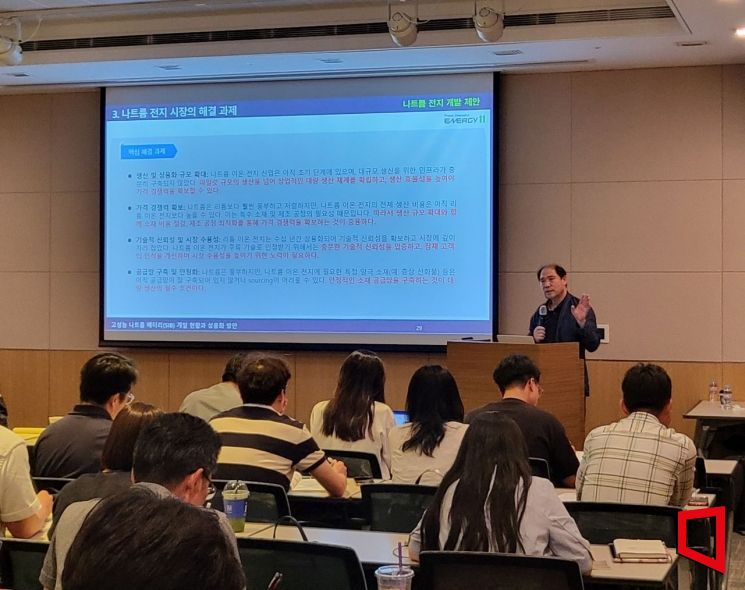 On the 11th, Hayoungkyun, CEO of Energy11, is giving a presentation on "The Domestic and International Industry Status and Commercialization Plans of Sodium Batteries" at the Sapphire Hall on the 2nd floor of the FKI Tower Conference Center in Yeongdeungpo-gu, Seoul. Photo by Shim Sunga
"Sodium Batteries Could Reach 50% Market Share by 2035"
Hayoungkyun, who oversees the SIB project for the Ministry of Trade, Industry and Energy, stated, "The next ten years will be a critical turning point for advancing SIB technology and achieving commercialization," and predicted, "By 2035, SIBs could replace a significant portion of LFP batteries and reach up to 50% of the overall market share."
More than 80% of global SIB development companies are concentrated in China, and companies such as HiNa and CATL are already mass-producing SIBs for use in small electric vehicles and ESS. Energy11 is preparing for commercialization faster than any other domestic company through joint development with Ecopro BM and supply chain construction via government projects.
Hayoungkyun said, "For ESS batteries, safety and price are the most important factors, and SIBs satisfy both conditions." SIBs are evaluated as maintaining charging performance even at low temperatures and having a high decomposition temperature, which reduces the risk of fire.
"Technical Challenges Remain... Too Early to Replace Lithium"
However, the industry believes that it is still too early for SIBs to fully replace lithium-ion batteries. Lee Dongwook said, "SIBs have excellent low-temperature performance, but still require improvement in terms of energy density and lifespan," adding, "In particular, stability at high voltage and residual sodium control technology are key challenges."
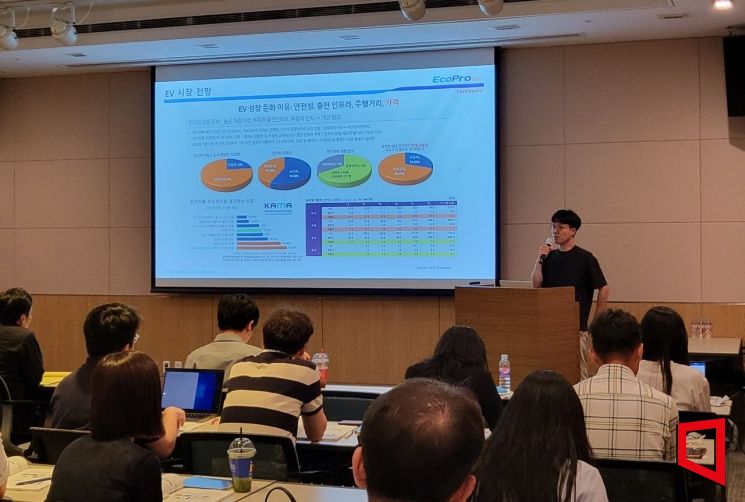 On the 11th, Lee Dongwook, Director of Ecopro BM, is giving a presentation on "Current Status of Sodium Battery Cathode Material Development Technology and Market Competition Strategies" at the Sapphire Hall on the 2nd floor of the FKI Tower Conference Center in Yeongdeungpo-gu, Seoul. Photo by Shim Sunga
Ecopro BM is developing layered oxide cathode materials, which are a core material for SIBs. The advantage is that existing lithium-based mass production lines can be used as they are, allowing for a rapid response when commercialization begins. Lee Dongwook explained, "To be competitive with existing LFP batteries, the core technology is to stably control residual sodium without a washing process."
There are still many technical challenges to be solved before SIBs can be commercialized on a large scale. In particular, energy density, lifespan, and high-voltage charging stability are still under development. In addition, competition with existing lithium-based battery companies such as those producing LFP batteries is inevitable.
Hayoungkyun said, "SIBs have sufficient potential in ESS and special markets for defense," adding, "Although it will be difficult to become a game changer in the short term, if we focus on developing technology to increase energy density and build a stable supply chain, we can be sufficiently competitive."
© The Asia Business Daily(www.asiae.co.kr). All rights reserved.













