Korean Economy Highly Vulnerable to U.S. Protectionist Measures
KCCI Report Reveals Highest Merchandise Export Dependence Among G20 Nations
It has been found that South Korea has the highest dependence on merchandise exports among the Group of Twenty (G20) economies. This indicates that the Korean economy is vulnerable to the strengthening of protectionist policies, such as the United States' tariff measures. As a result, there are growing calls for current account management that diversifies the export structure from goods-centered to include services and overseas investments.
According to the report "Trends and Implications of Merchandise Export Dependence in the G20," released by the Korea Chamber of Commerce and Industry on July 9, 2025, the ratio of merchandise exports to gross domestic product (GDP) in South Korea was 37.6% in 2023, the highest among G20 countries. This figure is higher than those of major manufacturing powerhouses such as Germany (33.3%), China (17.9%), and Japan (17.0%), and is more than double the G20 average of 16.5%.
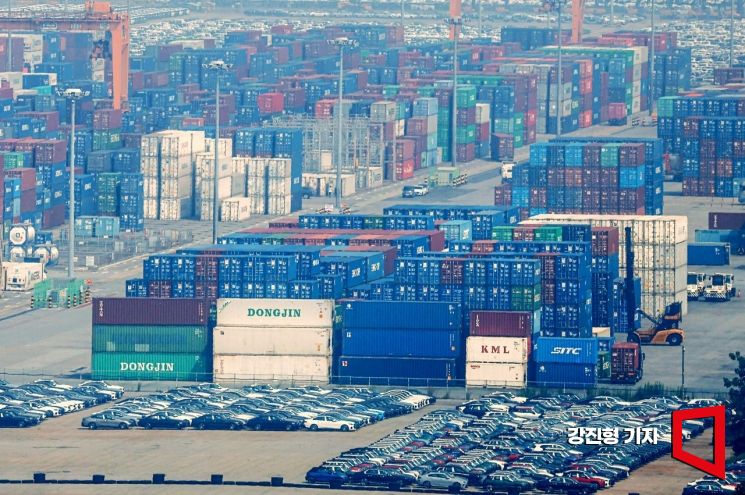 President Donald Trump of the United States announced that starting August 1, a 25% reciprocal tariff will be imposed on all Korean imports. On the 8th, cars awaiting shipment were lined up at the export yard of Pyeongtaek Port in Gyeonggi Province. Photo by Kang Jinhyung
Since the launch of the World Trade Organization (WTO) system, South Korea's dependence on merchandise exports has increased by 16.5 percentage points over the past 30 years, from 21.1% in 1995 to 37.6% in 2023. This is the second largest increase after Mexico (20.5 percentage points).
In its recently published book "New Order, New Growth," the Korea Chamber of Commerce and Industry emphasized "improving the structure of the current account" as a growth strategy for the Korean economy. The organization suggested that "it is now necessary to actively target not only the goods balance, which is the focus of tariff policies, but also the services balance and the primary income balance." Since 1995, Korea's services balance has been in chronic deficit, except for two years of surplus from 1998 to 1999. The deficit, which stood at minus $1.39 billion in 1995, expanded nearly nineteenfold to minus $26.82 billion in 2023.
The report also highlighted the importance of expanding the "primary income balance" as a stable source of foreign currency income. This refers to income transactions involving the provision and receipt of production factors, such as wages earned abroad, overseas investment income, and interest and dividends. Since the 2000s, as Korea's overseas investments have increased and net external assets have accumulated, the primary income balance has shifted to a stable surplus trend from the 2010s. However, the ratio of primary income to GDP remains at 4%, which is weak relative to the size of the economy and lags behind countries like Japan (9.8%) and Germany (9.7%).
Lee Jugwan, a research fellow at the Korea Institute for International Economic Policy, said, "Korea, with its high ratio of manufacturing to GDP, has long relied on growth driven by merchandise exports." He added, "It is necessary to refer to the efforts of the United Kingdom and Japan to strengthen their services and primary income balances." He further explained, "Last year, both the UK and Japan recorded deficits in their goods balances. However, the UK achieved a large surplus in its services balance through efforts to export financial and distribution industries, while Japan posted a significant surplus in its primary income balance through efforts to build and invest in overseas assets. These surpluses played a crucial role as a safety net for both countries."
Since the launch of the WTO, the UK's services balance surplus has increased sixteenfold, making it the second largest among G20 countries. In addition, Japan declared in 2006 its transition from an "export powerhouse" to an "investment powerhouse" focused on securing investment income, and has since significantly expanded its investments in high-yield overseas assets. As of 2023, Japan's primary income balance surplus was $259.1 billion, the highest among G20 countries.
Lee Jongmyung, head of the Industrial Innovation Division at the Korea Chamber of Commerce and Industry, stated, "There are concerns that growth based solely on product exports will eventually reach its limits." He added, "To target the services and primary income balances, it is necessary to foster 'soft money' through the industrialization of K-food and K-culture, the strategic export of intellectual property rights, and institutional reforms to facilitate strategic overseas investments."
© The Asia Business Daily(www.asiae.co.kr). All rights reserved.

![Clutching a Stolen Dior Bag, Saying "I Hate Being Poor but Real"... The Grotesque Con of a "Human Knockoff" [Slate]](https://cwcontent.asiae.co.kr/asiaresize/183/2026021902243444107_1771435474.jpg)















