Lula Criticizes "Intimidating the World Online... Very Wrong"
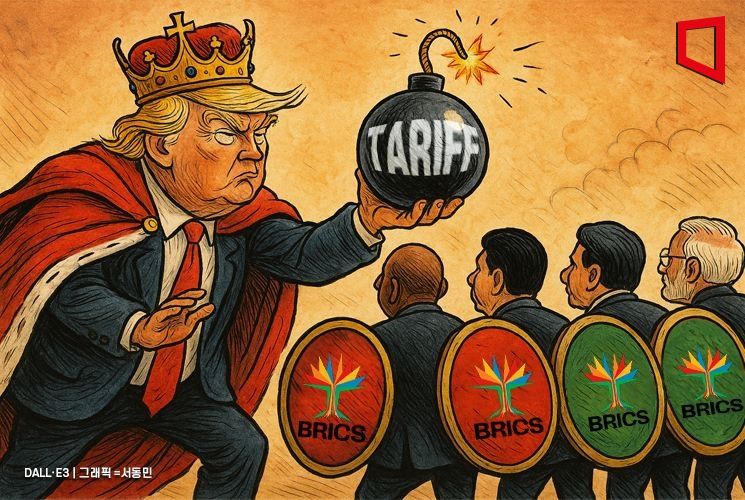
The BRICS member states, an alliance of emerging economies outside the Western bloc including Russia and China, have criticized U.S. President Donald Trump's threat of additional tariffs.
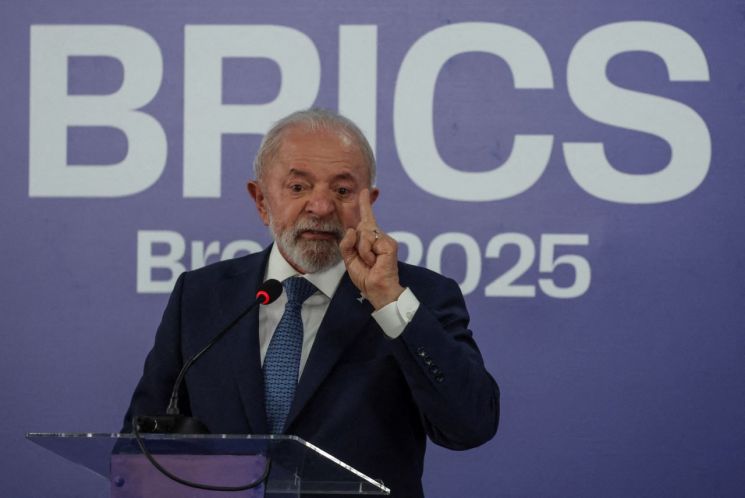
On July 7 (local time), Brazilian President Luis Inacio Lula Da Silva, during a press conference in Rio de Janeiro held on the occasion of the 17th BRICS Summit, stated, "It is very wrong for the president of a major country like the United States to intimidate the world through online networks," adding, "We do not want an emperor." He further emphasized, "People need to truly understand the meaning of the word sovereignty," and said, "He (President Trump) must realize that the world has changed, and we are sovereign nations."
Previously, President Trump warned on his social media platform Truth Social that he would impose an additional 10% tariff on all countries that align with the BRICS' "anti-American policies." This warning came after the release of the BRICS summit declaration, which condemned "military attacks on Iran's peaceful nuclear facilities under the full supervision of the International Atomic Energy Agency (IAEA)" and addressed the disruption of global trade order caused by the "indiscriminate imposition of increased tariffs."
From the perspective of Brazil, the largest economy in South America, there was also a suggestion that U.S. tariffs would actually have a negative impact on the United States itself. Celso Amorim, Special Advisor for International Affairs to the President of Brazil, described the U.S. additional tariffs as "shooting oneself in the foot" (meaning the same as "cutting off one's nose to spite one's face") in an interview with CNN Brazil.
According to trade figures released by the Brazilian government, Brazil recorded a deficit of 40 billion reais (approximately 10 trillion won) in trade with the United States last year. Advisor Amorim emphasized, "In fact, the biggest problem is not the U.S. tariffs," and stated, "A more significant challenge is the change in the global trading system, specifically the shift from multilateral negotiations to a preference for bilateral negotiations." He added, "If threats and tariffs are always used, other countries will look for alternatives and negotiate with each other," suggesting the possibility of cooperation among BRICS member states through solidarity.
Cyril Ramaphosa, President of South Africa, who is visiting Brazil to attend the summit, also said, according to Bloomberg, "It is truly disappointing when there are attempts to punish participating countries or view them negatively at a time when there is such a positive movement from a group like BRICS," adding, "Might does not make right."
President Ramaphosa stated, "BRICS does not seek to compete with any other major power." Previously, during a summit at the White House in May, the South African president drew international attention for his composed response as he countered President Trump's unsubstantiated claims of "white genocide" without concrete and verified evidence.
Russia also responded to President Trump's threats, saying, "Mutual actions within BRICS have never targeted third countries and will not do so in the future," according to AFP, citing Russian media. Sergey Lavrov, Minister of Foreign Affairs, who attended the summit on behalf of President Vladimir Putin, stated, "BRICS is beginning to realize its potential," reaffirming that BRICS can serve as a focal point for issues of common interest among member states.
Founded in 2009, BRICS had for over a decade consisted of five member countries (Brazil, Russia, India, China, and South Africa), but recently expanded to 11 members (with the addition of Egypt, Ethiopia, Iran, Saudi Arabia, United Arab Emirates (UAE), and Indonesia), thereby increasing its influence. The share of BRICS countries in the world's nominal GDP, based on the U.S. dollar, is about 39% of the global economy.
© The Asia Business Daily(www.asiae.co.kr). All rights reserved.













