AI-Based Cooling System Pilot at Pyeongchon 2 Center
Collaboration with LG Electronics and LG CNS
On July 7, LG Uplus announced that it will collaborate with LG Electronics and LG CNS to conduct a pilot project for data center cooling efficiency technology (DCIM) by integrating artificial intelligence (AI) and digital twin technology.
The purpose of this project is to independently secure management technology that reduces energy consumption and increases operational efficiency at data centers. To achieve this, LG Group affiliates are joining forces.
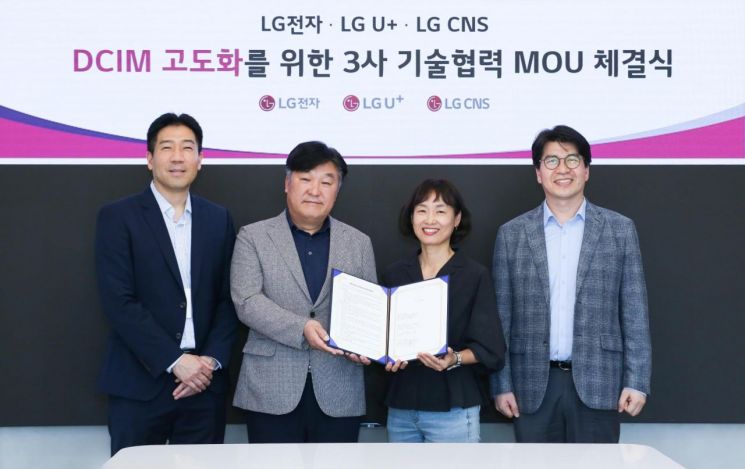 LG Uplus announced on the 7th that it will collaborate with LG Electronics and LG CNS to conduct a pilot project for data center cooling efficiency technology by integrating artificial intelligence (AI) and digital twin technology. Woojin Yoo, head of Open Innovation TF at LG Electronics; Wankyu Park, head of Chiller Business at LG Electronics; Sukkyung Jung, head of AIDC Business at LG Uplus; and Jungsu Oh, head of Smart City Services at LG CNS, are posing for a commemorative photo at the signing ceremony held on the 2nd at the LG Uplus Yongsan office. (From left) Photo by LG Uplus
Specifically, the goal is to reduce cooling energy consumption by up to 10% by controlling cooling equipment through AI and utilizing digital twin technology to simulate operations in a virtual environment.
The pilot will first be conducted at the LG Uplus Pyeongchon 2 Center. AI control algorithms and digital twin models will be applied to major equipment such as chillers and computer room air conditioners (CRAC). The results of the pilot will later be expanded to other key LG Uplus data centers, including the Paju Center.
Currently, LG Uplus manages Pyeongchon 1 and 2, Gasan, and Seocho 1 centers with an integrated management system. The company plans to expand this system to the Nonhyeon and Sangam centers within this year. For the Paju Center, which is scheduled for completion next year, an AI-based integrated management system reflecting the pilot results will be established.
LG Electronics is responsible for developing a digital twin-based CRAC control algorithm and applying it to the Pyeongchon 2 Center facilities to derive optimal operating conditions. LG CNS will design an AI model based on digital twin technology and build a platform that can be expanded to other centers.
LG Uplus is leading the overall project by setting up a dedicated test room within the Pyeongchon 2 Center to collect real-time data and create an environment for testing AI control. The three companies have signed a business agreement (MOU) for this collaboration.
Through this partnership, the three companies plan to accumulate practical operational know-how and establish a self-reliant technology system within the group to enhance competitiveness. The pilot project will be carried out in three stages: optimization of cooling and air conditioning, predictive maintenance of equipment, and expansion of integrated power and equipment monitoring functions. The pilot will officially begin in September.
Sukkyung Jung, head of AIDC Business at LG Uplus (Executive Vice President), said, "Although there is high interest in AI-based management systems in the domestic data center industry, there are still few actual cases of implementation. Through this pilot, we will improve the efficiency of cooling power and strengthen the group's smart data center competitiveness."
© The Asia Business Daily(www.asiae.co.kr). All rights reserved.












