KAIST and King Saud University in Saudi Arabia are pursuing a strategic partnership to build artificial intelligence (AI) and digital platforms.
On July 4, KAIST announced that it had reached this agreement during an international joint research cooperation meeting with the president group of King Saud University held the previous day at the KAIST Dogok Campus in Seoul.
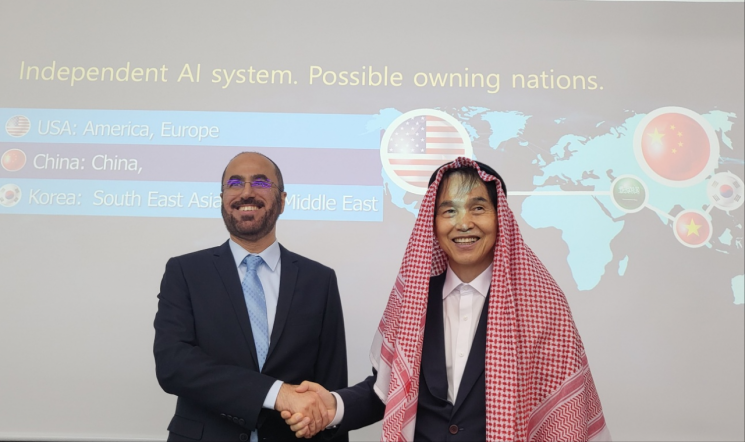 Kwanghyung Lee, president of KAIST (right), is taking a commemorative photo after concluding an international joint research cooperation meeting with the president group of King Saud University in Saudi Arabia on the 3rd. Provided by KAIST
The global AI ecosystem is increasingly divided between closed models from the United States, which limit use by both users and developers (such as OpenAI and Google), and China’s domestically focused technology system.
Amid this U.S.-China bipolar structure, countries like South Korea have continuously raised the need to establish a 'third cooperation model' that can ensure technological diversity and accessibility.
In this context, Kwanghyung Lee, president of KAIST, proposed the 'Sam Bun Ji Gye' (Three-way Strategy), which envisions a new order of mutual cooperation and coexistence beyond the existing polarized digital order, based on an international cooperative body rooted in open-source principles.
The collaboration between KAIST and King Saud University is seen as an effort to pool their expertise to create a new AI model as part of the Sam Bun Ji Gye strategy. This trend is also in line with ongoing international discussions.
In particular, the underlying strategy is to establish an innovative multilateral cooperation base in the Middle East and Southeast Asia regions through a collaborative system based on open AI models.
Through this strategic partnership, both sides expect to establish a mutually complementary relationship by leveraging their respective strengths. Saudi Arabia, with its large-scale capital and digital infrastructure, is positioned for strategic investment, while South Korea has competitiveness in foundational AI technology, application capabilities, and a robust talent ecosystem. These factors make a complementary partnership possible.
Both parties plan to combine these strengths to realize a sustainable cooperation model where 'investment, technology, and talent' form a virtuous cycle. They expect that this will lead to the creation of an open platform distinct from the existing AI technology hegemony, contributing to greater diversity in the global AI ecosystem.
During the meeting, the two sides also discussed specific directions for future cooperation. Key areas of collaboration include: joint development of open-source-based AI technologies and digital platforms; establishment and operation of a joint degree program between KAIST and King Saud University; expansion of student, faculty, and researcher exchange programs; and activation of joint research in basic science and STEM (science, technology, engineering, and mathematics) fields.
In particular, in the field of AI, the two universities agreed to establish a joint research institute to develop open AI models and pursue projects for their practical industrial application. The goal of establishing this joint research institute is to broaden access to technology, thereby creating an environment where more countries and institutions can participate in AI innovation.
Kwanghyung Lee, president of KAIST, stated, "By combining Saudi Arabia’s investment capacity, KAIST’s technological innovation, and the outstanding talent resources of both countries, we can contribute to injecting diversity into the global AI ecosystem. If the two universities develop an independent AI model through joint research, the realization of the 'Sam Bun Ji Gye' structure will create a new domain in the digital order currently centered on the United States and China, expanding beyond the Middle East and North Africa (MENA) and ASEAN regions to the global market."
Meanwhile, KAIST plans to sign a memorandum of understanding with King Saud University based on the outcomes of these discussions. Going forward, the two institutions will develop concrete cooperation plans, make the establishment of the joint research institute more tangible, and promote global talent development programs.
This partnership began as part of the 'Invitation Program for Distinguished Overseas Figures' organized by the Korea Foundation (KF) under the Ministry of Foreign Affairs.
© The Asia Business Daily(www.asiae.co.kr). All rights reserved.












