351.9 Billion Won Investment... Scheduled for Completion by 2032
Establishing an Industry-Academia-Research Cluster and Creating an "Energy Capital" National Industrial Complex
Linked with Naju Innovation Industrial Complex to Form an Energy Mega-Cluster
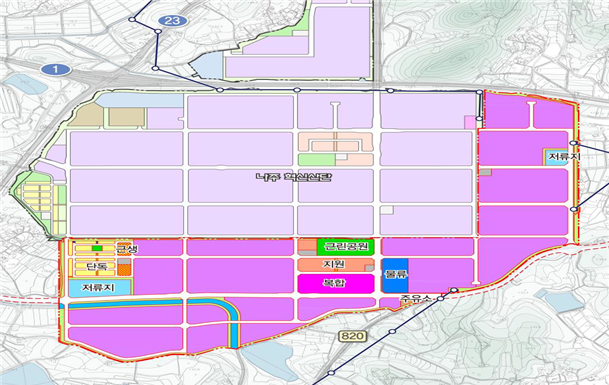
On July 2, Naju City in South Jeolla Province announced that it will officially begin establishing a key hub to lead the future of South Korea's energy industry, following the Ministry of Land, Infrastructure and Transport's approval of the industrial complex plan for the Naju Energy National Industrial Complex.
This national industrial complex project will be carried out over eight years, from 2025 to 2032, with a total investment of 351.9 billion won on a 1.24 million square meter (approximately 380,000 pyeong) site in Deoksan-ri, Wanggok-myeon, Naju.
The Energy National Industrial Complex will be developed as a cluster hub for the future energy industry, leveraging Naju's industry-academia-research infrastructure, including the headquarters of Korea Electric Power Corporation, Korea Institute of Energy Technology, and Energy New Technology Research Institute.
Through this initiative, Naju is expected to further solidify its position as an "energy-centric city" and serve as a focal point for attracting domestic and international corporate investment and fostering advanced industries.
This project has been continuously pursued despite internal and external uncertainties, progressing from passing the preliminary feasibility study in 2022, launching the industrial complex plan service in 2023, and applying for approval in 2024, to receiving final approval in July 2025.
With the project's approval, the land compensation process will begin, and after compensation payments are made in 2026, site development, infrastructure construction, and company move-ins are expected to proceed in earnest.
In particular, this national industrial complex is drawing attention for its proximity to the existing Naju Innovation Industrial Complex, which allows for integrated operation.
By organically linking the two complexes, public infrastructure such as transportation, electricity, and water and sewage systems can be jointly utilized, and administrative support systems can be unified, which is expected to maximize cost savings and investment efficiency.
Additionally, the possibility of collaboration with energy and high-tech companies already located in the existing innovation complex will lay the foundation for technological convergence and industrial synergy.
Ultimately, this is expected to lead to the formation of an "energy mega-cluster" and elevate Naju as a leading city in the national power industry.
Going forward, the city plans to closely cooperate with South Jeolla Province, LH, and Jeonnam Development Corporation to simultaneously pursue prompt compensation and construction, company-tailored infrastructure development, and the design of an eco-friendly smart industrial complex.
Mayor Yoon Byungtae of Naju emphasized, "This Energy National Industrial Complex is not merely a development project, but the starting point of a strategic industry that will be responsible for Naju's next 100 years," adding, "By linking it with the Naju Innovation Industrial Complex, we will establish South Korea's leading energy industry belt, create youth jobs, attract corporate investment, and achieve tangible results in revitalizing the local economy."
© The Asia Business Daily(www.asiae.co.kr). All rights reserved.











