Mayor Lee Kangdeok Marks 11th Anniversary in Office
Highlights Achievements and Outlines Future Vision for Pohang
Remarkable Progress in Fostering New Industries such as Secondary Batteries, Bio, and Hydrogen
Significant Results in Diversifying the City's Industrial Structure
On July 2, Lee Kangdeok, the first three-term mayor of Pohang, held a press conference in the main conference room at City Hall to mark the 11th anniversary of his inauguration. He emphasized, "Through relentless challenge and innovation, I will make Pohang a sustainable city on the global stage during the remainder of my term."
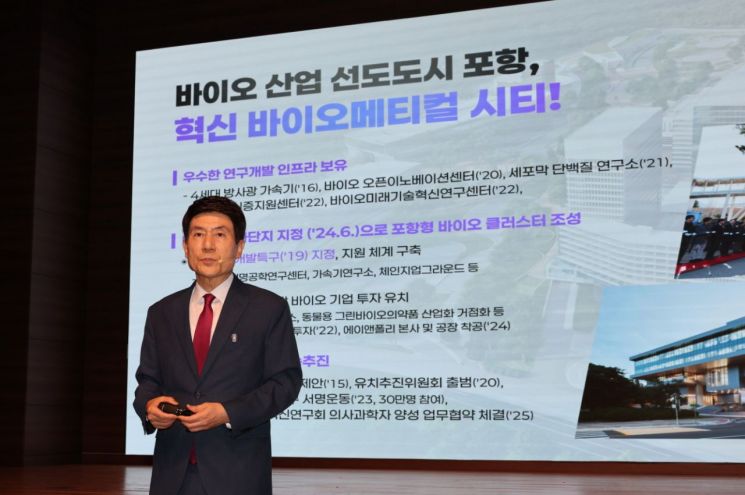 On the 2nd, Mayor Kangdeok Lee of Pohang held a press conference at City Hall to mark the 11th anniversary of his inauguration and presented the future vision of Pohang. Photo by Pohang City
Mayor Lee began by expressing his gratitude, saying, "When I took office in 2014 as the head of the 6th popularly elected administration, I was able to keep my promise to open a new era with citizens and create a leap forward for Pohang thanks to the citizens who were not afraid of change and took on challenges together."
In the early days of his tenure, Pohang faced difficulties due to the steel industry crisis. However, from the 6th to the 8th administrations, the city focused on industrial structure innovation and strengthening urban competitiveness, laying the foundation for a new leap forward.
The city is recognized for transforming its industrial landscape by fostering three major advanced new industries: secondary batteries, bio, and hydrogen. Pohang became the first city in the country to be designated as a specialized complex in all three sectors?secondary batteries, bio, and hydrogen?and was selected as the largest Opportunity Development Zone among basic local governments, establishing itself as a hub for advanced new industries.
Looking ahead, the city plans to promote hydrogen engine power generation based on clean ammonia through the forthcoming Distributed Energy Special Zone. This will supply renewable energy locally and encourage the spread of RE100 across industries, thereby strengthening global competitiveness.
Pohang has also made continuous efforts to change its identity as an industrial city and shed its image as a gray industrial city.
By creating marine tourism and leisure attractions such as Spacewalk, Gonryunsan Paragliding Site, and Yonghan Surfer Beach, Pohang has transformed into a marine tourism city. In particular, the successful hosting of this year's World Green Growth Forum raised its profile as a green ecological city in the international community.
The city plans to develop the International Exhibition and Convention Center, which broke ground last year, as a key hub for the MICE industry and foster it as a global conference platform.
The Greenway Project, which was implemented to transform the city from gray to green, created 760,000 square meters of urban forest?equivalent to 107 soccer fields?reducing the heat island effect and fine dust. The railway that once divided the city north to south has been turned into a forest, providing citizens with a place to relax.
Going forward, the city plans to expand the Greenway and restore ecological streams to complete an eco-friendly green ecological city where forest paths and waterways are harmoniously integrated.
Mayor Lee emphasized, "Despite many difficulties such as earthquakes, infectious diseases, and natural disasters, we were able to overcome crises together with citizens and make Pohang stronger."
After the unprecedented 11·15 earthquake, Pohang identified the quake as an induced earthquake through public-private cooperation and passed a special earthquake law, opening the way for substantial relief for victims.
In particular, the downtown area of Heunghae-eup, which suffered severe damage, is drawing attention as a new model for urban reconstruction through a special regeneration project.
During the spread of COVID-19, Pohang was the first in the nation to proactively respond by establishing a joint public-private infectious disease response headquarters, operating integrated screening clinics, and conducting one-person-per-household mass testing to block the spread of infection.
To prepare for natural disasters such as typhoons, the city has focused its administrative efforts on creating a safe city infrastructure, including maintenance of the Hyeongsan River as a national river, construction of the Hangsa Dam, and expansion of rainwater pumping stations, to protect citizens' lives and property.
For the future of Pohang, the city has also devoted itself to strengthening transportation networks and driving digital innovation.
The city has worked to establish an extensive transportation network connecting land, sea, and air, including the opening of the Pohang-Ulsan Expressway, KTX, SRT, Donghae Nambu Line, Donghae Jungbu Line, the resumption of flights at Pohang Gyeongju Airport, and the completion of the international passenger terminal at Yeongilman Port. At the same time, the city is accelerating its transformation into a smart city by building AI and digital infrastructure such as data centers.
The expansion of leisure infrastructure, including culture and sports, has also been remarkable. The establishment of the Pohang Cultural Foundation has enhanced the professionalism of local culture and arts, and the city has been recognized externally by being designated as a legal cultural city and selected as the best cultural city.
The Pohang International Fireworks Festival has been selected as a cultural tourism festival by the Ministry of Culture, Sports and Tourism for 13 consecutive years, and the Homigot Korean New Year Sunrise Festival has been named one of the "Top 100 Regional Cultural Attractions." The city has also created an environment where everyone can easily enjoy sports and leisure by expanding balanced sports and library infrastructure across regions.
In welfare and education, which are key to living conditions, the city implemented customized welfare across all life stages, including the region's first "Three-Free Welfare" initiative, realizing resident-centered welfare.
The "Three-Free Welfare" includes free childcare at private daycare centers, free meals at kindergartens and elementary, middle, and high schools, and free school uniforms for new middle and high school students.
Additionally, Pohang fostered local talent and established a foundation for universities and the city to grow together by establishing the region's first youth foundation and career and academic support center, being the only basic local government to have two universities?POSTECH and Handong University?selected as Glocal Universities, and designating an Education Development Special Zone.
Mayor Lee Kangdeok stated, "From the 6th to the 8th administrations, the remarkable transformation of Pohang was possible because 500,000 citizens worked together with one heart and one mind. With the spirit of challenge that has driven Korea's industrialization, I will do my utmost during the remainder of my term to achieve shared change and a leap forward for Pohang."
© The Asia Business Daily(www.asiae.co.kr). All rights reserved.












