Metropolitan Area's Share of National Output Approaches 50%
Service Sector Share Rises in All Regions Compared to 2015
The proportion of the Seoul, Gyeonggi, and Incheon metropolitan area in the South Korean economy is approaching half, according to recent data. Compared to 2015, this share has grown, indicating a deepening concentration in the metropolitan area. The proportion of employed persons (in full-time equivalent terms) in the metropolitan area also reached nearly half of the national total.
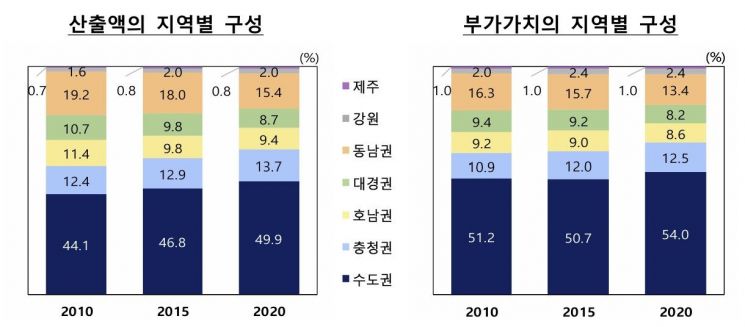
According to the Bank of Korea's "2020 Regional Input-Output Table" released on July 2, 2025, the metropolitan area accounted for 49.9% of total output, an increase of 3.1 percentage points compared to 46.8% in 2015.
The Regional Input-Output Table divides the country into regional economic units and reflects the characteristics of interregional flows and regional industrial structures. It serves as an indicator for analyzing interdependencies between regions and industries. Output refers to the total value of goods and services produced in a given year, essentially representing corporate sales or factory shipments.
After the metropolitan area, the next largest shares of output were the Southeast region (15.4%) and the Chungcheong region (13.7%). While the shares of the metropolitan and Chungcheong regions increased, the shares of the Southeast, Daegu-Gyeongbuk, and Honam regions decreased. By province, Gyeonggi had the highest share at 25.8%, followed by Seoul (19.3%) and South Chungcheong (7.1%).
In terms of regional economic structure, supply was composed of 65.7% local production, 24.7% inflow from other regions, and 9.6% imports. The metropolitan area had the highest share of local production at 68.4%, and also had the largest share of intra-economic bloc inflow at 11.4%. Ulsan had the highest import share at 16.6%.
Regional economic demand consisted of 64.9% local demand, 24.7% outflow to other regions, and 10.3% exports. Gangwon had the highest proportion of local demand at 75.9%, while Seoul had the highest outflow to other regions at 29.9% nationwide.
In terms of industrial structure, the share of services increased in every region compared to 2015. By province, Seoul had the highest service sector share at 87.5%, followed by Jeju (71.8%) and Daejeon (65.7%). Ulsan had the highest proportion of manufactured goods at 79.4%. Sejong had a relatively high share of construction (13%), while Jeju had a relatively high share of agricultural, forestry, and fishery products (9.0%).
Value-added ratios increased in all regions except Ulsan, where the petroleum and related industries were sluggish due to the COVID-19 pandemic. Jeju (54.1%), Gangwon (52.9%), and Seoul (52.9%), where the service sector including tourism is prominent, exceeded the national average of 44.7%.
The localization rate of intermediate goods was also high in Jeju (91.7%) and Gangwon (88.8%). Among these, the proportion of locally produced goods used was highest in Seoul (45.8%), Gyeonggi (40.3%), and the metropolitan area overall (40.7%). Ulsan (24.9%) and South Jeolla (18.2%), which had high import dependency, also had lower shares of domestic intermediate goods usage at 65.5% and 70.5%, respectively, compared to the national average of 80.6%.
In terms of final demand, Jeju had the highest consumption share at 76.3%, while Ulsan had the highest export share at 63.7%. Sejong had a relatively high investment share at 43.4%. Ulsan had the highest share of demand for locally produced goods at 82.2%.
In 2020, interregional trade amounted to 1,719.8 trillion won, an increase of 26.5% compared to 2015. The metropolitan area accounted for the largest shares of both outflow (48%) and inflow (43.8%).
The regional production inducement coefficient was highest in the metropolitan area (1,037). By province, Gyeonggi (1,090), Ulsan (1,073), and Seoul (1,012) led the rankings. The production inducement coefficient is higher in regions where the share of final demand for locally produced goods is high and where local intermediate goods are heavily used in production activities.
The regional value-added inducement coefficient was also highest in the metropolitan area (0.513). This figure is greater in regions with strong local production inducement effects and high value-added ratios in major industries.
In terms of full-time equivalent employment, the metropolitan area accounted for 49.7% of the national total, the largest share. However, this proportion has decreased compared to 2015, when it exceeded half. In all regions, employment was centered on the service sector, with Seoul's service sector employment share (90.8%) far exceeding the national average (71.1%).
The average employment inducement coefficient was 9.7 persons, with 5.6 persons induced locally and 4.1 persons induced in other regions. By region, Jeju (12.5), Daegu (11.7), and North Jeolla (11.5) had the highest local inducement effects. The employment inducement coefficient refers to the number of full-time equivalent jobs created locally and in other regions by 1 billion won of final demand for domestic products in each region.
© The Asia Business Daily(www.asiae.co.kr). All rights reserved.












