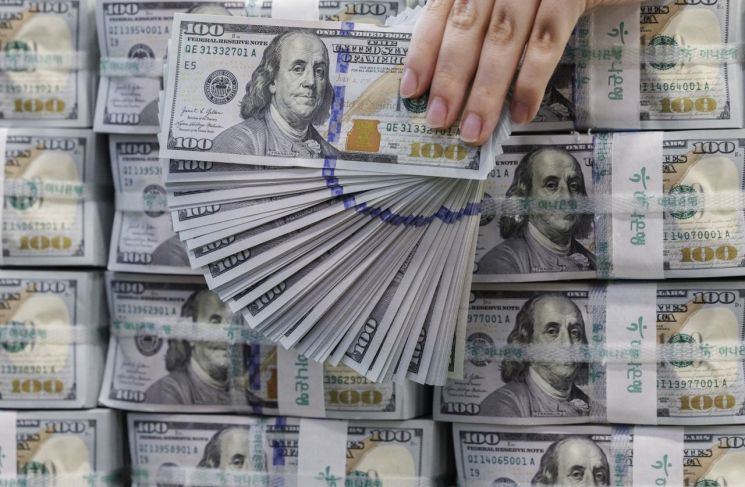
On July 2, Daishin Securities predicted in its report "Weakening Dollar" that the downward stabilization of the KRW-USD exchange rate (weaker dollar, stronger won) will continue throughout July.
In mid-June, the value of the dollar temporarily rebounded as the United States attacked Iranian nuclear facilities and tensions in the Middle East escalated. However, as geopolitical risks quickly eased, the dollar index declined again. The U.S. Federal Reserve announced a relaxation of the Supplementary Leverage Ratio (SLR) regulation, and expectations for rate cuts within the year have expanded to three times. The KRW-USD exchange rate also reflected the decline in the external value of the dollar, dropping to the 1,340 won range per dollar during intraday trading.
The financial market is gradually lowering its guard because it has already become familiar with Trump's negotiation tactics. However, there is a possibility that exchange rate volatility will temporarily increase as trade-related uncertainties resurface around the trade negotiation deadline, which has been set for July 9.
Nevertheless, the trend of a weaker dollar and stronger Asian currencies is expected to continue. This is because: ▲ there is a high possibility that risk appetite will persist amid a phase of expanding global liquidity; ▲ the U.S. economic expansion is expected to slow as preemptive demand ahead of full-scale tariffs is coming to an end; ▲ Trump continues to pressure the Fed for rate cuts; and ▲ the U.S. Treasury's currency report has reaffirmed the current administration's preference for a weak dollar stance.
Meanwhile, U.S. policy uncertainties, excluding tariffs, are gradually being resolved. The OBBBA (One Big Beautiful Bill Act), which promises large-scale tax cuts, is being amended in the Senate, and the GENIUS (Guiding and Establishing National Innovation for U.S. Stablecoins Act) bill related to stablecoins has also passed the Senate.
Lee Juwon, an economist at Daishin Securities, analyzed, "Some Fed officials have recently hinted at the possibility of a rate cut in July, and Powell has also shown a stance that can be interpreted as more dovish than in the past. In addition, the news of the Fed's SLR regulation relaxation has eased the recent upward pressure on market interest rates." He added, "Although China was not designated as a currency manipulator in the June currency report, the stance has become tougher compared to November last year, and the current administration's preference for a weak dollar was reaffirmed."
© The Asia Business Daily(www.asiae.co.kr). All rights reserved.












