Clear Trend Toward Price-Conscious Consumption Amid Prolonged Economic Downturn
Seeking Breakthroughs Through Product Diversification and Expansion of Consumer Base
Slow but Steady Growth Continues
Since the COVID-19 pandemic, the vegan food market?which had been growing rapidly with the launch of various products such as alternative meats, plant-based beverages, and vegan desserts?has recently shown signs of stagnation. As the economic downturn continues, a clear trend toward practical consumption that prioritizes price over value-driven spending has emerged, causing the relatively expensive vegan product category to gradually lose ground as a consumer choice.

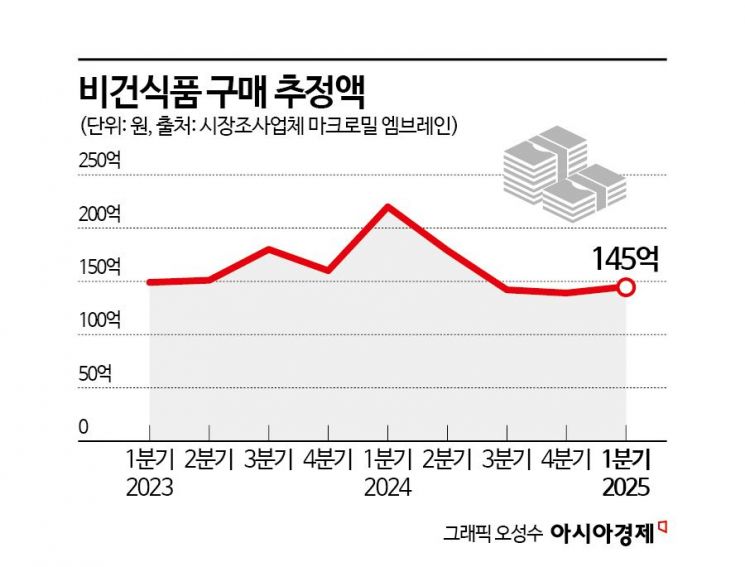
According to market research firm Macromill Embrain on June 28, the vegan food market, which had gained attention as a sustainable food option after the COVID-19 pandemic, has recently entered a stagnation phase. The estimated purchase amount of vegan foods sold at major supermarkets and convenience stores showed a sharp upward trend from early 2023, peaking in the first quarter of last year at a total of 22 billion won. However, this figure began to decline, dropping significantly to 13.9 billion won in the fourth quarter of last year. In the first quarter of this year, the purchase amount was 14.5 billion won, a 34.1% decrease compared to the same period last year, indicating a clear decline in demand for vegan foods.
This trend is interpreted as a result of the prolonged economic downturn, which has led to a preference for practical spending over value-driven consumption, with the relatively high price of vegan foods becoming a burden for consumers. In fact, a survey conducted by Embrain last year found that only 13.9% of alternative food buyers were satisfied with prices, indicating that consumers did not perceive any particular advantage in terms of cost.
One notable trend is the growth of vegan bakery products. The estimated purchase amount of vegan bakery items sold last year reached 7.2 billion won, nearly doubling from 3.6 billion won in the previous year. This result is attributed to the popularity of slow-aging diets and the growing demand for healthy desserts, suggesting that vegan bakery products have established themselves as alternative foods that simultaneously satisfy taste, health, and trends, going beyond the traditional concept of vegetarianism.
It is also noteworthy that older consumers have shown significant interest in vegan foods. As of last year, those in their 40s and 50s accounted for more than 20% of total purchases each (20s: 10.9%, 30s: 17.7%, 40s: 27.2%, 50s: 27.5%, 60s: 16.7%), demonstrating a clear presence compared to other age groups. This result suggests that, contrary to the previous image of vegan foods being consumed mainly by younger generations, people in their 40s and 50s are now playing a leading role in driving market growth. It also indicates that capturing demand among middle-aged and older consumers will be a key factor in securing the mainstream appeal of vegan foods in the future.
Overall, while the vegan food market has entered a period of slower growth, it continues to expand steadily, albeit gradually, by diversifying its product range and broadening its consumer base. In particular, the upward trend driven by bakery products signals that vegan foods are increasingly becoming part of everyday eating habits. However, since price remains a significant barrier, securing price competitiveness is expected to be crucial for vegan foods to become a staple in daily consumption.
© The Asia Business Daily(www.asiae.co.kr). All rights reserved.













