An international joint research team, led primarily by domestic university researchers, has announced the results of a study analyzing the global potential and economic feasibility of solar-based hydrogen production.
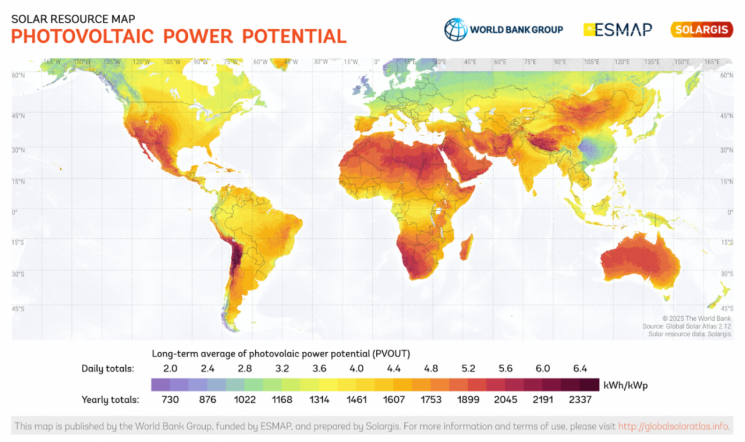
Pukyong National University stated that the research teams of Professor Yoo Jun, an energy analysis expert, and Professor Lee Yangwon, a geospatial analysis expert, utilized geographic information system (GIS) data, as shown in the accompanying illustration, to calculate regional hydrogen production potential and hydrogen production costs at a 1km resolution. Based on this, they developed a data-driven model to optimize global hydrogen trade routes.
Hydrogen production using renewable energy is gaining attention as a sustainable alternative to fossil fuels and is considered a key technology for achieving a global net-zero economy. However, it has been a significant challenge to determine whether solar hydrogen can meet global hydrogen demand and to identify the optimal production regions for efficiently meeting this demand.
In this study, the research team found that, based on a single system consisting of a 38-megawatt (MW) solar power plant and a 12.6MW electrolyzer, it is possible to produce between 215 and 1,829 tons of hydrogen annually depending on the region. As of 2023, the hydrogen production cost ranged from $5.85 to $15.25 per kilogram, but the team projected that, considering technological advancements and cost reductions, this could decrease to as low as $2.99 by 2050. Additionally, the team calculated the production and import/export costs of hydrogen derivatives such as ammonia, methanol, and liquefied hydrogen. They also demonstrated that, in certain regions, it is possible to avoid up to 12,000 tons of carbon dioxide emissions annually, highlighting the climate change mitigation effect.
Professor Yoo Jun stated, "This study is the world's first to precisely analyze the global potential of a solar-based hydrogen economy, and it accurately demonstrates the feasibility of solar hydrogen for achieving carbon neutrality by 2050." He added, "In particular, the data-driven optimization and supply chain model we developed will serve as an important decision-making tool for policymakers in various countries to identify global trade routes necessary to realize their 2050 hydrogen roadmaps."
Professor Lee Yangwon commented, "This study, which utilized high-resolution GIS data, is an important example of how regions rich in solar resources can play a role in the global hydrogen economy." He added, "As a follow-up, it is possible to develop even more precise and detailed models by integrating GIS data on land and water resource availability."
This research was supported by the Mid-Career Research Program (Type 2: Global Type) of the National Research Foundation of Korea. The results were published in the July issue of the authoritative journal in chemical engineering, the Chemical Engineering Journal, under the title 'Comprehensive analysis of solar hydrogen production potential and economics for achieving 2050 carbon neutrality.'
© The Asia Business Daily(www.asiae.co.kr). All rights reserved.












