Signed MOU for 2 Trillion Won Project:
Starting with 40MW, Aiming to Expand Beyond 1GW
2.8 Trillion Won in Added Value,
Approximately 28,000 Direct and Indirect Jobs Expected to Boost Regional Economy
Pohang City has taken a major step toward becoming a key hub city that will lead South Korea to become one of the world's top three AI powerhouses, by proactively fostering the AI computing infrastructure industry, which is at the core of the global AI supremacy race.
On June 26, the city signed an investment memorandum of understanding (MOU) for the establishment of a "Global AI Computing Center" at the City Hall's main conference room, together with Gyeongbuk Province, domestic and international AI companies and investment firms, local universities, and related organizations.
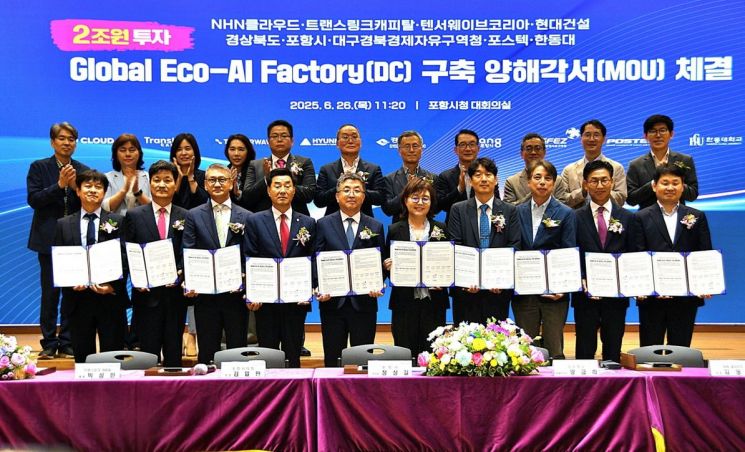
Over 100 people attended the signing ceremony, including Deputy Mayor Jang Sanggil, City Council Chairman Kim Ilman, Gyeongbuk Vice Governor for Economic Affairs Yang Geumhee, Daegu-Gyeongbuk Free Economic Zone Authority Commissioner Kim Byungsam, NHN Cloud CEO Kim Donghoon, Translink Capital CEO Park Sungbin, Tensorwave Korea CEO Ahn Hyundeok, Hyundai Engineering & Construction Executive Vice President Kim Taehui, POSCO AI Robot Convergence Research Center Director Lee Junghyung, and Pohang Chamber of Commerce and Industry President Na Jooyoung.
This MOU marks a large-scale project to build AI computing infrastructure on a 47,647-square-meter site within the Pohang Convergence Technology Industrial Complex, with a total investment of 2 trillion won to be implemented in four phases.
In the first phase (2025-2027), a 40MW-class AI computing infrastructure capable of accommodating 20,000 of the latest GPUs will be established. In the second phase (2028-2030), the capacity will be expanded to 100MW, and in the third phase (2031-2035), to 200MW.
Subsequently, in the fourth phase (from 2036 onward), the project aims to complete a 1GW (1,000MW)-class global AI computing cluster.
The project involves Pohang City, Gyeongbuk Province, the Daegu-Gyeongbuk Free Economic Zone Authority, four domestic and international companies including NHN Cloud, Hyundai Engineering & Construction, Translink Capital, and Tensorwave, as well as two universities, POSTECH and Handong Global University.
More than 30% of the total investment will come from foreign capital. Construction of the center is scheduled to begin within 2025, with completion targeted for 2027. As a result, more than 600 new jobs are expected to be created.
The Global AI Computing Center will be a world-class AI hub, equipped with over 170,000 of the latest GPUs, providing ultra-high-performance AI infrastructure capable of supporting both advanced AI model training and large-scale real-time data processing simultaneously.
The city plans to accelerate the AI transformation (AX) of the region's industries, including AI-based manufacturing innovation, new drug development, and next-generation battery material research, making the center the "starting point of the AI highway" that will lead South Korea's AI industry.
Once the center is fully operational, it is expected that domestic and international AI companies will actively invest further by relocating R&D centers or establishing demonstration testbeds in Pohang to utilize high-performance AI computing resources.
It is also anticipated that this will have a significant impact on the regional economy, generating a total added value of 2.8 trillion won, an induced production effect of 6.3 trillion won, and creating approximately 28,000 direct and indirect jobs.
This Global AI Computing Center is a private sector-led, preemptive project designed with functional linkage and expansion with the government-led National AI Computing Center in mind. It is evaluated as a strategic outpost that will give Pohang a competitive edge in attracting future national projects, thanks to its location, infrastructure scalability, and ability to attract private investment.
With this MOU as momentum, the city plans to strengthen key strategies such as advancing AI computing infrastructure, attracting corporate R&D, and cultivating professional talent, aiming to develop Pohang into the national hub city for the AI computing industry.
Deputy Mayor Jang Sanggil emphasized, "The establishment of the Global AI Computing Center is a critical turning point for Pohang to become a global AI industry hub, and a strategic foundation for South Korea to become an AI powerhouse. We will make AI the core driver for Pohang's next 100 years and turn the city into a leading global AI industry hub."
Recently, as the government-led National AI Computing Center project was ultimately canceled, the autonomous development of ultra-high-density data industries by the private sector and local governments is gaining attention as a new driving force for the advancement of national AI technology.
Accordingly, Pohang City is sequentially promoting large-scale infrastructure projects, including the Yukyanguk-linked Data Center Campus (worth 1.52 trillion won), the AI Accelerator Center (worth 97.2 billion won), and the AI Open Innovation Center. The city also plans to develop these into a "national-level K-Artificial Intelligence Cluster" where companies, research institutes, universities, and infrastructure are organically integrated and concentrated.
© The Asia Business Daily(www.asiae.co.kr). All rights reserved.












