In-Depth Survey of 12 Experts from Industry, Research Institutes, and Academia
"Opportunities for a Rebound Have Not Disappeared... Drastic Efforts Needed Within 5 Years"
The Most Urgent Task Is Reviving Domestic Demand
Warning: "Without Structural Reform, Any Rebound Will Be Temporary"

Despite harsh assessments such as "The current state of the Korean economy scores 3.2 out of 10" and "Potential growth rate will plunge to 0% within 10 years," the opportunity for a rebound has not disappeared. More than half of the experts who responded to the Asia Economy survey offered an optimistic outlook, predicting that Korea's economic growth rate could trend upward within the next five years. The key issue is where the new government, which holds the steering wheel, will place its emphasis?between short-term stimulus measures and structural reforms. Experts advised that, taking Japan's experience with prolonged stagnation as a lesson, Korea must set a clear direction: to lay the groundwork necessary for a major transformation.
"The Global Economy Is at a Turning Point, and Korea Has Opportunities Too"
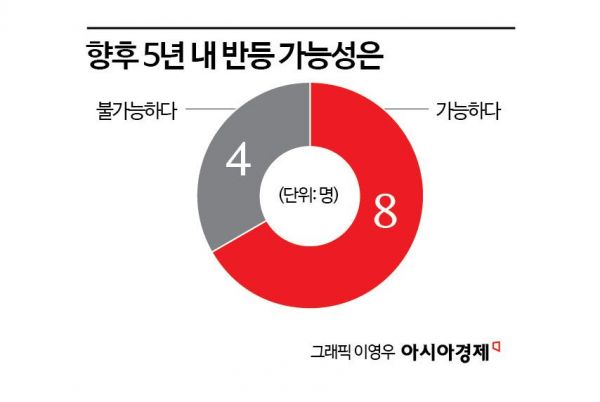
On June 27, Asia Economy conducted an in-depth survey of 12 experts from various fields, including industry and economic research institutes and academia. Two-thirds of respondents (8 people) answered that the Korean economy could rebound within five years. Although the first quarter of this year recorded negative growth and the outlook remains grim, there is weight behind the positive signal that a rebound is not impossible.
Kwon Namhoon, President of the Korea Institute for Industrial Economics and Trade, emphasized, "Although we are facing various crises, there are still areas where we retain high competitiveness, and the opportunity for a rebound has not vanished." Kim Kyungjin, Vice President of the Institute for Global Economics, also commented, "Since the entire global economy is at a major turning point, it is not too late for Korea either." Kang Sungjin, Professor of Economics at Korea University, likewise pointed out, "There is no need to view the present too negatively."
However, experts commonly attached the prerequisite "if structural reforms succeed." The four experts who answered that a rebound would be difficult also cited, "Without structural reform, any rebound will be temporary" (Jung Heesu, Head of Hana Institute of Finance), and "If political strife and national division continue as now, it will be difficult to focus on fostering new industries" (Kim Jeongsik, Professor Emeritus of Economics at Yonsei University). Ultimately, all experts emphasized structural reform as the key condition for a 'trend reversal' in the economy. Jang Min, Senior Research Fellow at the Korea Institute of Finance, stated, "Socioeconomic restructuring through political determination may cause side effects in the short term, but in the mid- to long-term, it will restore policy credibility and strengthen social cohesion, which will become the driving force for economic rebound."
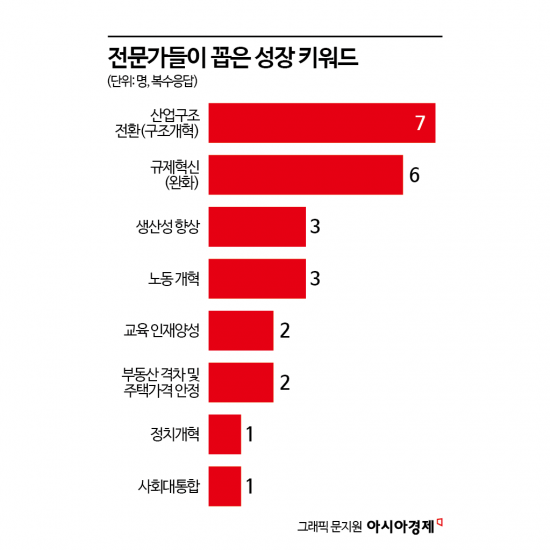
When asked about the key growth keywords the new administration should focus on during its term (multiple responses allowed), the most common answer was industrial structure transformation (7 respondents), followed by deregulation (6), productivity improvement (3), and labor reform (3).
Park Yangsoo, President of the Sustainable Growth Initiative (SGI) at the Korea Chamber of Commerce and Industry, said, "The new government should approach the issue from the perspective of laying the foundation necessary for a major transformation," adding, "If the strengthening of economic fundamentals becomes evident in the latter half of the term, that is a success." He further suggested, "If the government secures trust through consistent policy implementation, encourages active private sector investment, and pursues industrial policies and institutional improvements to enhance mid- to long-term growth potential, the major transformation can succeed."
The most urgent task facing the new government was cited as reviving sluggish domestic demand. To overcome the domestic market slump, efforts such as supporting the closure of small businesses were deemed necessary. In the short term, some believed that expansionary fiscal policy and other stimulus measures would be unavoidable, but there was also a call to resist that temptation and invest in enhancing growth potential. As the government pushes for a second supplementary budget, it was pointed out that care must be taken to ensure that liquidity supplied as part of stimulus measures does not lead to overheating in the real estate market.
Japan Relied on Macroeconomic Policy, Lost Momentum for Structural Reform, and Prolonged Stagnation..."A Lesson for Korea"
Japan experienced a prolonged stagnation lasting 30 years, ahead of Korea. The Korean economy, now standing at the threshold of long-term stagnation, faces low birth rates, an aging population, excessive government debt, and declining productivity?conditions not much different from Japan's in its era of low growth.
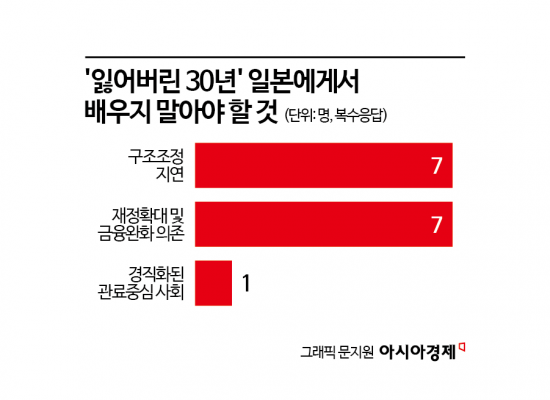
Experts pointed out that Japan's failure to recover over such a long period was the result of relying solely on macroeconomic policies such as fiscal expansion and monetary easing, while delaying structural reforms.
In fact, in the early 1990s, Japan failed to decisively address financial and corporate insolvency after the bubble burst, which prolonged stagnation. Under the Abe administration, regulatory easing and structural reform were set as policy goals, but either lacked specifics or were pursued with insufficient momentum, resulting in limited achievements. During this period, the policy rate was kept near zero or even negative, maintaining an ultra-low interest rate stance. This led to a liquidity trap, where no matter how much rates were lowered, consumption and investment did not increase.
Experts noted that this is precisely the lesson Korea must learn. Lee Insil, President of the Korea Future Population Institute, said, "We must not follow the easy path of delaying structural reform and relying excessively on fiscal measures." Park, too, emphasized, "After the 1985 Plaza Accord, Japan pursued debt-driven growth, which inflated the bubble. In responding to the bubble's collapse, the government adopted a 'stop-and-go' approach to fiscal and monetary policy, resulting in a loss of policy credibility. We must not forget this lesson."
Conversely, some pointed out that Japan's aging policy, having entered a super-aged society more than 20 years ahead of Korea, is worth referencing.
In the early stages of stagnation, Japan's conservative employment practices and lack of family support policies led to failures in utilizing female, elderly, and foreign labor. However, from the mid-2000s, Japan began efforts to raise female labor force participation and gradually expanded employment measures for the elderly, eventually making employment up to age 65 mandatory. Jang, Senior Research Fellow, stated, "Even during prolonged stagnation, Japan consistently pursued long-term, structural social policy responses such as addressing an aging society and improving quality of life. We should also take note of this."
Survey Participants (in alphabetical order)
© The Asia Business Daily(www.asiae.co.kr). All rights reserved.














