A 44% Surge
Driven by Advance Imports to Avoid Tariffs
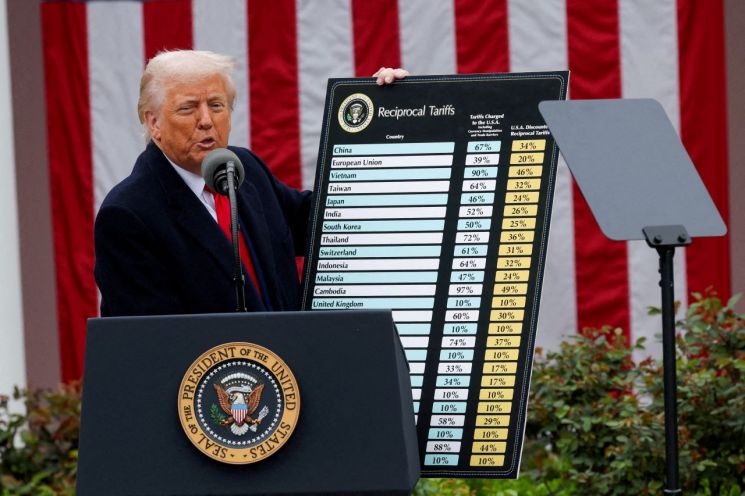 On April 2nd (local time), U.S. President Donald Trump announced tariffs on the United States. Photo by Reuters Yonhap News
The U.S. current account deficit reached a record high in the first quarter of this year, as American companies rushed to increase imports in order to avoid higher tariffs.
According to Reuters on June 24 (local time), citing the U.S. Bureau of Economic Analysis (BEA), the current account deficit?which combines the goods and services balance and the capital account for the first quarter (January to March)?increased by $138.2 billion from the previous quarter to $450.2 billion. This represents a sharp rise of 44.3%.
This current account deficit is equivalent to 6.0% of the U.S. gross domestic product (GDP), the highest level since the third quarter of 2006, when it reached 6.3%. It is a significant jump from 4.2% in the fourth quarter of last year.
Goods imports surged by $158.2 billion to a record high of $1 trillion. The increase was mainly driven by non-monetary gold for industrial use, pharmaceuticals, dental products, and related pharmaceutical goods. Goods exports rose by $21.1 billion to $539 billion, thanks to increased exports of capital goods such as civilian aircraft, computer accessories, peripherals, and parts. This is the highest level since the third quarter of 2022.
As a result, the goods trade deficit widened from $328.9 billion in the fourth quarter of last year to $466 billion in the first quarter of this year. The surge in goods imports in the first quarter, driven by advance purchases to avoid tariffs, subsided in April. According to recently released statistics, goods imports in April dropped sharply by 19.9% to $277.9 billion.
Service imports fell by $1.8 billion to $217.8 billion, mainly due to a decrease in intellectual property royalties such as research and development-related licenses. Service exports decreased by $4.4 billion to $293.2 billion, primarily due to a decline in government goods and services, including military units and agencies. Personal travel also declined, as did professional and management consulting services.
Primary income receipts, which mainly consist of dividends and interest from overseas investments in stocks and bonds, decreased by $22.9 billion to $355.1 billion.
Meanwhile, the current account deficit for the fourth quarter of last year was revised from the previously reported $303.9 billion to $312 billion.
© The Asia Business Daily(www.asiae.co.kr). All rights reserved.












