Seven Major Visions Proposed, Including Leading an Eco-Friendly Steel City
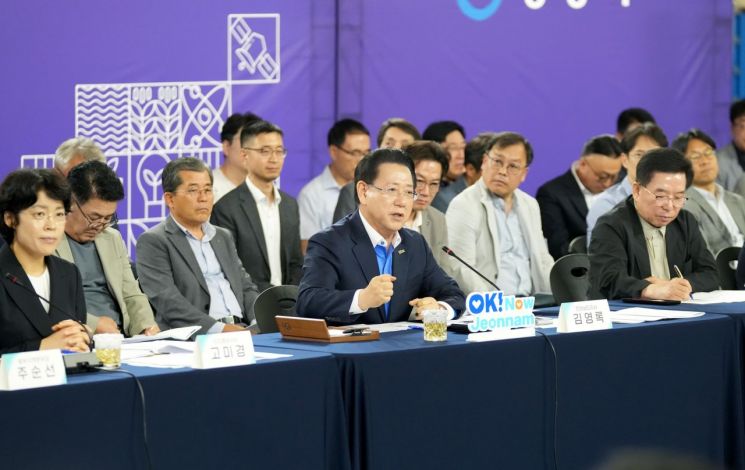
Kim Yungrok, Governor of Jeollanam-do, emphasized on June 24, "We will focus on developing Gwangyang, where nature and industry are perfectly integrated, into a new growth hub city centered on the steel industry, secondary batteries, and global logistics."
Governor Kim made these remarks at the Gwangyang City Policy Vision Tour held at Seonghwang Sports Center in Gwangyang on the same day. The event was attended by Kim Taegyun, Chairman of the Jeollanam-do Provincial Council; Jung Inhwa, Mayor of Gwangyang; Choi Daewon, Chairman of the Gwangyang City Council; Lim Hyungseok and Kang Jeongil, Jeollanam-do Provincial Council members; officials from Jeollanam-do and the Jeonnam Research Institute; and about 150 residents.
In his greeting, Governor Kim highlighted Gwangyang's potential, stating, "Gwangyang is the best city in the country, where the natural environment created by the 550-ri Seomjin River and industries such as Gwangyang Port and POSCO are perfectly harmonized. It is the youngest city and the only one in Jeollanam-do where the population has increased for three consecutive years. In addition, it is leading the secondary battery industry and spearheading competitiveness-enhancing industries in steel and port sectors."
The Jeonnam Research Institute presented seven major visions under the slogan "Gwangyang, the Heart of K-Advanced Industry and a New Growth Hub in the Era of Global Oceans." The visions include: ▲Innovation in the K-steel industry, leading a global eco-friendly steel city; ▲A specialized city for secondary batteries aiming for global advancement; ▲Establishing a smart port and becoming a global logistics hub city; ▲Completing the industrial belt by making Gwangyang Bay Area a transportation hub; ▲Becoming a K-tourism city attracting ten million tourists; ▲A youth venture start-up hub city; ▲Fostering high-income, eco-friendly, Gwangyang-style future agriculture.
During the subsequent policy discussion, Jung Inhwa, Mayor of Gwangyang, said, "We have established a turning point toward becoming a tourism city by promoting development projects in the Baegunsan, Gubongsan, and Seomjin River regions. As a result, a surge in visitors is expected, making it urgent to expand the infrastructure of the 'Gubongsan Observatory' for the safety and convenience of visitors." He requested a budget support of 1 billion KRW for parking lot expansion, installation of a roundabout, and improvement of safety railings.
Lee Geunhui, Chairman of the Gwangyang City Disabled Veterans Association, pointed out, "The Gwangyang Veterans Hall is the only established building among the 22 cities and counties, but two organizations cannot use the hall due to its aging condition." He requested 500 million KRW in support for the new construction and relocation of the veterans hall. Lee Byungman, Chairman of the Gwangyang City Tourism Association, requested 600 million KRW in support for building a training center to preserve and pass down the Jeonnam intangible cultural heritage, "Gwangyang Jinwol Jeoneojabi Sori."
In response, Governor Kim said, "Although the veterans hall project is not eligible for provincial support, we have already applied for next year's national funding and will do our best to secure it." He added, "I fully support the purpose of building the training center. The demolition and design costs of 160 million KRW have already been agreed upon, and we will strive to secure the construction budget through the National Heritage Administration."
In addition, Heo Hyeongtae, a resident and member of the Gwangyang Bay Environmental Forum, proposed that the authority to comprehensively manage environmental pollution facilities be returned to cities and counties to prevent environmental accidents in advance and to handle civil complaints quickly.
Furthermore, Ahn Seongsu, Chairman of the Gwangyang City Venture Business Association, suggested simplifying the approval process for installing power plants so that idle land can be used for citizen-participatory solar power facilities, allowing citizens to share in the revenue from electricity sales. He also urged that issues related to the power grid be resolved quickly. Another request from Ahn Seongsu, Chairman of the Gwangyang City Venture Business Association, was to support the designation of the Gwangyang Bay Area as a specialized complex for secondary battery raw materials and materials, in order to establish a leading secondary battery ecosystem in Gwangyang.
© The Asia Business Daily(www.asiae.co.kr). All rights reserved.












