Fake Documents Created Instantly with Generative AI
Punishments Are Increasing,
But Detection and Identification Remain Difficult
"Please create a medical record for patient ○○○."
Posts explaining how to use generative artificial intelligence (AI) to get university attendance recognized, among other things, are circulating on online communities including X (formerly Twitter). Following the instructions in one such post, when I asked ChatGPT to create a new patient medical record based on an actual record, a forged medical record was generated within minutes. Although some of the fonts looked awkward, when I asked for revisions, they were quickly corrected.
As generative AI becomes more widespread, cases of misuse are also increasing. Document forgery, in particular, has become a major issue. Since anyone who knows how to use AI can easily create fake documents, experts point out that the barrier to committing forgery crimes is becoming lower.
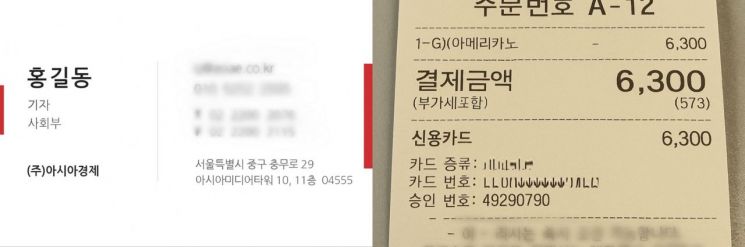
AI also created fake receipts. After showing a coffee franchise receipt stating that an Americano costs 5,300 won and then requesting to change the price to 6,300 won, a manipulated receipt was produced within a minute. Awkward fonts and layout can be revised several times to closely resemble a real receipt, making it difficult to distinguish the fake from the genuine. Such AI-generated fake receipts can be exploited for crimes such as inflating business expenses, including travel reimbursements.
Not only fake business cards, but also important documents used in daily life, such as lease contracts, can reportedly be manipulated.
However, it is extremely difficult to detect AI-generated forged documents. In the past, documents generated by AI often contained contextual errors and other flaws, but as the technology rapidly advances, it is now able to closely replicate the format and structure of real documents. Unless the issuing institution verifies unique identifiers such as issuance numbers or authentication codes, it is not easy to determine the authenticity of a document with the naked eye.
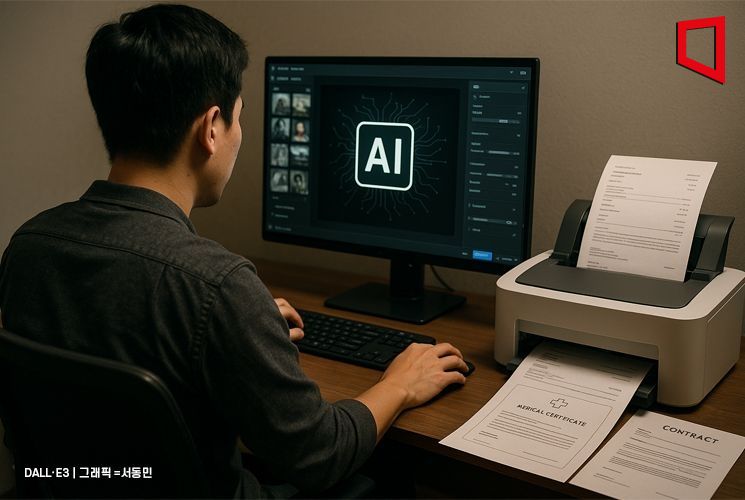
For this reason, there are concerns about the abuse of AI-generated forged documents in fields where verification through the issuing institution is not strictly required. Documents manipulated by generative AI could be accepted without scrutiny in organizations such as companies and schools.
Forgery crimes using generative AI are on the rise. Recently, on the secondhand trading platform Danggeun Market, there was a case where a fake delivery invoice created with AI was used to commit fraud. A Danggeun Market representative stated, "Because of the potential for forgery crimes using AI, we advise users to avoid non-face-to-face transactions whenever possible."
In January, the Seoul Central District Court sentenced a defendant to six months in prison for charges including forgery of private documents, after the defendant used AI to write a false petition. The defendant, who was on trial for methamphetamine use, submitted a false petition to the court under the name of the Goyang City Sports Association team leader, created using ChatGPT. A legal professional commented, "This is a representative case where the judiciary imposed a prison sentence for forging documents using AI."
In February, a broker organization that assisted with forged refugee applications using AI was caught by the police. The brokers reportedly received fees from Indian nationals who entered Korea for employment purposes and, between December 2023 and March of the previous year, used AI to create false stories for their applications.
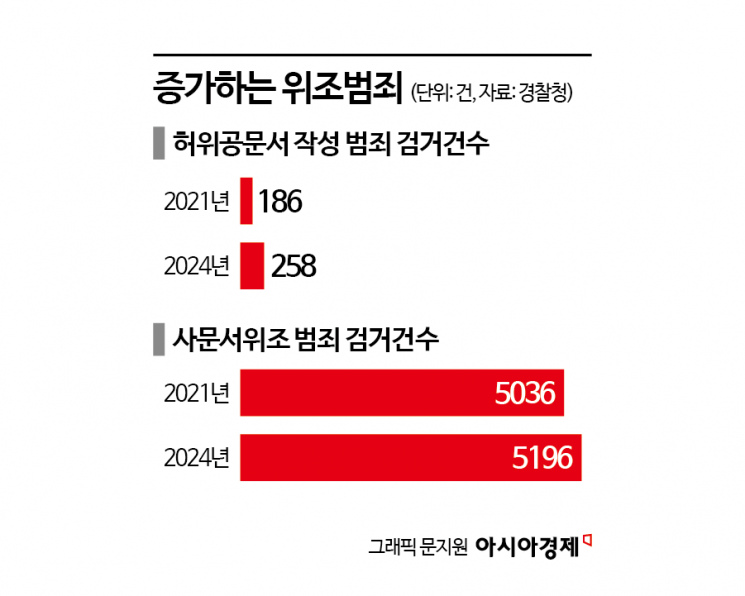
According to the National Police Agency, there were 5,196 cases of private document forgery detected in 2024. There were also 258 cases of public document forgery. If the use of AI becomes more widespread, the number of such crimes could increase rapidly. Attorney Oh Junho said, "In the past, you needed to know how to use specialized tools like Photoshop to forge documents, but now, we live in an era where you can forge documents simply by entering a few commands," adding, "It is important to recognize that document forgery using AI is subject to the same legal penalties."
Professor Koo Jungwoo of the Department of Sociology at Sungkyunkwan University said, "Improving user awareness should come before technology controls," and added, "Public institutions and others should continuously publicize cases of forgery using AI to raise awareness, and the government should consistently remind people that document forgery is a crime."
© The Asia Business Daily(www.asiae.co.kr). All rights reserved.













