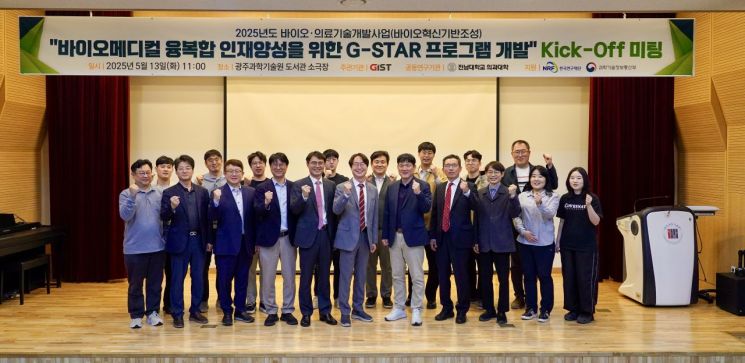
 Kick-Off Meeting for Developing the G-STAR Program between GIST and Chonnam National University Medical School. Provided by GIST
Gwangju Institute of Science and Technology (GIST) announced on the 24th that the 'G-STAR (Global Scientist Training for Advanced Research) Program Development' project, jointly planned with Chonnam National University Medical School, is gaining attention in the research and medical fields as a new model for nurturing convergent talents.
This project was selected in April as the final recipient for the 2025 Bio-Medical Technology Development Project organized by the Ministry of Science and ICT. Professor Kim Jaegwan of the Department of Biomedical Science and Engineering at GIST serves as the principal investigator for the lead institution, while Professor Jung Chaeyong of Chonnam National University Medical School is the principal investigator for the collaborating institution.
The two universities plan to foster more than 60 physician-scientists and biomedical convergent talents over the next four years, from this year through 2028, with government support totaling 3.4 billion KRW.
The 'G-STAR Program' is an integrated education and research platform designed to nurture next-generation convergent talents who will lead the bio-health industry, with a particular focus on training physician-scientists who bridge clinical and basic sciences. Rather than being a short-term educational program, it aims to establish a Korean model for training physician-scientists and expand it into a global network, thereby contributing to strengthening the global competitiveness of K-Bio.
Modern medicine requires close collaboration between basic science and clinical medicine. However, there is a critical shortage of research-oriented physicians in Korea. Each year, less than 1% of approximately 3,300 medical graduates enter the field of basic medical research.
In response, GIST and Chonnam National University designed the G-STAR program with the goal of nurturing convergent talents capable of serving as a 'bidirectional bridge'?connecting insights from clinical practice to scientific research, and translating research outcomes back to patient care.
To ensure the successful operation of this program, GIST provides a hands-on, demonstration-based educational infrastructure leveraging advanced convergent technologies such as AI, biomedical engineering, and space medicine. Chonnam National University Medical School offers a strong clinical and research foundation in immunotherapy and precision medicine.
The G-STAR program consists of: ▲convergent education among physician-scientists, biomedical engineers, and biomedical scientists; ▲credit exchange and joint degree programs; ▲mini-degree courses; ▲overseas training and performance sharing events; ▲R&D projects in six specialized fields (medical AI, immunotherapy, space medicine, bioinformatics, neuroscience, and digital healthcare); ▲and opportunities for laboratory internships and project-based research participation.
In particular, participating students can systematically complete core theories and practical training in medical science and biomedical engineering through mini-degree courses jointly operated by GIST and Chonnam National University Medical School. Completion records will be indicated on degree certificates or transcripts.
Additionally, both GIST and Chonnam National University will establish dedicated administrative offices to integrate academic and research administration, and systematically support the continuous growth and career development of participating students.
Kim Jaegwan, professor at GIST's Department of Biomedical Science and Engineering and principal investigator for the lead institution, said, "The G-STAR program is a new educational paradigm that transcends the boundaries of medicine, science, and engineering, and will serve as the cornerstone for nurturing key talents who will drive future medical innovation."
Jung Chaeyong, professor at Chonnam National University Medical School and principal investigator for the collaborating institution, stated, "This project represents the realization of the long-awaited goal of training physician-scientists, and is expected to serve as a catalyst for advanced medical research with global competitiveness."
© The Asia Business Daily(www.asiae.co.kr). All rights reserved.











