Decrease in Exports to the U.S. and Declining Demand in the American Market
"High Dependence on the U.S. Makes Industry Vulnerable to Tariffs, Support Measures Needed"
There have been calls for the Korean automobile industry to adjust its export and production strategies for North America. This is because Hyundai Motor Company and Kia have a relatively low proportion of local production and sales in the United States, and the Donald Trump administration has imposed a 25% item-specific tariff on imported automobiles since April, which is expected to place a heavier burden on them compared to competitors.
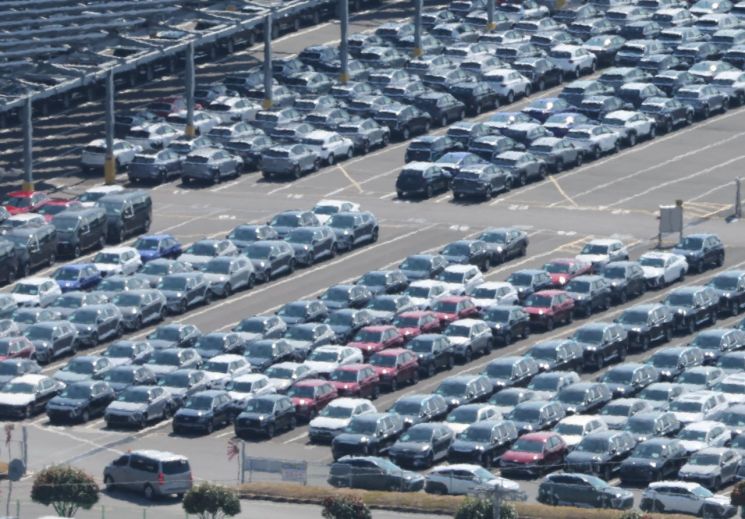 Finished vehicles are waiting in the storage yard next to the export shipment dock at Hyundai Motor Company's Ulsan plant. Photo by Yonhap News
On June 24, the Korea Institute for Industrial Economics and Trade (KIET) stated in its report, "The Impact and Implications of the New U.S. Administration's Tariff Policy on the Korean Automobile Industry," that "in a situation where vehicle demand is declining and competition among companies is intensifying, automakers will not be able to pass all of the increased costs from tariffs onto prices, leading to a deterioration in profitability."
According to the report, last year, the share of Korean finished vehicles and auto parts exported to the United States was 49.1% and 36.5%, respectively. Hyundai, Kia, and GM Korea exported a total of 1.48 million units of 29 models to the United States, with each company's U.S. export share recorded at 54.3%, 37.5%, and 84.4%, respectively.
Given this high dependence on the U.S. market, the report predicted that the 25% high tariff imposed by the second Trump administration would have a negative impact on the Korean automobile industry.
First, it is expected that as companies expand local production to avoid high tariffs, exports to the United States will decrease.
In fact, Hyundai and Kia currently operate production plants in the United States with an annual capacity of 700,000 units, and plan to increase production to a maximum of 1.2 million units by expanding new plant operations. In addition to the Hyundai Alabama plant (360,000 units) and the Kia Georgia plant (340,000 units), they will expand the production capacity of the electric vehicle-dedicated plant, which began operations at the end of last year, to a maximum of 500,000 units.
The report explained, "This figure amounts to about 63% of the volume Hyundai and Kia sold in the United States last year," and added, "About 50% of U.S. export volume will be replaced by local production."
In addition, it is predicted that high tariffs will lead to higher vehicle prices in the U.S. market, which will result in decreased demand and, consequently, a reduction in export volume. In particular, from the second half of the year, when cost pressures are expected to intensify, finished vehicle manufacturers are expected to pass a portion of the tariff burden onto vehicle prices.
The parts industry is also expected to face concerns over reduced demand due to price increases from high tariffs and a decrease in finished vehicle exports. Automakers may also pressure parts suppliers to lower unit prices in order to offset the tariff burden.
S&P Global Mobility initially projected that vehicle sales in the United States this year would increase by 1.2% compared to the previous year, but after the tariff measures, it revised its forecast to a 3.1% decrease, projecting sales of 15.4 million units.
The report emphasized, "Given the Korean automobile industry's high dependence on the U.S. market, it is expected to be vulnerable to the risks of the U.S. high-tariff policy, so response measures such as expanding local production or diversifying exports should be sought."
It further added, "Short-term support such as financial and tax assistance and management stabilization for the parts industry is needed, along with long-term support for technological and productivity improvements," and "region-specific support differentiated by the structure of U.S. exports is also required."
© The Asia Business Daily(www.asiae.co.kr). All rights reserved.












