Development of an AI Model That Enhances Both Resolution and Frame Rate of Low-Quality Videos
Applications in Real-Time Streaming, Medical Imaging, and CCTV Restoration; Accepted by CVPR
An artificial intelligence model capable of restoring blurry and choppy videos into clear and smooth footage has been developed.
The research team led by Professor Jaejun Yoo at the UNIST Graduate School of Artificial Intelligence announced on June 24 that they have developed an AI model called 'BF-STVSR (Bidirectional Flow-based Spatio-Temporal Video Super-Resolution)', which simultaneously enhances both the resolution and frame rate of videos.
 Research team, (from left) Professor Jaejun Yoo, Researcher Eunjin Kim (first author), Researcher Hyunjin Kim. Provided by UNIST
Resolution and frame rate are key factors that determine video quality. Higher resolution results in sharper and more detailed images, while a higher frame rate ensures smoother motion without choppiness.
Existing AI video restoration technologies process resolution and frame rate separately and rely on pre-trained optical flow prediction networks for frame enhancement. Optical flow calculates the direction and speed of object movement to generate intermediate frames, but this approach involves complex computations and is prone to accumulating errors, which limits both the speed and quality of video restoration.
In contrast, 'BF-STVSR' introduces a signal processing technique tailored to video characteristics, allowing the model to independently learn bidirectional motion between frames without depending on external optical flow prediction networks.
Based on this approach, the model can simultaneously enhance both resolution and frame rate by inferring object contours and other features.
When this AI model was applied to low-resolution and low-frame-rate videos, it outperformed existing models in quality metrics such as PSNR and SSIM. Higher PSNR and SSIM scores indicate that even in videos with significant motion, the appearance of people is restored naturally without breakage or distortion.
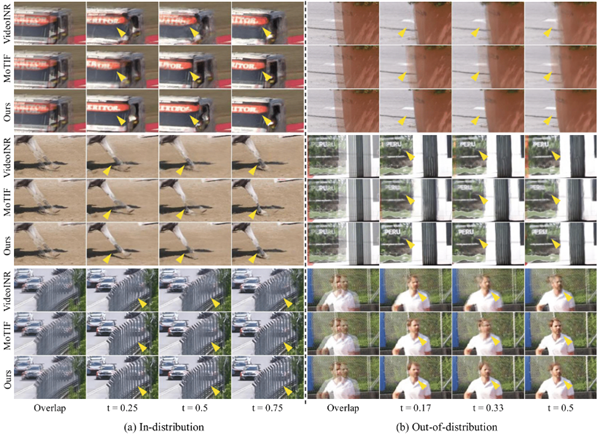 Video restoration results of C-STVSR techniques. The developed AI models (below each test) clearly restore the video compared to existing models.
Professor Jaejun Yoo explained, "This technology can rapidly restore high-quality footage not only from CCTV or black box videos recorded with low-end equipment, but also from compressed streaming videos designed to reduce transmission capacity. As a result, it can be widely applied in fields such as media content production, medical image analysis, and VR technology."
This research was led by Researcher Eunjin Kim as the first author, with Researcher Hyunjin Kim as co-author. The study was accepted by the 2025 CVPR (Conference on Computer Vision and Pattern Recognition), a prestigious conference in the field of computer vision. The 2025 CVPR was held in Nashville, USA, from June 11 to 15, with 13,008 papers submitted worldwide, of which only 2,878 papers (22.1%) were accepted.
The research was supported by the National Research Foundation of Korea under the Ministry of Science and ICT, the Institute of Information & Communications Technology Planning & Evaluation, and the UNIST Supercomputing Center.
© The Asia Business Daily(www.asiae.co.kr). All rights reserved.













