Severance Hospital announced on June 24 that it has recently achieved 3,000 cases of auditory implant surgeries.
The process by which humans hear sound involves the outer ear (the external part of the ear), the middle ear (the eardrum and ossicles), and the inner ear (the cochlea). The outer ear collects sound waves in the form of air vibrations, and the ossicles?three small bones located in the middle ear?amplify these sound waves and transmit them to the cochlea. When the lymph fluid inside the cochlea vibrates, the hair cells in the organ of Corti generate electrical signals. These electrical signals are transmitted to the brain via the auditory nerve, and the brain interprets these signals as sound.
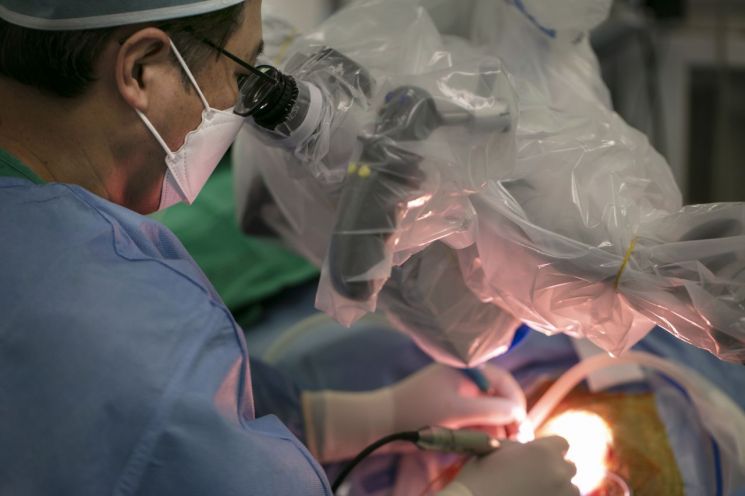 Professor Chae Young Choi of the Department of Otorhinolaryngology at Severance Hospital is performing a cochlear implant surgery. Photo by Yonsei Medical Center
Hearing loss, or the inability to perceive sound, is classified as either conductive hearing loss, which results from problems in the outer or middle ear, or sensorineural hearing loss, which is caused by issues in the inner ear. Conductive hearing loss can typically be managed with hearing aids, as amplifying external sound vibrations is sufficient. Mild to moderate sensorineural hearing loss can also be rehabilitated to some extent with hearing aids. However, in cases of severe hearing loss caused by damage to the cochlear hair cells or the auditory nerve, even very loud sounds cannot be properly recognized as speech.
In such cases, a cochlear implant is a device that compensates for the process of converting sound waves into electrical signals. Among the components of a cochlear implant, the speech processor worn outside the ear converts external sounds into digital signals and transmits them to the internal implant. The implant then transforms these signals into electrical stimulation, which is sent to the cochlea. The auditory nerve delivers these signals to the brain, allowing for clear understanding of speech.
In addition to cochlear implants, there are various types of auditory implants that can help restore hearing. For moderate sensorineural hearing loss or for conductive hearing loss where hearing aids are not effective, a middle ear implant directly stimulates the ossicles, providing clearer and more natural sound than a hearing aid. For cases with abnormalities in the outer or middle ear, a bone conduction implant transmits sound stimulation to the cochlea through the skull bone, bypassing the ear entirely. For patients who lack an auditory nerve or have severe damage to it, an auditory brainstem implant is inserted directly into the brain. Depending on the cause and degree of hearing loss, a variety of auditory implant surgeries have been developed.
In Korea, Professor Kim Heenam of the Department of Otorhinolaryngology at Severance Hospital successfully performed the first cochlear implant surgery on October 11, 1988. At that time, the price of a cochlear implant device was close to $20,000. With the support of Lee Yubok, the 19th Dean of Yonsei University College of Medicine, and the pooled monthly salaries of otorhinolaryngology faculty members, the first device was purchased and the surgery was carried out. Subsequently, the hospital reached 1,000 and 2,000 cases in 2013 and 2019, respectively, continuing to lead the field of hearing loss surgery.
Beyond cochlear implants, Severance Hospital holds several other pioneering titles. Professors Lee Wonsang and Chae Young Choi of the Department of Otorhinolaryngology performed Korea’s first auditory brainstem implant in 2008. Because this procedure involves brain surgery, only a limited number of hospitals are capable of performing it due to its high level of difficulty. In 2011, Professor Chae Young Choi also performed Korea’s first middle ear implant surgery, providing optimal auditory solutions for hearing loss patients who struggle with hearing aids. Since 2014, Professor Moon Inseok and others have published more than 10 papers in prestigious international journals as a result of research aimed at identifying the best indications for middle ear implants.
Of the 3,000 cases recently achieved, there were 2,376 cochlear implants, 408 middle ear implants, 190 bone conduction implants, and 26 auditory brainstem implants. The total number of middle ear implant procedures in Korea is currently about 1,000, with Severance Hospital accounting for approximately 40% of these cases.
Precision medicine is the most distinctive feature of Severance Hospital’s hearing loss treatment. Over the past 15 years, Professor Chung Jinse has analyzed the genetic information of more than 3,500 hearing loss patients, implementing patient-tailored precision medicine throughout the diagnostic and prognostic process. Notably, the hospital is enhancing treatment effectiveness by combining implants with medication. For patients with OSBPL2 (intracellular cholesterol regulation) or NLRP3 (inflammation response) gene mutations, the hospital has confirmed hearing recovery and tinnitus improvement through treatment with rapamycin and anakinra. Professor Chung Jinse, together with Professor Chae Young Choi, has developed and transferred targeted drug therapies for hearing loss patients with mutations in the pendrin and KCNQ4 (progressive hearing loss syndrome) genes.
Rehabilitation is essential after auditory implant surgery. Even after surgery, there are still limitations in perceiving a wide range of sounds, and mapping is required to adjust the frequency and range of sounds that the patient finds comfortable. The Department of Otorhinolaryngology at Severance Hospital has established a systematic ‘one team’ care system, collaborating with various departments before surgery to increase surgical success rates and providing patient-customized auditory rehabilitation through the audiology lab, auditory-language therapy room, social work team, and Hanlim Precision Medicine Center.
In addition, since September 2012, Severance Hospital has operated the 'Kkumpoom Classroom' to support auditory recovery and social rehabilitation for children who have undergone cochlear implant surgery. The Kkumpoom Classroom is sponsored by KT and is known for its long history among corporate social contribution activities. The program offers not only language therapy but also music, art, and English classes, supporting children in their ongoing rehabilitation and socialization after surgery so that they can grow into healthy members of society. Severance Hospital has also shared its know-how in running the Kkumpoom Classroom with regions across Korea, including Jeonnam, Jeju, and Gyeongbuk. The hospital is also taking the lead in supporting the hearing recovery and social adaptation of overseas patients. In 2019, Severance Hospital opened the second Kkumpoom Classroom in Cambodia, where auditory rehabilitation systems were previously lacking, introducing and operating the country’s first auditory rehabilitation program for children with hearing impairment.
Professor Chae Young Choi stated, "Over the past 40 years, Severance Hospital has led groundbreaking technological advances and overcome the disability of hearing loss," adding, "Our strength in hearing loss treatment lies in our integrated approach, which includes genetic analysis, combined treatment with tumor management, and the use of both medication and surgery."
© The Asia Business Daily(www.asiae.co.kr). All rights reserved.











