Export Unit Price Drops Over 9%
Full Impact of 25% Tariff Begins
50% Tariff Imposed from June 4
Export Conditions Expected to Worsen in Second Half
Nippon Steel Pursues Acquisition of US Steel
Outlook for Korean Steel Industry Darkens
Industry Reviews Export Restructuring
Focusing on Strategic Products for US Market
South Korea's steel exports to the United States dropped by more than 16% last month compared to the same period last year. Export unit prices also fell by over 9%. This is due to the full impact of the United States' 25% tariff on specific steel and aluminum products, which took effect on March 12 (local time). There are growing concerns in the industry that export conditions could deteriorate further in the second half of the year, as the tariff rate was raised to 50% starting from June 4.
According to the Korea International Trade Association on June 23, South Korea's steel exports to the United States in May amounted to $327 million, a 16.3% decrease from $390 million in the same month last year. During the same period, the export unit price fell by 9.4%, from $1,429 per ton to $1,295 per ton. Compared to the previous month (April), exports decreased by 14.6%. Since the beginning of this year, the volume of steel exports to the United States has remained relatively stable, with 217,000 tons in January, 242,000 tons in February, 250,000 tons in March, 248,000 tons in April, and 252,000 tons in May. However, it appears that exporters continued shipments after March, when the tariffs were imposed, by lowering prices.
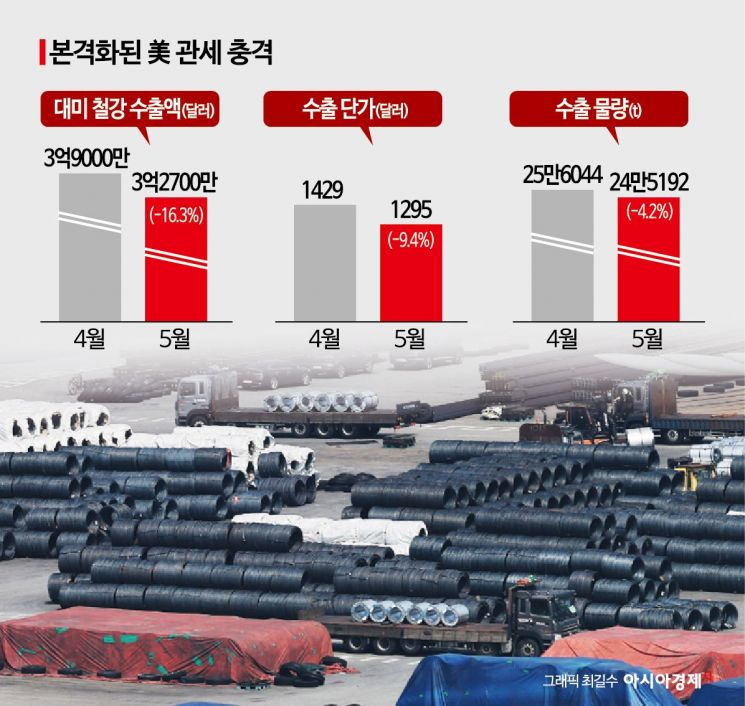
The decline in exports is also confirmed in data released by the Korea Iron & Steel Association on June 6. According to the association, South Korea's steel exports to the United States last month totaled 245,192 tons, a 4.2% decrease from 256,044 tons in the same month last year. The cumulative export volume from March to May was 721,650 tons, down 2.6% from 741,061 tons in the same period last year.
This trend is interpreted as the result of steelmakers sacrificing margins and lowering unit prices to offset the tariff burden and defend export volumes. Due to the industry practice of placing orders several months in advance, the impact of the U.S. tariffs, which began in March, was limited until April. However, starting in May, the effects of the tariffs began to be fully reflected. The Korea Institute for Industrial Economics & Trade stated in a report last month, "The impact of steel tariffs generally becomes apparent two to three months after they are imposed," adding, "The effects may start to appear in exports from May or June."
Both within and outside the industry, there is concern that the U.S. decision to raise tariffs on Korean steel from 25% to 50% as of June 4 will place even greater pressure on export prospects for the second half of the year. Lee Jaeyoon, a research fellow at the Korea Institute for Industrial Economics & Trade, said, "When the tariff rate was 25%, it was widely expected that exports would only see a limited decline of around 5%. However, with the rate at 50%, profitability will be fundamentally undermined, and exports are bound to drop sharply." He added, "If end-use industries such as automobiles contract, overall steel demand will inevitably decrease, making the export environment even more challenging."
Starting next year, the impact of Nippon Steel's acquisition of U.S. Steel is expected to become more pronounced, casting an even darker outlook for South Korean steel exports to the United States. Nippon Steel previously pursued the acquisition, judging that it could not survive with only the shrinking domestic market. The strategy is to combine its advanced sheet metal technology with U.S. Steel's local production and distribution network to directly overcome high tariff barriers. Lee also expressed concern, saying, "Nippon Steel plans to significantly upgrade the U.S. industry. If Japan and other countries increase local investment in the United States, the country's own steel capacity will be strengthened in the long run, and the market share for South Korean steel could gradually shrink."
The steel industry is considering ways to minimize damage through future government and trade cooperation, while also restructuring export strategies to focus on strategic products that are difficult to substitute within the United States. An industry official said, "With the United States importing 28 million tons of steel annually, it is difficult to meet all demand with domestic supply alone. We plan to restructure our export strategy to focus on high-value-added products that are less affected by tariffs, and in the long term, to pursue local production in the United States or indirect exports through third countries."
© The Asia Business Daily(www.asiae.co.kr). All rights reserved.












