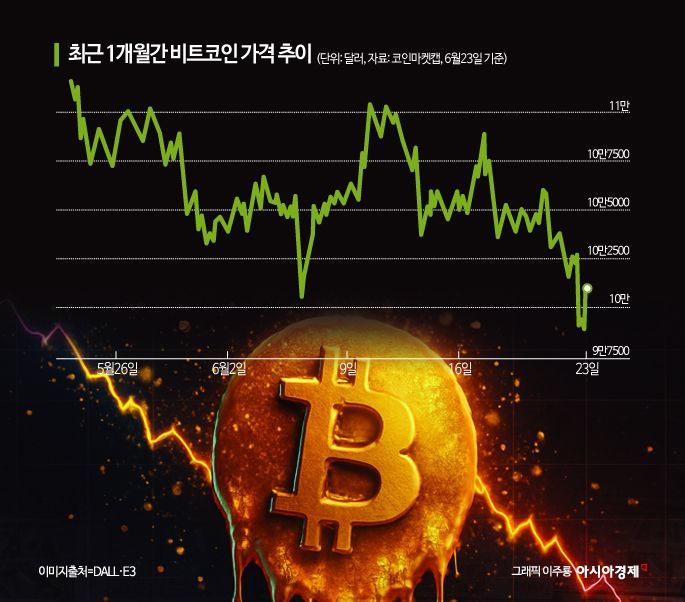
The leading cryptocurrency, Bitcoin, is facing pressure around the $100,000 mark on June 23, following the aftermath of a U.S. airstrike against Iran. As Iran decided to blockade the Strait of Hormuz, international oil prices surged, and the popularity of safe-haven assets such as gold, the U.S. dollar, and the Japanese yen soared.
According to the global market data site CoinMarketCap, as of 8:44 a.m., the price of Bitcoin was $101,012, down 0.84% from the previous day. Compared to the previous month, when Bitcoin surpassed $110,000, this represents a decline of 6.32%. However, it is still up 57.11% compared to a year ago.
The previous day, Bitcoin temporarily fell below the $100,000 level due to the shock from news of the U.S. airstrike. It dropped as low as $98,286. This is the first time Bitcoin has traded below $100,000 since May 8, about a month and a half ago. However, the $100,000 level was soon recovered as bargain buying emerged.
Altcoins (cryptocurrencies other than Bitcoin) are also declining alongside Bitcoin. The leading altcoin, Ethereum, fell 0.64%, while major altcoins by trading volume such as XRP, BNB, Solana, Tron, Dogecoin, Bitcoin Cash, and Sui dropped between 1% and 3%. Since Bitcoin is generally classified as a risk asset, the outbreak of war is interpreted as a collective bearish factor.
At the same time, oil prices surged as Iran decided to blockade the Strait of Hormuz, a key global route for oil and gas shipments. The Iranian parliament (Majlis) voted the previous day to blockade the Strait of Hormuz in response to the U.S. bombing. However, the final decision on the blockade rests with the Supreme National Security Council (SNSC), so the situation needs to be monitored. Currently, Brent crude is trading at $79.60 per barrel, up 3.3% from the previous session, while West Texas Intermediate (WTI) is trading at $76.16 per barrel, up 3.1%.
Both optimism and pessimism coexist in the market. Optimists point out that, since one of Iran's export destinations is China and considering the importance of oil as a source of fiscal revenue, the likelihood of a complete blockade of the Strait of Hormuz is low. On the other hand, pessimists warn that Iran could take extreme actions for emotional or political reasons. Bloomberg Economics (BE), JP Morgan, and Oxford all share the view that if the blockade scenario becomes reality, international oil prices, currently in the mid-$70 range, could soar as high as $130.
Gold futures, a safe-haven asset, are trading at $3,389.80, up 0.11% from the previous session. Silver prices have also risen 0.08% to $36.04. The U.S. dollar index (DXY), which measures the value of the U.S. dollar, is up 0.31% at 99.01. In contrast, the outlook for the stock market, which is classified as a risk asset, is gloomy. Futures for the benchmark U.S. S&P 500 index are down 0.6%.
© The Asia Business Daily(www.asiae.co.kr). All rights reserved.











