On June 24, Gyeonggi Province will publish a comprehensive report titled "Please Even Translate the Tears... The Record and Tasks of the Gyeonggi-do Battery Factory Fire Accident," marking the first anniversary of the Hwaseong battery factory fire. The report details the full account of the disaster, its causes, the response, and the process of policy transformation.
The Hwaseong battery factory fire was a major tragedy that occurred on June 24, 2024, at lithium battery manufacturer Company A, resulting in 23 deaths and numerous injuries.
This report is not merely a factual account of the accident, but rather a record of self-reflection on what Gyeonggi Province has reconsidered and how it has changed over the past year. It is also significant as the first "victim-centered" comprehensive report in Korea completed with the voices of victims by a local government.
Gyeonggi Province defined this incident not as an exceptional workplace accident, but as a social disaster caused by the multi-layered subcontracting structure in industrial sites and the institutional exclusion of migrant workers. Baek Domyeong, Professor Emeritus at Seoul National University and chair of the advisory committee, diagnosed it as "an inevitable tragedy that resulted from the repeated accumulation of outsourcing and migrant labor risks."
The report consists of Part 1, "Gyeonggi Province's Response," and Part 2, "Analysis and Recommendations of the Advisory Committee."
Part 1 of the report chronologically organizes Gyeonggi Province's response, including analysis of closed-circuit television (CCTV) footage, fire suppression efforts, the fire department's reenactment experiments, and the provision of emergency living expenses, interpretation, medical, and psychological support.
In particular, under Governor Kim Dongyeon's declaration that "migrant workers are also residents of Gyeonggi Province," the province provided support without discrimination even to foreign bereaved families with unclear legal support systems. This was the nation's first such social disaster support. The report also covers the process and outcomes of establishing new response systems, such as the on-site installation of the Disaster and Safety Countermeasures Headquarters and solution meetings.
The statements of on-site stakeholders were reconstructed as oral records, resulting in a "memory-centered record" distinct from traditional administrative white papers.
Part 2 focuses on the recommendations of the "Gyeonggi-do Battery Factory Fire Investigation and Recovery Advisory Committee," and includes actual policy adoption cases such as shifts in immigration society, labor, and safety policies, institutionalization of consolation payments, and future tasks.
Gyeonggi Province began by questioning whether "using water to extinguish a lithium battery fire was appropriate" at the time of the incident, reviewed the adequacy of response manuals, and achieved substantive policy changes through reflection and self-examination.
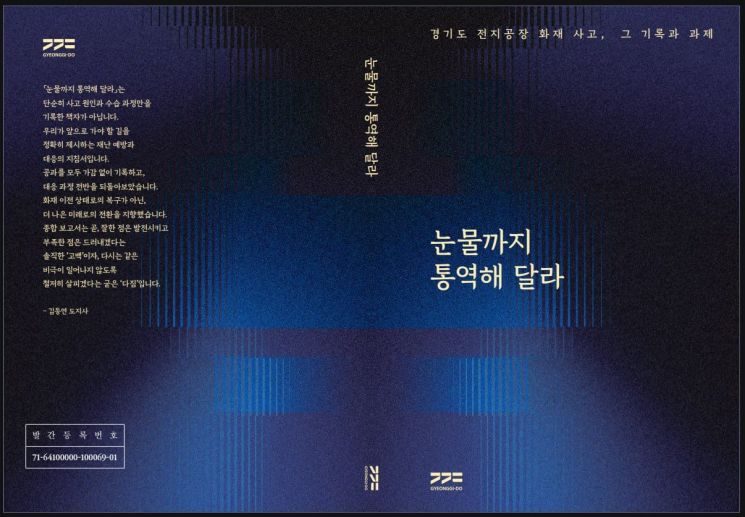 Gyeonggi Province published a comprehensive report last year documenting the fire accident at the Hwaseong battery factory. Photo shows the cover of the report titled "Please Even Translate the Tears."
First, the "migrant worker protection policy" was expanded into an "immigration society policy." In July 2024, Gyeonggi Province will establish the nation's first "Immigration Society Bureau," and in July of this year, the "Immigration Society Integration Support Center" will open. Through these efforts, the province will pursue 33 tasks across four key areas: labor, safety, settlement support, and prevention of discrimination.
The approach to social disaster response has also changed. Emergency living expenses were provided to all victims and bereaved families, including migrant workers, and subsequently, Gyeonggi Province introduced the nation's first "Gyeonggi-style disaster consolation payment" to support even those with moderate and severe injuries. This has become a new standard for disaster compensation in social catastrophes.
Additionally, structural changes to industrial safety policies are underway. For the first time in the country, a pilot "4.5-day workweek" has been introduced to prevent industrial accidents by reducing working hours. The number of "labor safety guardians" will be increased, and a "policy incentive system" reflecting industrial accident rates will also be established.
Governor Kim Dongyeon, in a message accompanying the report's publication, stated, "We aimed not just to record the past, but to show that Gyeonggi Province can lead structural changes in our society through reflection and self-examination," adding, "I sincerely hope this report will serve as a manual for the prevention and response to social disasters."
This report will be available in e-book format on the Gyeonggi Province website (gg.go.kr) for anyone to access, and will be distributed free of charge to public institutions, libraries, and migrant support organizations. Starting in mid-July, Gyeonggi Province will also begin paid sales at major bookstores and online bookstores nationwide.
Meanwhile, Gyeonggi Province has designated the fourth week of June as Labor Safety Week and will hold various events.
© The Asia Business Daily(www.asiae.co.kr). All rights reserved.