UN Security Council Holds Emergency Briefing
Grossi: "No increase in external radiation detected after US attacks"
Damage at Fordow facility remains unknown
UN Secretary-General Guterres: "Diplomacy must prevail to prevent escalation"
Raphael Grossi, Director General of the International Atomic Energy Agency (IAEA), stated on June 22 (local time) that no increase in external radiation levels had been detected following the United States' attacks on three Iranian nuclear facilities.
Grossi made this statement during a briefing on the situation at Iran's nuclear facilities at an emergency United Nations Security Council meeting convened in New York at Iran's request.
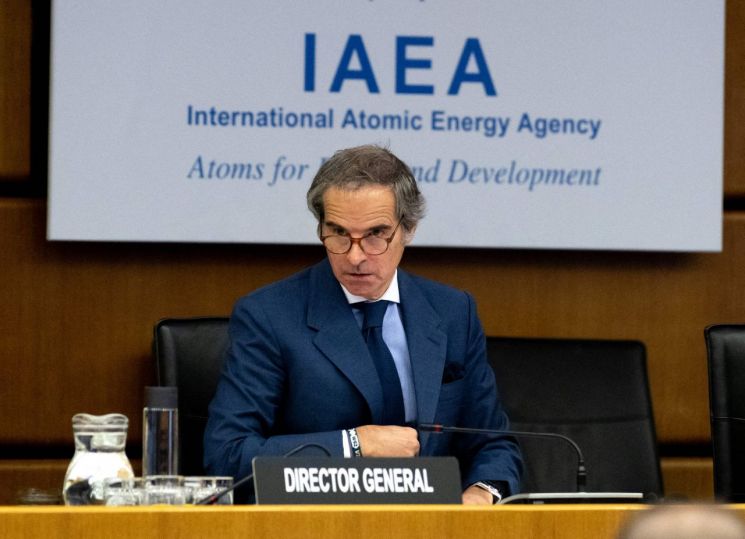
He expressed caution regarding the extent of damage at Fordow, Iran's key underground uranium enrichment facility, saying that the situation was unknown.
The previous day, U.S. President Donald Trump had announced, "We have completed a very successful attack on three Iranian nuclear facilities: Fordow, Natanz, and Isfahan," adding, "Fordow is finished."
At the Fordow nuclear facility, which is a core uranium enrichment site in Iran, a "large crater" was confirmed. Grossi indicated that this suggests the United States used bunker-buster bombs and explained that this matches the U.S. statements.
The Fordow facility is located in a mountainous area of Iran's Qom Province. Its depth is estimated to be 80 to 90 meters. According to U.S. Joint Chiefs of Staff Chairman Dan Kane, seven U.S. B-2 bombers dropped 14 GBU-57 Massive Ordnance Penetrator (MOP) bombs, commonly known as "bunker busters," the previous day.
Regarding the underground damage at Fordow, Grossi said, "At this point, no one, including the IAEA, is in a position to assess the extent of the underground damage at Fordow."
He explained that at the Isfahan nuclear facility, some of the damaged buildings included facilities related to uranium conversion, and that the entrances to tunnels used for storing enriched material also appeared to have been attacked. The Natanz enrichment facility, which is a nuclear fuel enrichment site, was attacked again, and the United States confirmed that bunker-buster bombs were also used there.
He stated, "Iran has informed the IAEA that there was no increase in external radiation levels at any of the three facilities."
Grossi urged restraint, saying, "Armed attacks on nuclear facilities must never occur, as they can cause radioactive leaks with serious consequences not only for the targeted country but also for neighboring countries." He added, "If the Security Council supports it, the IAEA could send nuclear safety and security experts to Iran, in addition to the existing safeguards inspection team."
He continued, "Hostilities must cease so that the IAEA inspection team currently in Iran can carry out its mission," and stated, "Any special measures that Iran can take to protect nuclear material and equipment can be carried out in accordance with Iran's safeguards obligations and the IAEA. This is possible."
Meanwhile, at the Security Council emergency meeting that day, United Nations Secretary-General Antonio Guterres emphasized, "We are now at risk of falling into a cycle of escalating retaliation," and stressed, "Diplomacy must prevail to avoid this."
He said, "We must act immediately and decisively to halt fighting and return to serious and sustained negotiations on Iran's nuclear program," adding that a reliable, comprehensive, and verifiable solution is needed, including full access for IAEA inspectors.
He also addressed Iran, stating, "The Treaty on the Non-Proliferation of Nuclear Weapons (NPT) is the cornerstone of international peace and security," and emphasized, "Iran must fully comply with it."
© The Asia Business Daily(www.asiae.co.kr). All rights reserved.












