Three Nuclear Facilities Including Fordow Struck in Surprise Air Raid
Surprise Attack Just Two Days After Proposing 'Two-Week Negotiation'
Direct U.S. Intervention in Israel-Iran Military Clash
Trump: "If There Is No Peace With Iran, Attacks Will Be Even Stronger"
The Donald Trump administration of the United States directly struck Iran's nuclear facilities using U.S. military force on the 21st (U.S. Eastern Time; morning of the 22nd Iran time). This marks the first time the United States has bombed Iran since the 1979 Iranian Islamic Revolution, and it is a direct intervention in the conflict between Israel and Iran.
This attack comes just nine days after Israel launched a preemptive airstrike against Iran on the 13th (Iran time), which led to an exchange of military clashes between the two countries. It was also a surprise attack that came only two days after President Trump, who had been contemplating a direct strike on Iran, remarked on the 19th that he would decide "within the next two weeks" whether to attack Iran, seemingly setting a negotiation deadline of up to two weeks.
Attention is now focused on how the Middle East conflict will unfold following U.S. intervention. Iran had previously warned that it would retaliate against U.S. military bases in the region if the United States directly intervened. Therefore, depending on the future responses of the United States, Iran, and Israel, this could become a critical turning point that determines whether the conflict will escalate or come to an early end.
On this day, President Trump announced on his social media platform, Truth Social, "We have completed a very successful attack on three of Iran's nuclear facilities: Fordow, Natanz, and Isfahan." He added, "All aircraft have now exited Iranian airspace and are returning safely," and stated, "The entire bomb payload was dropped on the primary target, Fordow." Fordow is known as the heart of Iran's nuclear facilities, where uranium enrichment for nuclear weapons development has reportedly taken place.
In a subsequent national address from the White House, President Trump called the day's military operation a "dramatic success," declaring that "Iran's major uranium enrichment facilities have been completely and totally eliminated." He clarified that the purpose of the attack was "to destroy Iran's uranium enrichment capability and to deter the nuclear threat posed by the world's largest state sponsor of terrorism." He added, "We will no longer need the service of our (U.S. military personnel) in this role. I hope that will be the case."
President Trump especially urged Iran to "build peace," warning that "if not, future attacks will be much stronger and much easier." He said, "Remember, there are more targets left. If peace does not come quickly, we will strike those other targets precisely, swiftly, and skillfully. Most can be eliminated in just a few minutes."
In his address, President Trump emphasized the legitimacy of the attack as an exercise of force, highlighting that Iran has chanted "Death to America, death to Israel" for 40 years and that more than 1,000 Americans and thousands worldwide have died. He specifically pointed out that "countless people were killed" by Qasem Soleimani, the commander of the Islamic Revolutionary Guard Corps (IRGC) Quds Force, who was eliminated in a targeted U.S. strike during his first term in office.
Despite the U.S. airstrikes, the International Atomic Energy Agency (IAEA) stated that there was no increase in external radiation levels at the three Iranian nuclear facilities. In response to the U.S. attack, Iran launched missiles at Israel. Iran's Fars News Agency reported that the Iranian military, in the 20th attack of "Operation Honest Promise 3," used long-range missiles to strike Israel's Ben Gurion Airport, a biological research center, a military supply base, and command and control centers.
The Israeli military confirmed that about 20 Iranian missiles were detected heading toward central and northern Israel. As a result, loud explosions were heard across Israel, and at least 16 people were injured, according to local media citing rescue authorities. Iranian Foreign Minister Abbas Araghchi warned on X (formerly Twitter) that "this morning's incident is absurd and will result in eternal consequences," adding, "Under the UN Charter and the provisions allowing for legitimate self-defense, Iran retains every option to protect its sovereignty, interests, and people."
Subsequently, Israel also joined the attack on Iran. The Israeli military announced that it had launched a series of airstrikes targeting military objectives in western Iran. The Houthi rebels in Yemen, supported by Iran, immediately condemned the United States and vowed retaliation. Mohammed al-Bukhaiti of the Houthi Political Bureau told Al Jazeera Mubasher TV that the Houthis' response to the U.S. attack on Iran was "only a matter of time." Another Houthi Political Bureau member, Ansar Allah, reportedly told Russia's TASS news agency that they would launch attacks on U.S. forces in the Red Sea in response to the U.S. strike on Iran.
Earlier, after returning to the White House from Bedminster, New Jersey, President Trump convened a National Security Council (NSC) meeting. Given the timeline, it is possible that President Trump made the final decision to attack Iran during this NSC meeting. U.S. media reported that the increasingly slim prospects for direct negotiations with Iran were a key background to the decision to launch the attack.
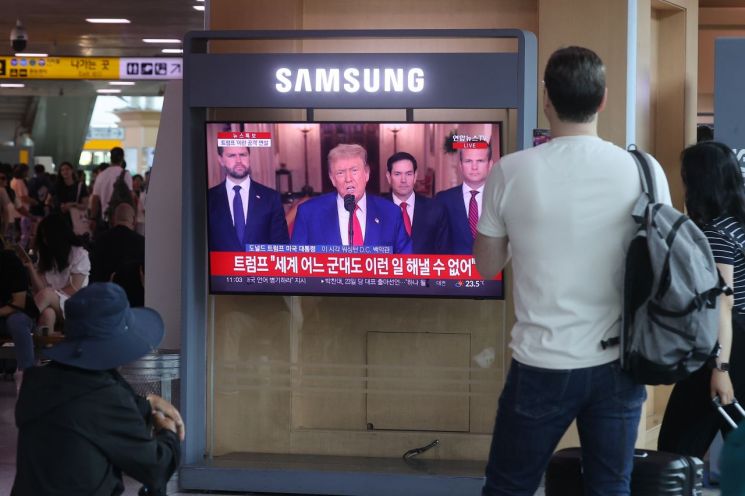 On the 22nd, citizens at the Seoul Station concourse are watching a national address by U.S. President Donald Trump regarding the airstrikes on Iran. Photo by Yonhap News
Iran stated that it could not engage in dialogue with the United States as long as Israeli attacks continued, while President Trump said the previous day that it would be very difficult to halt Israel's attacks while it was winning the war. U.S. authorities did not officially disclose which military assets were used in the attack, but media outlets reported that B-2 stealth bombers and the "bunker buster GBU-57," the only existing super-large bomb capable of destroying deeply buried nuclear facilities, were used.
The New York Times (NYT) and CNN reported that the U.S. military dropped 12 bunker buster GBU-57 bombs on Fordow and launched about 30 Tomahawk missiles at other nuclear facilities. The NYT noted that, since a B-2 typically carries two bunker busters, six B-2 bombers were likely deployed in the strike on the Fordow nuclear facility. Several B-2 bombers reportedly departed from Whiteman Air Force Base in Missouri and were en route to Guam, according to U.S. officials cited by the media, although it remains unclear whether these bombers participated in the operation.
Although President Trump has described the operation as a complete victory, significant backlash is expected. First, President Trump had pledged during the last presidential election not to intervene in foreign conflicts, and this attack breaks that promise, potentially provoking opposition from his supporters. While President Trump had been weighing a direct strike on Iran, some of his supporters, including conservative commentator Tucker Carlson and former White House advisor Steve Bannon from his first term, have criticized U.S. intervention as a betrayal of his base.
While the ruling Republican Party largely supports President Trump's decision, some anti-war Republicans and members of the opposition Democratic Party argue that direct involvement in war without congressional approval is unconstitutional, suggesting that political controversy will intensify. Criticism from outside the United States also emerged immediately. United Nations Secretary-General Antonio Guterres stated in a declaration that the situation is "a dangerous escalation in a region already on the brink, and a direct threat to international peace and security."
© The Asia Business Daily(www.asiae.co.kr). All rights reserved.













