During the Pandemic, the Rate Was 20-40%
Some Analysts Expect a Greater Effect Than During COVID-19
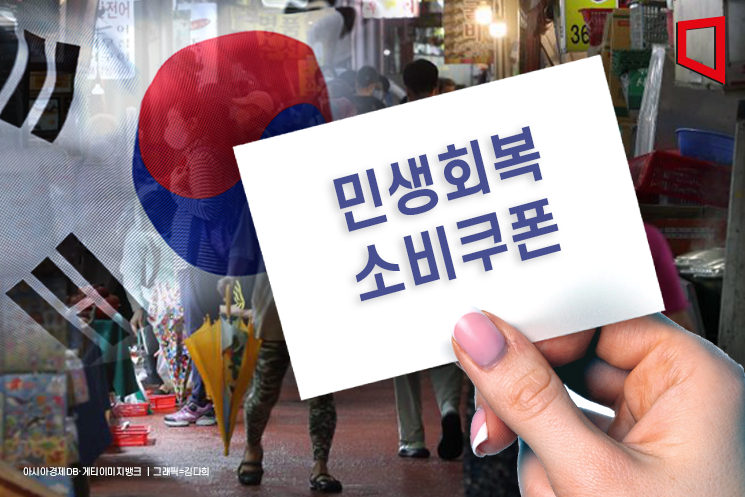
As the government has decided to distribute livelihood recovery consumption coupons worth 150,000 to 500,000 won per person to all citizens through the second supplementary budget, attention is focused on the actual effect this will have on boosting consumption. Research on COVID-19 disaster relief funds has shown that the effect of creating new consumption was analyzed to be between 20% and 40%.
On June 22, Yonhap News reported that Kim Miru, a research fellow at the Korea Development Institute (KDI), and others analyzed the effects of the first round of COVID-19 emergency disaster relief funds in May 2020. The study found that, in industries where the funds could be used, sales increased by 26.2% to 36.1% compared to the total budget allocated. At that time, the government provided emergency disaster relief funds of 400,000 to 1,000,000 won per household to all citizens.
During the pandemic, the effect varied by industry. The impact was significant in (quasi-)durable goods and essential goods, which do not require face-to-face contact, but was relatively small in face-to-face service industries and the food service sector.
According to a paper by Lee Woojin of Korea University, Kang Changhee of Chung-Ang University, and Woo Seokjin of Myongji University, the marginal propensity to consume from the COVID-19 emergency relief funds was 0.362 to 0.421 in the second quarter of 2020 and 0.401 to 0.481 in the third quarter. Combining the second and third quarters of 2020, the marginal propensity to consume was estimated at about 0.654 to 0.782. Of the total 21.7 trillion won in emergency relief funds distributed by the government in the second and third quarters of 2020, approximately 14.2 trillion to 17 trillion won was used for consumption expenditure.
Unlike during the pandemic, when policies such as social distancing were in effect, face-to-face consumption is now more active, and domestic demand has been stagnant for a long period. For these reasons, some believe that the consumption effect could be even greater this time. Experts predict that the marginal propensity to consume for the current livelihood recovery consumption coupons will also be around 40%. For example, if a four-person household receives 1,000,000 won, 400,000 won would result in additional consumption. Woo Seokjin estimated in a phone interview with Yonhap News that the marginal propensity to consume could reach up to 50%.
Meanwhile, on June 19, the Ministry of Economy and Finance announced the supplementary budget plan and stated that it would distribute 13.2 trillion won worth of 'livelihood recovery consumption coupons.' The coupons will be distributed in two rounds. The total amount per person, combining both rounds, will be as follows: ▲150,000 won for the top 10% income group (5.12 million people), ▲250,000 won for the general public, ▲400,000 won for the near-poor (380,000 people), and ▲500,000 won for basic livelihood security recipients (2.71 million people). Residents of 84 rural and fishing village areas at risk of depopulation will receive an additional 20,000 won per person.
© The Asia Business Daily(www.asiae.co.kr). All rights reserved.












