Gangseo-gu Records Highest Proportion at 54%
46% of Transactions Were Reverse Jeonse Last Year
As of May this year, one out of every four jeonse (long-term lease) transactions for multiplex and townhouse units in Seoul was found to be a "reverse jeonse" transaction.
According to an analysis by the real estate platform coffeehouse, based on actual transaction data from the Ministry of Land, Infrastructure and Transport, there were 31,166 jeonse transactions for multiplex and townhouse units in Seoul from January to May 2023. Among these, there were 7,547 cases where at least one transaction occurred at the same address and for the same unit size between January and May this year.
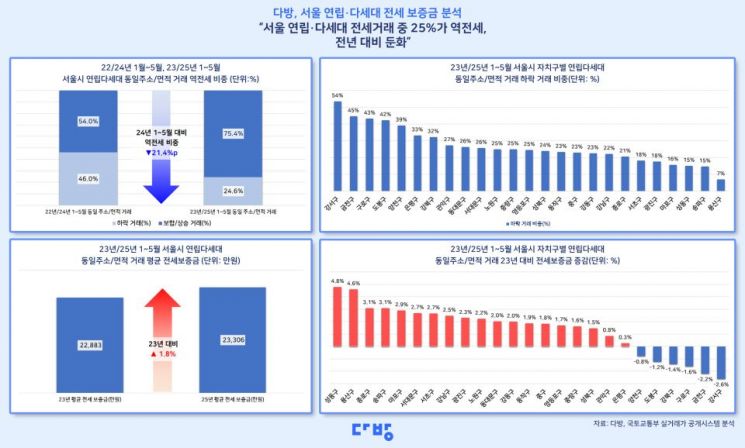
Of these, 1,857 cases, or about 25% of the total, were identified as "reverse jeonse" properties, where the current jeonse price had dropped compared to the previous deposit. The average jeonse price difference for reverse jeonse properties was 4.23 million won. A reverse jeonse transaction occurs when the current jeonse price falls below the deposit amount previously contracted by the outgoing tenant.
However, compared to last year, this proportion decreased by 21 percentage points. During the same period last year, 46% of jeonse transactions were for reverse jeonse properties. The average jeonse price difference for reverse jeonse properties last year was 9.79 million won. Compared to the same period last year, the average jeonse price difference for reverse jeonse properties this year decreased by 5.56 million won.
As of this year, the areas where jeonse prices fell the most compared to the deposit were, in order: Gangseo-gu, Geumcheon-gu, Guro-gu, Gangbuk-gu, Dobong-gu, and Yangcheon-gu. In Gangseo-gu, the average jeonse deposit for reverse jeonse transactions fell from 190.44 million won in 2023 to 185.48 million won in 2025, a decrease of 4.97 million won on average.
Gangseo-gu also recorded the highest proportion of reverse jeonse transactions among same-unit transactions for multiplex and townhouse units in Seoul, with 54% being reverse jeonse. This was followed by Geumcheon-gu (45%), Guro-gu (43%), Dobong-gu (42%), Yangcheon-gu (39%), Eunpyeong-gu (33%), Gangbuk-gu (32%), Gwanak-gu (27%), and Dongdaemun-gu and Seodaemun-gu (26% each). The lowest proportion was in Yongsan-gu (7%).
A coffeehouse representative stated, "Since 2023, we have continuously analyzed reverse jeonse transactions for multiplex and townhouse units in Seoul. Although the reverse jeonse phenomenon still exists in the jeonse market, the proportion of such transactions has decreased somewhat compared to last year," adding, "As the proportion of reverse jeonse and the extent of jeonse price declines vary by region, it is now time to closely monitor future trends in the jeonse market."
© The Asia Business Daily(www.asiae.co.kr). All rights reserved.












