Meritz, the Largest Creditor, Agrees to Pre-Approval M&A
Sale Price Expected to Be Set at 3.7 Trillion Won, Based on Liquidation Value
Industry Downturn and High Acquisition Cost Fuel Pessimism Over 1 Trillion Won Price
PE Firms Reluctant to Acquire... Naver, GS, Coupang Among Potential Candidates
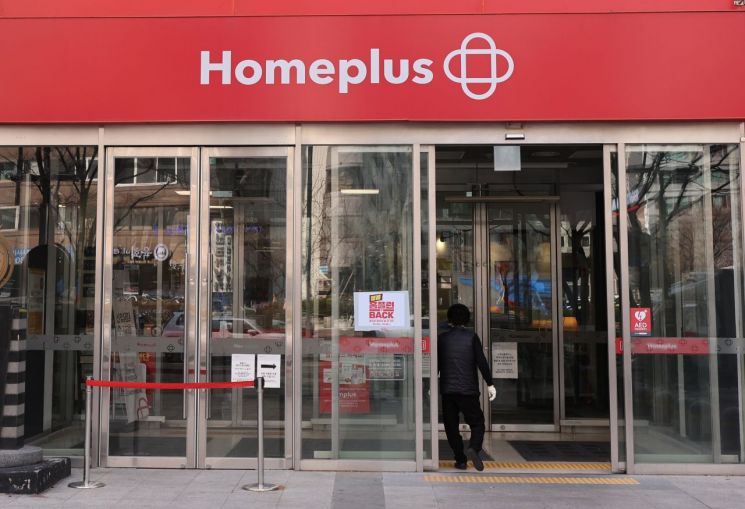
Homeplus is set to officially begin the search for a new owner. This comes as Meritz Financial Group, its largest creditor, has agreed to a pre-rehabilitation merger and acquisition (M&A) before the approval of Homeplus's rehabilitation plan. The key issue is the price. Although the liquidation value is high, the decision to seek a new acquirer suggests that a tense tug-of-war over the sale price between creditors and potential buyers is likely to unfold.
According to the investment banking (IB) industry on June 20, Meritz plans to submit a statement to the Seoul Bankruptcy Court indicating it does not oppose a pre-rehabilitation M&A for Homeplus. Meritz, through its subsidiaries Meritz Fire & Marine Insurance, Meritz Securities, and Meritz Capital, is the largest creditor, having loaned a total of 1.2 trillion won to Homeplus last year.
On June 13, Homeplus filed for a pre-rehabilitation M&A with the Seoul Bankruptcy Court, and to proceed with this plan, the consent of the senior creditor, Meritz, was required. With Meritz's decision, Homeplus can now proceed in earnest with the M&A process.
The Key Issue Is Price... Speculation Ranges from 1 Trillion to 4 Trillion Won
Although the Homeplus M&A process has just begun, there is already considerable speculation in the market about the sale price.
The estimated sale price in the industry is around 3.7 trillion won, which is set based on the liquidation value. Samil PwC, the court-appointed examiner, recently assessed Homeplus's going concern value at 2.5 trillion won and its liquidation value at 3.7 trillion won.
According to Article 243 of the Debtor Rehabilitation and Bankruptcy Act, "The repayment method under the rehabilitation plan must not be less favorable to each creditor than repayment upon liquidation of the debtor's business; however, this does not apply if the creditor agrees otherwise." In other words, based on the principle of guaranteeing the liquidation value, the acquisition price must exceed the liquidation value, meaning the minimum sale price for Homeplus should be at least 3.7 trillion won.
However, some argue that the company could be put on the market at a price below its liquidation value. Despite the high liquidation value, Meritz's agreement to a pre-rehabilitation M&A and the potential impact on the national economy could lead creditors to accept a sale below liquidation value.
Homeplus directly employs 19,000 staff, so its bankruptcy would have a significant impact on local economies. With the new administration closely monitoring the Homeplus situation, it is unlikely that the company will be allowed to go bankrupt. Previously, the largest shareholder, MBK Partners, announced that if a pre-rehabilitation M&A is completed, it would fully cancel its 2.5 trillion won stake in Homeplus common shares free of charge, further supporting the M&A process.
Another obstacle is that, given the difficulties facing the offline retail sector, including competitors like Emart and Lotte Mart closing numerous underperforming stores, it is unlikely that any buyer would realistically pay an acquisition price close to 4 trillion won. As a result, some predict that, considering all these factors, a potential buyer could propose an acquisition price as low as around 1 trillion won.
An accounting firm representative stated, "Common sense dictates that a seller should not incur a loss, so the sale price should be based on the liquidation value," but also added, "However, if no buyers emerge and bankruptcy is not an option, a tug-of-war between potential buyers and creditors could result in a sale at a somewhat reduced price."
Homeplus Seeks New Owner, but Private Equity Funds Remain Reluctant
The search for a new owner for Homeplus is expected to be challenging. There are few companies in Korea capable of handling a multi-trillion-won acquisition, so private equity (PE) firms would need to step in, but most have expressed negative views about acquiring Homeplus.
The head of a PE firm managing a fund worth over 1 trillion won said, "There are almost no PE firms that would proceed with an acquisition against the opinions of domestic institutional investors (LPs), who are highly sensitive to political issues."
Another PE executive commented, "If a PE firm acquires Homeplus and problems arise, and then another PE firm tries to acquire it again, it would inevitably spark significant controversy. Above all, the offline retail sector is in a slump, and with new government regulations on large supermarkets, it does not seem easy to drive new growth by acquiring Homeplus."
There is also the opinion that if PE firms do not participate in a multi-trillion-won deal, the sale will be difficult to complete.
The head of a mid-sized PE firm said, "Some are even mentioning a sale price as low as 1 trillion won, well below the liquidation value, but the acquirer would have to bear billions of won in unpaid obligations and debts amounting to trillions of won on the balance sheet. For ordinary companies, acquiring Homeplus could spark political controversy, so unless a PE firm managing a multi-trillion-won fund steps up, the M&A will not be easy."
Despite these challenges, various potential acquirers are being discussed in the industry. Major distribution companies such as Naver and GS are being mentioned as primary candidates. Coupang and AliExpress are also considered potential buyers thanks to their strong financial resources. If any of these companies acquire Homeplus, they would secure a nationwide distribution network and could strengthen their fresh food business by utilizing existing stores, which is seen as an advantage.
However, most candidates are taking a cautious stance regarding the acquisition of Homeplus. This is because the offline retail market itself is shrinking, and the slowdown in the growth of large supermarkets is intensifying. According to government data from April this year, large supermarket sales have declined for three consecutive months year-on-year, and competitors such as Emart and Lotte Mart are also closing numerous underperforming stores.
There is also the possibility of a split sale. Previously, in June last year, MBK Partners attempted to sell Homeplus Express, an SSM subsidiary, through a split sale, but canceled the plan in March this year due to court receivership proceedings.
© The Asia Business Daily(www.asiae.co.kr). All rights reserved.











