"Despite Growing to a City of 400,000, the Law Still Reflects a Population of 70,000"
There was a suggestion that a comprehensive revision of the Sejong City Act is essential to clarify the legal status of Sejong as the administrative capital and to strengthen the city's self-sufficiency through administrative and financial special provisions. It was emphasized that all-encompassing special measures should be actively promoted so that Sejong can serve as a central pillar for balanced national development and the realization of local autonomy.
At the "National Balanced Development and the Future of the Administrative Capital: Sejong City Act Amendment Discussion Forum" held at the Sejong Joint Campus on June 18, Mayor Minho Choi, who served as the keynote speaker, and other panelists unanimously voiced the necessity of amending the Sejong City Act.
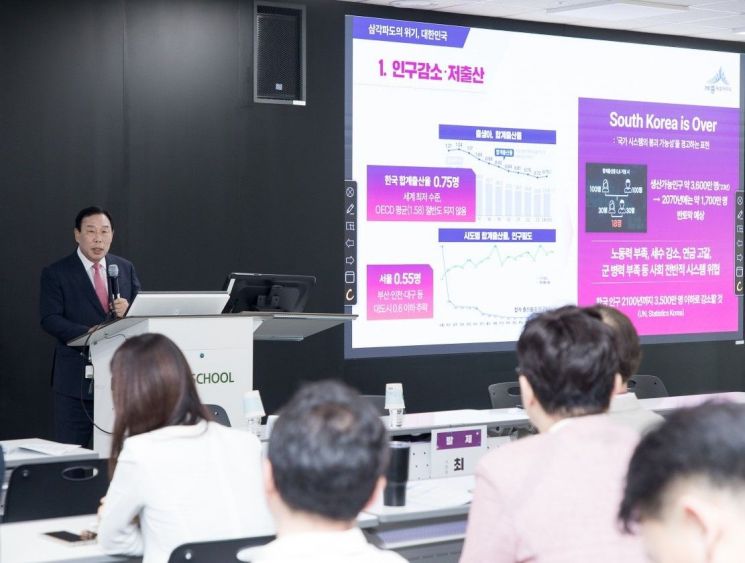 Sejong Mayor Minho Choi is speaking at the special administrative capital planning seminar discussion.
 Photo by Policy Planning Officer, Planning and Coordination Office
In his keynote speech, Mayor Choi stressed, "The completion of the administrative capital is not just a task for Sejong, but a matter of national importance for the next hundred years, including the younger generation and balanced regional development."
He continued, "To overcome the triple wave of crises facing our country?low birth rate, regional extinction, and polarization?a phased strategy is needed. This includes completing the administrative capital, relocating prestigious universities from the Seoul metropolitan area, attracting large corporations, and establishing a mega think tank in the central region."
He particularly highlighted the need for a comprehensive revision of the Sejong City Act to establish Sejong as a practical administrative capital.
He said, "Sejong has grown into a city with a population of 400,000, but the Sejong City Act is still based on a population of 70,000. To illustrate, the number of special provisions in the relevant laws is 481 for Jeju, 131 for North Jeolla, 84 for Gangwon, but only 30 for Sejong."
He further explained, "Due to the structural limitation of a single-tier government system, Sejong is missing out on the ordinary local allocation tax given to basic local governments, which causes financial difficulties. While handling both basic and metropolitan administrative tasks, Sejong is not receiving adequate administrative and financial support. To resolve these practical issues, the Sejong City Act must be revised to address all of these aspects."
Professor Hwi Moon Ra of Sungkyul University stated, "I agree with Mayor Minho Choi's presentation, and I especially want to emphasize the financial aspects of the Sejong City Act amendment. Since Sejong, as a single-tier local government, clearly receives less in allocation taxes and transferred resources from the central government, it is necessary to properly calculate and reflect this."
He added, "Since the issue of allocation taxes can be sensitive for other local governments as well, it is important to respond wisely by actively cooperating with organizations such as the Council of Governors to gain regional consensus."
The city plans to actively incorporate the expert opinions presented at the forum and to continue pursuing public consensus and a comprehensive revision of the Sejong City Act to secure the status of Sejong as the administrative capital and to enable it to fully perform its administrative functions.
© The Asia Business Daily(www.asiae.co.kr). All rights reserved.












