President Trump Returns Home Early from G7, Korea-U.S. Summit Canceled
High Interest Ahead of Tariff Negotiations... Presidential Office Says "U.S. Requested Understanding"
Presidential Office Moves Quickly to Find Alternatives... Considering NATO and U.S. Visit
Korea-Japan Summit to Take Place... First Meeting with Prime Minister Ishiba Shigeru
Due to escalating military conflict between Israel and Iran, U.S. President Donald Trump decided to return home early on June 16 (local time) during the Group of Seven (G7) summit. As a result, President Lee Jaemyung's first summit-level diplomacy with the United States, which was scheduled to take place ahead of "tariff negotiations," has been derailed by this unexpected variable. There is now a strong possibility that President Lee will have to conclude his G7 schedule at the level of simply announcing South Korea's return to the global stage after a six-month hiatus following the December 3 Martial Law incident. However, on the second day of summit diplomacy (June 17), President Lee has confirmed a Korea-Japan summit, giving him the opportunity to hold his first face-to-face talks with Japanese Prime Minister Ishiba Shigeru.
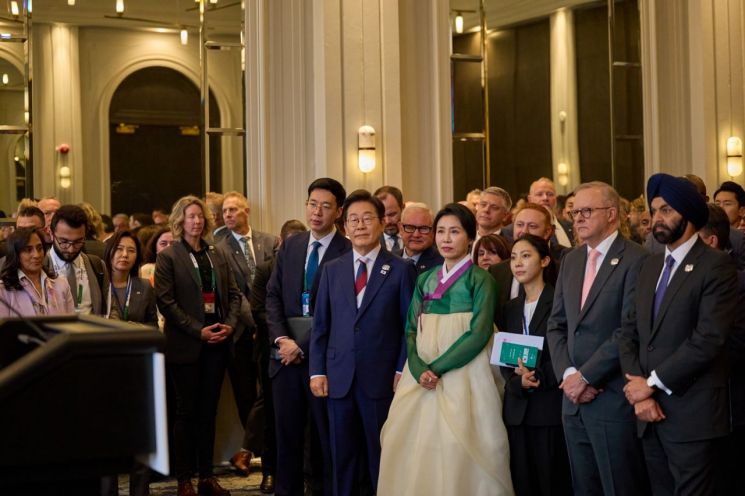
President Lee Jaemyung attended the G7 summit in Kananaskis, Alberta, Canada, as the leader of an invited nation. This marked his dramatic debut on the diplomatic stage just 12 days after taking office. President Lee entered the summit with three main objectives: "return to the international stage after martial law," "kickstarting trade diplomacy," and "restoring South Korea's status as a country that has revived democracy." In this context, the biggest focus of this schedule was undoubtedly the first summit with President Trump. There were high expectations for discussions on key trade and security issues between South Korea and the U.S., such as tariff negotiations, defense cost-sharing, and the relocation of U.S. Forces Korea. However, the summit was ultimately canceled due to President Trump's unexpected return to the U.S.
The White House announced that President Trump was returning home to respond to the heightened military tensions between Israel and Iran. During his time at the G7, President Trump held a series of bilateral meetings with Canada, the United Kingdom, Japan, and the European Union (EU), but was unable to meet with South Korea as scheduled. An official from the presidential office stated, "The cause appears to be the armed conflict between Israel and Iran," and added, "We received a message from the U.S. side requesting understanding."
President Lee, who is making his summit diplomacy debut, faced his first major challenge due to President Trump's sudden return. During an impromptu press conference on the presidential jet en route to Canada, President Lee emphasized pragmatic diplomacy, stating, "What matters in Korea-U.S. trade negotiations is ensuring that our companies are not placed at a disadvantage compared to those from other countries" and "We must achieve mutually beneficial results." However, the symbolic first scene of this pragmatic diplomacy has been delayed by an unforeseen international conflict.

Within the presidential office, there is both disappointment and a swift effort to seek alternatives. A senior official stated, "If the summit had taken place, it would have provided greater momentum for working-level negotiations, but the negotiations themselves have not stopped," and added, "The president has instructed us to pursue the summit again at the earliest opportunity." National Security Advisor Wi Sunglak also expressed his expectations for a meeting with President Trump in a pre-departure briefing, saying, "The G7 summit can serve as a catalyst for addressing diplomatic and economic issues such as tariffs."
The presidential office is considering the possibility of arranging a Korea-U.S. summit during the North Atlantic Treaty Organization (NATO) summit to be held in The Hague, Netherlands, on June 24-25, should President Lee attend. President Trump is also reportedly likely to attend this meeting. If this opportunity is missed, the first face-to-face meeting could take place in the form of President Lee visiting the U.S. at President Trump's invitation. Since the deadline for working-level tariff negotiations, the most critical trade issue between South Korea and the U.S., is July 8, whether a summit can be held before then is expected to be a significant variable in the negotiation framework. The presidential office stated, "Ministerial and working-level negotiations are ongoing, so the negotiations themselves are not being delayed, but a summit would certainly provide additional momentum," expressing strong determination to reschedule the meeting.
On the first day of the summit schedule, President Lee focused on communicating the resilience of South Korean democracy to the international community during meetings with G7 leaders. At the G7 welcome reception, UN Secretary-General Antonio Guterres and South African President Cyril Ramaphosa praised "the impressive resilience of South Korean democracy," while President Lee expressed his respect for the late President Nelson Mandela and delivered the message, "Korea has risen again."
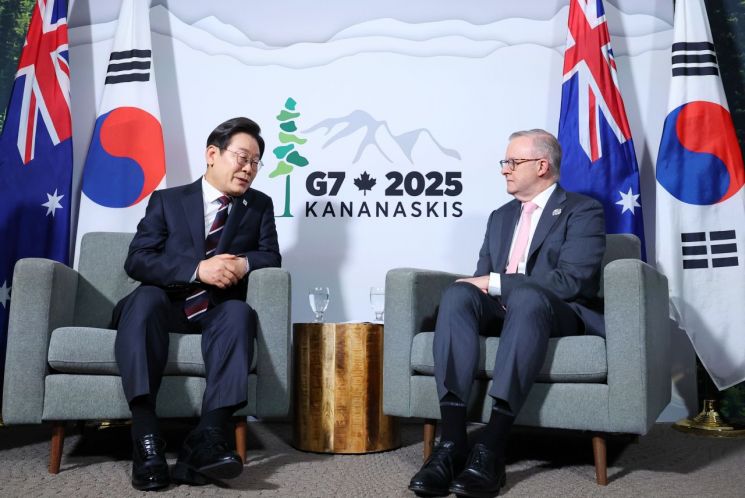
Meanwhile, the Korea-Japan summit on the sidelines of the G7 will take place on the afternoon of June 17 (local time). President Lee has established a "two-track" approach, responding to historical issues based on principles, while addressing economic and security cooperation according to practical interests, and has been delivering a consistent message. An official from the presidential office explained, "There are delicate issues such as historical disputes, and there are also tasks that require cooperation for the present and future," adding, "There will be discussions aimed at managing historical issues well while enhancing cooperation."
© The Asia Business Daily(www.asiae.co.kr). All rights reserved.














