Gijang County (Governor Jung Jongbok) has officially launched the 'Our Village Food Package Sharing Project' to address welfare blind spots in the region. The initiative is designed to implement a customized welfare support model based on a public-private partnership structure, in collaboration with the Korea Hydro & Nuclear Power Gori Nuclear Power Headquarters.
According to the county on June 16, this project is funded by a donation of 100 million won from the Gori Nuclear Power Headquarters, designated through the Busan Community Chest of Korea. The Gijang County Community Security Council (headed by Kwon Myoyeon) is leading the effort, with participation from five towns and townships and 25 welfare institutions.
The beneficiaries include approximately 1,600 people, such as vulnerable groups and seniors who use senior centers. They will receive packages containing six types of local specialties from Gijang County, including Korean beef for soup, anchovies, and seaweed.
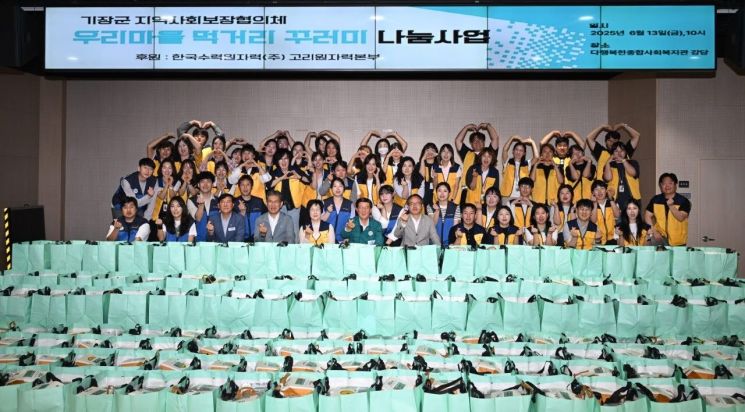
Previously, on June 13, a package assembly event was held at the Daehappy Han General Social Welfare Center. Over 50 people, including Governor Jung Jongbok, officials from the Gori Nuclear Power Headquarters, and representatives from local welfare institutions, participated in the packaging process. Three hundred assembled packages were delivered to vulnerable households on the same day. By June 30, 308 senior centers in Gijang County will sequentially receive rice (two 20kg bags) and Korean beef (3kg).
Kwon Myoyeon, chairperson of the council, said, "We hope this project, created through public-private cooperation, will spread as a sustainable model for regional welfare." Governor Jung Jongbok also stated, "The core of this project is to realize a Gijang without exclusion and a warm community," adding, "We will continue to expand social contribution partnerships with local businesses in the future."
This project is notable for introducing a livelihood support approach that utilizes local specialties through cooperation between public institutions and the regional welfare network. In particular, it is highly regarded for its sustainability, as it is driven by voluntary participation from the local community rather than being a top-down, municipality-led support initiative.
© The Asia Business Daily(www.asiae.co.kr). All rights reserved.












