Data-Driven, Remote-Controlled...
The Secret of Future Agriculture
Gangbuk District Operates Smart Farm Center and Smart Agricultural Facilities
"I've never seen strawberries grown like this before." "We would love to introduce this kind of agriculture in our country as well."
The Gangbuk Smart Farm Center, located in a newly constructed three-story building on a five-lane road in front of Seoul Susong Elementary School in Beondong, Gangbuk-gu, Seoul, was bustling with unfamiliar visitors. On June 12, eight officials from the Ethiopian Ministry of Agriculture visited the cutting-edge urban agriculture site and expressed their strong desire to implement similar systems, stating that it would be essential for increasing farmers' income and improving productivity.
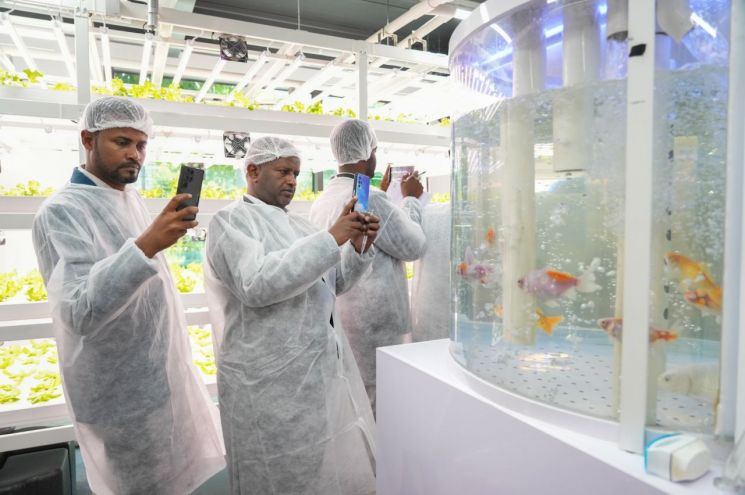 Asechu Hunde, Director of Agricultural Mechanization at the Ethiopian Ministry of Agriculture (left in the photo), and officials are capturing a video of the aquaponics leafy vegetable experiential cultivation room on the first floor of the Gangbuk Smart Farm Center. Provided by Gangbuk-gu.
This training program was organized as part of the Knowledge Sharing Program (KSP) for Korea’s Economic Development Experience, led by the Ministry of Economy and Finance and the Korea Development Institute (KDI), in response to the Ethiopian Ministry of Agriculture’s wish to introduce smart agriculture. Ethiopia currently maintains mostly traditional, small-scale farming, and lacks the technology and infrastructure necessary for smart agriculture.
Gangbuk-gu accepted KDI's request for a site visit and introduced the Gangbuk Smart Farm Center, which opened in mid-April, to the Ethiopian officials. The first floor of the center features an aquaponics leafy vegetable experiential cultivation room and a direct sales market. Aquaponics is an eco-friendly agricultural system that combines hydroponics and aquaculture.
Choi Seokhoon, the center manager, explained, "When fish consume feed, their waste passes through a filter and is broken down into nitrate form. This nitrate is then converted into nitrogen that plants can absorb. As plants absorb the nitrate, the water is purified, and thanks to the circulation system, we can achieve both water conservation and prevention of water pollution." The trainees took notes diligently and captured various parts of the facility on their phones, eager not to miss a single detail of Choi’s explanation.
The area that drew the most attention was the strawberry specialized cultivation facility on the second floor. Jin Suheon, head of Gangbuk-gu’s Local Economy Division, explained, "The temperature here is maintained at 18 to 19 degrees Celsius year-round, making it possible to harvest strawberries at least five times a year. By artificially supplying carbon dioxide to enhance photosynthesis in strawberries, and increasing its concentration in the sealed indoor environment, the strawberries become sweeter and firmer."
The third floor houses a leafy vegetable cultivation room, where both nutrient film technique (NFT) and drip irrigation hydroponic systems can be experienced. The nutrient film technique involves growing plants with their roots immersed in a nutrient solution, while the drip irrigation method supplies only the necessary amount of nutrients to each crop through tubes. Both systems are eco-friendly, minimizing water use and environmental pollution, and allowing for flexible harvest timing.
Manager Choi said, "In the past, people had to determine the amount and timing of fertilizer application, but now, everything is automatically adjusted based on data. Remote control is also possible via web or app." The trainees were amazed by the system, remarking, "It's surprising that you can manage everything without being on-site," and continued to ask questions about the operation system.
Asechu Hunde, Director of Agricultural Mechanization at the Ethiopian Ministry of Agriculture, whom the reporter met at the center, said, "Before coming here, I couldn't imagine that it was possible to grow plants on such a large scale inside a building. I would like to introduce these technologies in Ethiopia as well."
Sileshi Bekele, Director of Urban Agriculture, remarked, "What is truly impressive is that this system not only allows for indoor cultivation of fruits and vegetables in a smart farm, but also provides education to residents, enables direct purchase, and even includes food trailers started by young entrepreneurs, all in the same space. We want to benchmark not only the technical aspects but also these ideas, and we would appreciate Korea's support."
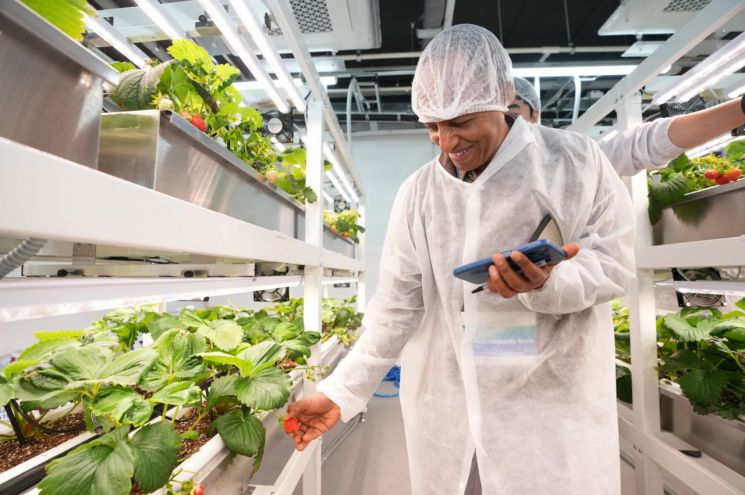 Ethiopian officials are touring a strawberry specialized cultivation facility. Provided by Gangbuk-gu.
Lee Soonhee, Mayor of Gangbuk-gu, said, "I hope this visit by Ethiopian officials will help expand international cooperation and advance agriculture in the field of smart farming." Gangbuk-gu currently operates the 650-square-meter Smart Farm Center and a 1,592-square-meter cutting-edge smart agricultural facility in Ui-dong, which is housed in a greenhouse structure.
During their visit last week, the trainees toured not only the Gangbuk Smart Farm Center and the Ui-dong agricultural facility, but also the Seoul Agro-Fisheries & Food Corporation (Garak Market), the National Institute of Crop Science’s Southern Crop Division, the Gyeonggi-do Agricultural Research & Extension Services, and the Seoul National University Agricultural and Life Sciences Joint Equipment Center.
© The Asia Business Daily(www.asiae.co.kr). All rights reserved.













