Development of Next-Generation Mirabilite Decomposition Technology with Kongju National University
Patent Application in Progress... Annual Revenue of 50 Billion KRW Expected
On June 15, Ecopro HN announced that it has begun developing water treatment technology in collaboration with Kongju National University to process saline wastewater generated during the battery material manufacturing process at a lower cost.
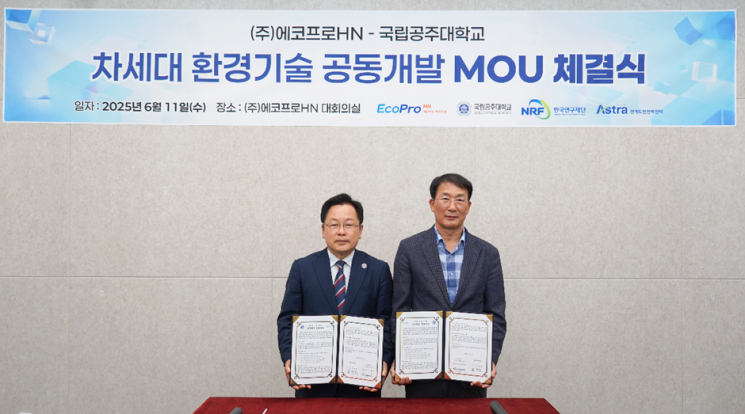 From the right, Jongseop Kim, CEO of Ecopro HN, and Kyungho Lim, President of Kongju National University, signed an MOU for joint development of next-generation environmental technology at the Ecopro HN headquarters on the 11th. Photo by Ecopro HN
To increase the purity of nickel and lithium, which are key minerals for batteries, sulfuric acid is added. As a result, developing technology to treat mirabilite (sodium sulfate) present in the process wastewater, and significantly reducing the associated treatment costs, has emerged as a major challenge for the industry.
In response, Ecopro HN and Kongju National University have started developing next-generation water treatment technology that decomposes mirabilite dissolved in saline wastewater. This technology separates mirabilite into caustic soda (sodium hydroxide) and sulfuric acid using a special chemical catalyst and electrolysis, enabling their reuse. Ecopro HN expects that, through this project, the technology can be applied not only to secondary batteries but also to the treatment and resource recovery of industrial wastewater in various fields, as well as to marine carbon dioxide removal.
Ecopro HN is also participating in the development of 'Redox Flow Electrodialysis (RFED)' technology, which is key to the next-generation water treatment system, together with the research team led by Professor Chunsoo Kim of Kongju National University. This technology facilitates electrolysis through redox chemical reactions, reducing decomposition costs by about 50% compared to existing methods.
Water treatment systems using the conventional bipolar membrane electrodialysis (BPED) method have posed significant challenges for many companies due to high energy costs, including electricity consumption. The next-generation water treatment system, jointly developed with Kongju National University, uses a proprietary catalyst that enhances electrolysis efficiency instead of expensive metal oxide electrodes used for water decomposition, thereby activating electrodialysis and reducing electricity consumption by about half compared to traditional methods.
This research is being carried out as part of the Ministry of Science and ICT's 'Extreme Challenge R&D Project.' The Extreme Challenge R&D Project aims to find practical technological solutions in response to global technological hegemony competition, and is notable for being Korea's first pilot project to grant full authority and responsibility to a project manager (PM). This project is also highly regarded as a significant example of industry-academia cooperation that enhances the efficiency of R&D investment.
Separately, Ecopro HN is also developing an innovative water treatment system that purifies wastewater under high pressure to improve the recovery efficiency of valuable metals, and is preparing to file a patent application. The wastewater treatment system precipitates and filters wastewater using chemicals, then applies pressure to the wastewater with a particulate reverse osmosis (RO) facility to filter out salts, heavy metals, and microorganisms with an ultrafine membrane, and finally extracts and separates contaminants in solid form through mechanical vapor recompression (MVR).
Ecopro HN has replaced the RO facility with a high-pressure reverse osmosis (HPRO) system to enable the treatment of high-salinity wastewater. This is expected to be used for purifying highly concentrated saline wastewater that is difficult to process at low pressure. Ecopro HN forecasts that its water treatment solution business will generate approximately 50 billion KRW in annual revenue.
Park Kibum, Head of Business at Ecopro HN, stated, "By collaborating with Ecopro affiliates engaged in the secondary battery business, we have secured technology to recycle 100% of the washing water generated during cathode material manufacturing," adding, "We plan to apply this system to other companies struggling with wastewater treatment issues going forward."
© The Asia Business Daily(www.asiae.co.kr). All rights reserved.

![Clutching a Stolen Dior Bag, Saying "I Hate Being Poor but Real"... The Grotesque Con of a "Human Knockoff" [Slate]](https://cwcontent.asiae.co.kr/asiaresize/183/2026021902243444107_1771435474.jpg)














