The clash between Israel and Iran has continued for a second day after Israel bombed Iran's nuclear facilities and military leadership. As Iran launched a large-scale retaliatory airstrike using ballistic missiles, and the United States mobilized its military assets to defend Israel, tensions in the Middle East have reached their peak.
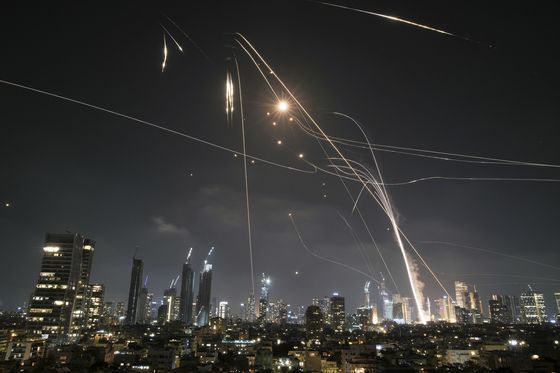 On the night of the 13th (local time), missiles launched by Iran over Tel Aviv, Israel, were intercepted by the Israeli air defense system. Photo by AFP, Yonhap News
According to the Associated Press on June 14 (local time), Iran fired hundreds of missiles toward Israel from the night of the previous day through the morning, resulting in at least three deaths and dozens of injuries in Israel. Israeli authorities stated that 34 people were injured and one person was killed in Tel Aviv and other areas as a result of Iran's retaliation.
This airstrike was a large-scale retaliation for the damage to Iran's nuclear facilities caused by Israel's attack. Previously, at dawn on the 13th, two days before the sixth round of nuclear negotiations between the United States and Iran, Israel carried out surprise strikes on dozens of Iran's nuclear and military facilities. At the same time, targeted airstrikes were conducted against nuclear scientists, including Hossein Salami, the commander-in-chief of the Islamic Revolutionary Guard Corps (IRGC), and former Atomic Energy Organization of Iran head Reza Abbasi.
In response to Israel's attack, Iran launched a large number of missiles toward Israeli territory as retaliation. Iran's airstrikes continued for about four rounds until the early morning of the 14th. Ayatollah Ali Khamenei, Iran's Supreme Leader, asserted the legitimacy of the retaliation, stating that "they started this and initiated the war" against Israel.
In response, the Israeli military detected and intercepted about 100 missiles coming from Iran at around 9 p.m. on the 13th.
As Israel's defense system was partially breached by Iran's large-scale retaliatory airstrikes, the United States also took action. The U.S. government announced that its military supported Israel in intercepting Iranian ballistic missiles and mobilized both ground and naval forces to assist in Israel's defense. The U.S. Navy ordered the forward deployment of major destroyers in preparation for Iran's retaliation, and Air Force fighter jets also enhanced security measures.
European countries, which are security allies of the United States, also expressed their willingness to provide support. French President Emmanuel Macron stated that France would participate in Israel's defense operations depending on the situation.
Leaders of major countries launched diplomatic efforts to prevent further escalation. On this day, British Prime Minister Keir Starmer held a three-way phone call with French President Emmanuel Macron and German Chancellor Friedrich Merz to discuss the situation in the Middle East.
Prime Minister Starmer also held consecutive calls with Prime Minister Netanyahu and former U.S. President Donald Trump, emphasizing diplomatic solutions. The Kremlin announced that Russian President Vladimir Putin also expressed his willingness to act as a mediator by holding successive calls with the leaders of Iran and Israel.
© The Asia Business Daily(www.asiae.co.kr). All rights reserved.












