Recent Economic Trends, June Issue
"Export slowdown" mentioned for two consecutive months
Exports to the United States down 8.1% in May
"Swift preparation and implementation of supplementary budget"
The government has maintained its assessment that "downward pressure on the Korean economy continues." It diagnosed the overall economic situation as weak, citing a return to declining exports in May and worsening domestic indicators such as construction investment and retail sales.
In the June issue of its "Recent Economic Trends (Green Book)" released on the 13th, the Ministry of Economy and Finance stated, "While the recovery of domestic demand, including consumption and construction investment, is being delayed and employment difficulties persist, especially in vulnerable sectors, downward pressure on the economy remains due to worsening external conditions caused by U.S. tariffs and a slowdown in exports." The term "downward pressure" has been used for six consecutive months this year.
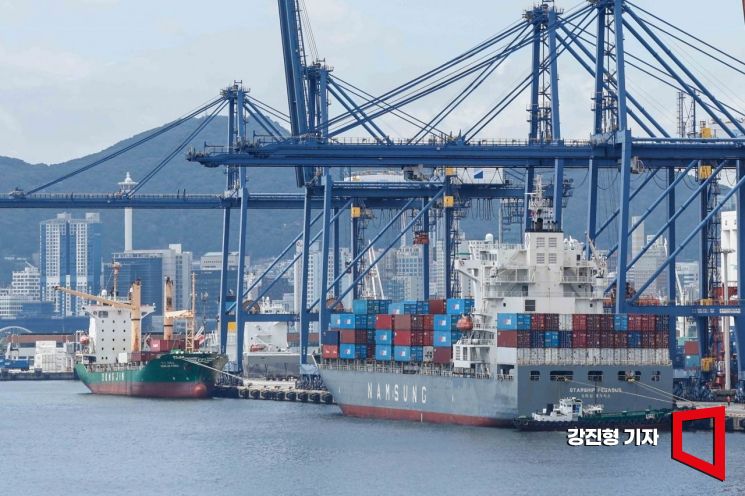
The expression "export slowdown" also appeared for the second consecutive month. Cho Sungjoong, Director of Economic Analysis at the Ministry of Economy and Finance, explained, "While exports maintained double-digit growth last year, the growth rate slowed from the fourth quarter. With U.S. tariffs continuing from April this year, we believe the downward pressure on exports has increased." In fact, exports turned negative again. Total exports in May decreased by 1.3% compared to the same month last year. Average daily exports rose by 1.0% to 2.66 billion dollars, but this was not a significant recovery from April's 2.43 billion dollars. In particular, exports to the United States last month fell by 8.1%. The sluggish performance of non-semiconductor items also appears to have constrained the overall export recovery.
Domestic indicators were also weak. Retail sales in April fell by 0.9% from the previous month and by 0.1% year-on-year. Facility investment decreased by 0.4% and construction investment dropped by 0.7% compared to the previous month. Construction investment plunged by 20.5% year-on-year, indicating a deepening and prolonged slump in the construction sector. In May, department store card approvals fell by 0.5% year-on-year, marking a decline for four consecutive months since February, while discount stores also saw a 5.9% decrease.
On the production side, signs of contraction were observed across the board. Total industrial production in April decreased by 0.8% from the previous month, with manufacturing (-0.9%), services (-0.1%), and construction (-0.7%) all declining simultaneously. The Korea Development Institute (KDI) also stated in its "June Economic Trends" report released on the 10th that "weakness in construction investment is restricting domestic demand recovery, and production growth has also weakened, especially in the construction sector."
Meanwhile, the Consumer Sentiment Index (CSI) rose by 8.0 points from the previous month to 101.8, indicating a partial recovery in optimism. However, the Corporate Business Survey Index (CBSI) remained at 90.7, still below the baseline of 100. This means that business sentiment remains subdued.
There were some positive trends in employment indicators. The number of employed persons in May increased by 245,000 compared to the same month last year, expanding from April's increase of 194,000. The unemployment rate fell by 0.2 percentage points year-on-year to 2.8%. The inflation rate eased slightly from 2.1% in April to 1.9% in May, largely due to falling prices of agricultural products and petroleum.
Regarding the global economy, the Ministry of Economy and Finance noted that while employment in the United States remains solid, the month-on-month increase in retail sales has narrowed, and uncertainty persists due to the U.S. government's tariff policies. In China, consumer prices fell by 0.1% in May, marking a decline for four consecutive months. The real estate market remains sluggish, and export growth slowed to 4.8% compared to 8.1% in the previous month.
The government stated, "With the global trade environment deteriorating and volatility in international financial markets persisting, we will swiftly prepare and implement a supplementary budget to support economic recovery, stimulate consumption, and assist vulnerable groups and small business owners." It added, "We will also make every effort to respond to trade risks, including supporting Korean companies affected by U.S. tariffs."
© The Asia Business Daily(www.asiae.co.kr). All rights reserved.












