Ministry of Health and Welfare: "Inappropriate to Specify a Particular Organization as the Main Body for Education Management"
Korean Nurses Association: "Conducted Education for Previous Pilot Project at Government's Request"
As the Nursing Act, which outlines the work standards and responsibilities of Physician Assistant (PA) nurses, is set to take effect on June 21, the government and the nursing community remain at odds over who should be responsible for the education and management of PA nurses and what authority they should have. With the nursing community staging rallies and protests on a daily basis in strong opposition, concerns are mounting that the conflict between the two sides will intensify further.
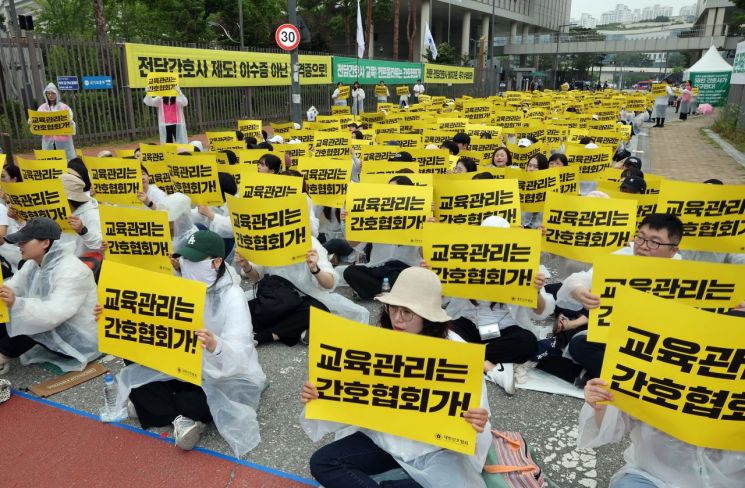 Nurses affiliated with the Korean Nurses Association are shouting slogans at a rally held in front of the Ministry of Health and Welfare at the Government Sejong Complex on the 2nd, demanding "Transparency and legalization of education and qualification management for nurses performing medical support tasks." Photo by Yonhap News
An official from the Ministry of Health and Welfare told Asia Economy on June 13, "It is fundamentally inappropriate to specify a particular organization or group as the main body responsible for education management in the draft enforcement rules regarding the performance of medical support tasks." This effectively draws a line against the nursing community's demand to delegate overall educational management authority for PA nurses. The Korean Nurses Association (KNA) is urging the government to allow the KNA, rather than medical institutions, to take full charge of designating, evaluating, and operating dedicated nurse training institutions, citing the professionalism of nursing practice and education.
Regarding the government's stance, a KNA official pointed out, "More than 70% of the fees generated from nursing management fees and night nursing fees are supposed to be used for nurses, but proper management and oversight are still lacking." The official added, "It is unrealistic for the Ministry of Health and Welfare, which cannot even resolve this issue, to directly manage thousands of training institutions." The official also stated, "The KNA has been responsible for nurse continuing education as well as education for PA nurses during last year's pilot project, at the request of the Ministry of Health and Welfare."
The educational management authority that the KNA is seeking to be delegated encompasses all aspects, from the educational field, curriculum, and environment for PA nurses to the inspection of educational status and quality control. The KNA argues that the current plan proposed by the Ministry of Health and Welfare is no different from the previous practice, where PA nurses informally learned medical procedures from senior nurses, meaning education took place "outside the formal system." The KNA insists that only a properly established system led by the association can prevent potential medical accidents caused by inadequate education and management.
At a public hearing on the Nursing Act held on May 21, the Ministry of Health and Welfare announced that it would designate educational institutions for PA nurses as follows: relevant associations such as the KNA, the Korean Medical Association, and the Korean Hospital Association; hospital-level medical institutions with 300 or more beds; advanced practice nurse training institutions; and public health care support centers.
With such divergent positions over the management of PA nurse education, the KNA has recently continued to organize rallies and protests. In addition to a rally held in front of the Ministry of Health and Welfare at the Government Sejong Complex on June 2, following one on May 26, the association has also been staging a one-person relay protest in front of the ministry for three consecutive weeks, demanding a review of the enforcement rules, which they claim undermine the original intent of the Nursing Act and threaten public health, and calling for transparency and legalization in the education and qualification management of nurses performing medical support tasks.
Although the implementation of the Nursing Act is imminent, the controversy is expected to continue for the time being, as it will take several months before the enforcement rules, which are subordinate to the act, are officially promulgated. A Ministry of Health and Welfare official explained, "Since discussions are still ongoing, it is difficult to predict when the rules will be promulgated. Even after discussions conclude, the procedures of legislative notice and regulatory review will take at least several months." The ministry plans to address any regulatory gaps that arise before the enforcement rules are promulgated by extending the current pilot projects related to nurse duties.
© The Asia Business Daily(www.asiae.co.kr). All rights reserved.