Evidence of Roof Tile Supply to Hwangryongsa Temple During the Goryeo Dynasty
"An Important Clue to Understanding the Roof Tile Supply System of the Time"
A roof tile inscribed with the characters "Hwangryong" (皇龍) has been discovered for the first time at the kiln site in Mangseongri, Gyeongju. This find is regarded as evidence that roof tiles produced at this location were supplied to Hwangryongsa Temple during the Goryeo Dynasty.
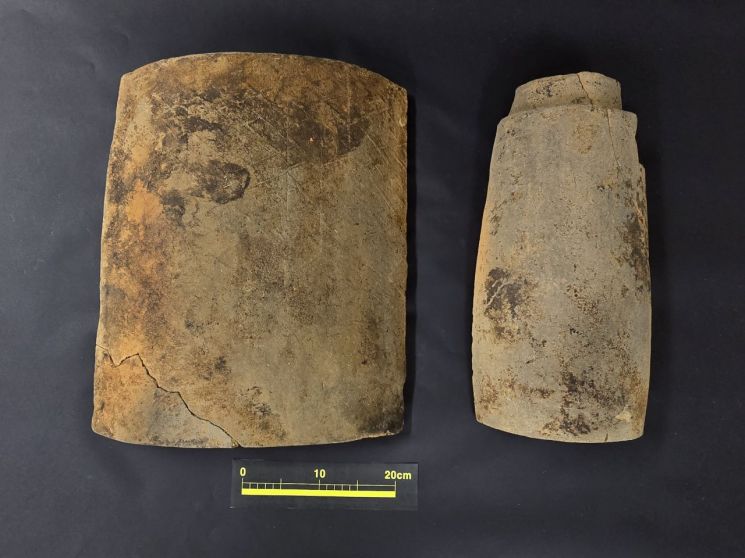
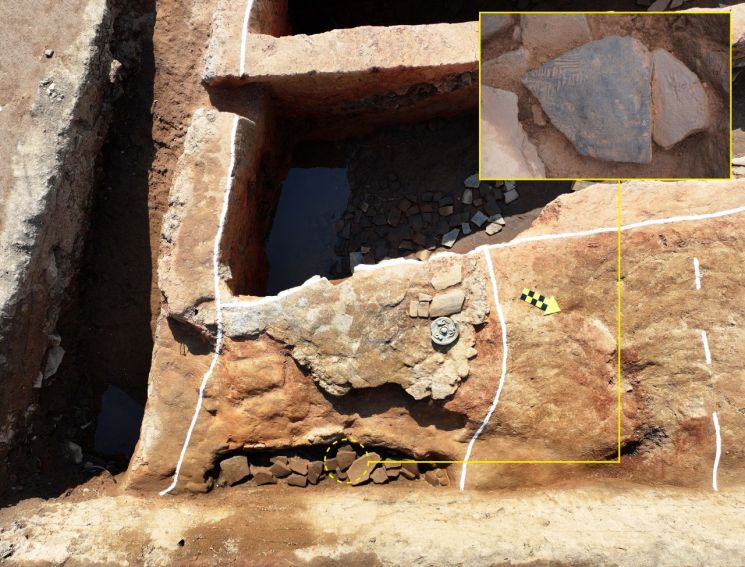
On June 12, the National Heritage Administration and the National Heritage Research Institute announced that a "Hwangryong" inscribed roof tile was unearthed at the tile kiln site of "Site No. 384, Mangseongri, Gyeongju," where excavation is currently underway. The kiln site is located approximately 7 kilometers southwest of the Hwangryongsa Temple site. Although only part of the firing chamber and the firebox remain, a large number of roof tile fragments and traces of tiles stacked in layers were found inside the kiln, indicating that roof tiles were mass-produced here at the time.
The excavated tile is a small concave roof tile fragment measuring 17 centimeters in length and 15 centimeters in width. The "Hwangryong" characters, written in clerical script style, are raised between vertical lines, with the left and right sides reversed. This form is identical to artifacts excavated from the eastern building site near the south gate of Hwangryongsa, the northeastern lecture hall site, and items in the collection of the Dong-A University Museum.
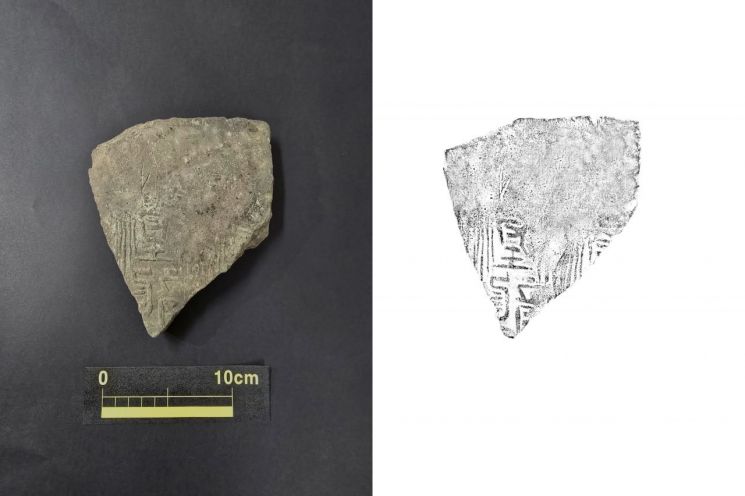
This is the first time that a roof tile inscribed with "Hwangryong" has been found at a kiln site known as a supplier. The National Heritage Research Institute explained, "This is significant evidence that roof tiles were actually supplied to Hwangryongsa Temple in Gyeongju during the Goryeo Dynasty."
The "Hwangryong" inscribed roof tile features only the pattern and characters, without any border around the inscription. It is estimated to have been produced from the late 10th century to the early 13th century. This corresponds with historical records of the reconstruction of Hwangryongsa Temple in the first year of King Yejong of Goryeo (1106), confirming that this kiln site was a major production center for roof tiles used in the repair and maintenance of Hwangryongsa during the Goryeo period.
The National Heritage Research Institute added, "It has long been assumed that the kilns in the Mangseongri area supplied roof tiles to royal palaces, Hwangryongsa Temple, and Sacheonwangsa Temple during the Unified Silla period. This discovery demonstrates that the tradition continued into the Goryeo Dynasty." The institute also evaluated, "This is highly significant as it provides an important clue to understanding the roof tile supply system of the time."
The National Heritage Research Institute will hold an on-site briefing at the Mangseongri site on the afternoon of June 18 to present the results of this excavation to the public.
© The Asia Business Daily(www.asiae.co.kr). All rights reserved.