Structure Presumed to Be Wooden Pagoda and Clay Buddha Fragments Unearthed
Mayor Choi Wonchul: "We Will Do Our Best to Clarify the True Nature of Daetongsa"
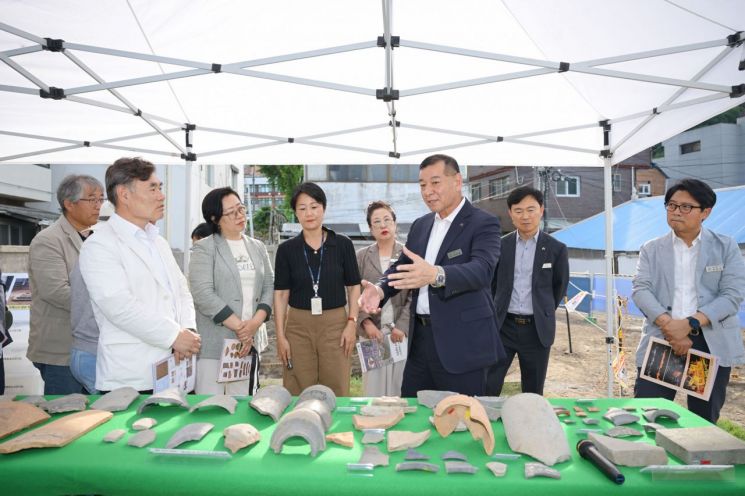
On June 12, Gongju City, Chungnam Province, announced that a detailed excavation survey of the site designated for the Gongju Daetongsa Temple Historic Park had confirmed the presence of more than 90 relics and remains dating from the Baekje period through to the late Joseon Dynasty.
According to the "Samguk Yusa," Daetongsa Temple was established in the first year of Daetong, Jeongmi (527), for Emperor Yangmu, in Ungcheonju, which is present-day Gongju. It is believed to have continued as a royal temple from its founding during the Baekje period, through the Unified Silla and Goryeo periods, and into the Joseon Dynasty.
This survey identified a total of over 90 archaeological features across six cultural layers spanning from the Baekje period to the late Joseon Dynasty.
In the Baekje period layer, retaining walls and stone alignments were found; in the Unified Silla period, 11 roof tile kiln sites were identified; in the Goryeo period, seven roof tile kiln sites were discovered; in the early Joseon period, pit features were found; and in the late Joseon period, building sites and fence alignments were uncovered.
In particular, the nature and variety of the excavated artifacts, including a diverse assemblage of clay Buddha fragments, strongly suggest that an actual temple existed in the vicinity of Daetongsa. There is also speculation that a wooden pagoda may have stood at the center of the site. This is considered a significant achievement, as previous investigations had not identified any specific temple building sites.
Since the 2000s, several small-scale detailed excavations had been conducted in the Banjuk-dong area, but no structures directly related to the temple had been found, leaving the true nature of Daetongsa unconfirmed.
In response, Gongju City and the National Heritage Administration commissioned a full-scale detailed excavation focused on the site at 197-4 Banjuk-dong, where a large number of temple artifacts had been identified, in order to clarify the true nature of Daetongsa and to establish future plans for preservation and utilization.
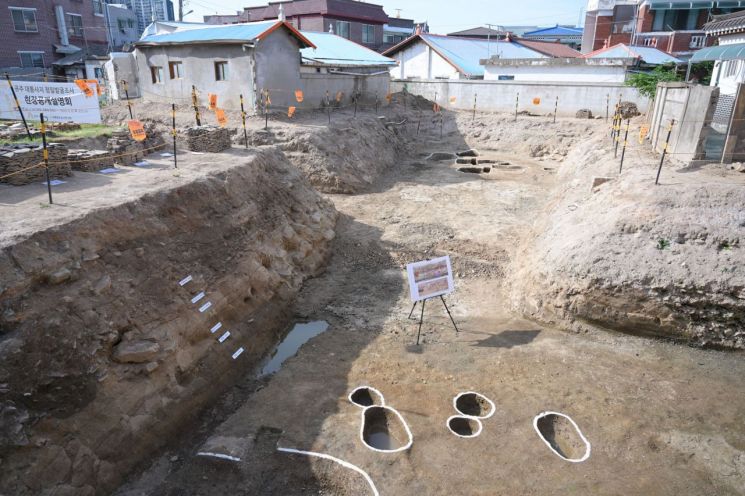
The city plans to actively present the newly discovered relics and remains to the public. Based on these findings, Gongju City aims to strengthen the connection with the Baekje Historic Areas, which are listed as UNESCO World Heritage sites, to increase public interest and to reestablish the historical significance of Ungjin Baekje.
Mayor Choi Wonchul stated, "Although the Daetongsa site is relatively less known compared to Gongsanseong Fortress, the Tomb of King Muryeong, and the Royal Tombs, it is nonetheless an important royal temple. We will do our utmost to clarify the true nature of Daetongsa in the future."
© The Asia Business Daily(www.asiae.co.kr). All rights reserved.