1:1 Ratio Likely for Flight Mileage; Different Rates Expected for Partner Mileage
Korean Air: "Details Cannot Be Confirmed, Awaiting KFTC Review and Announcement"
Korean Air will submit its plan for integrating mileage programs with Asiana Airlines to the Korea Fair Trade Commission (KFTC) on June 12, as part of their corporate merger process. For flight mileage, a 1:1 integration ratio is considered most likely. However, for partner mileage accumulated through credit card usage and other means, it is highly likely that different conversion rates will be applied.
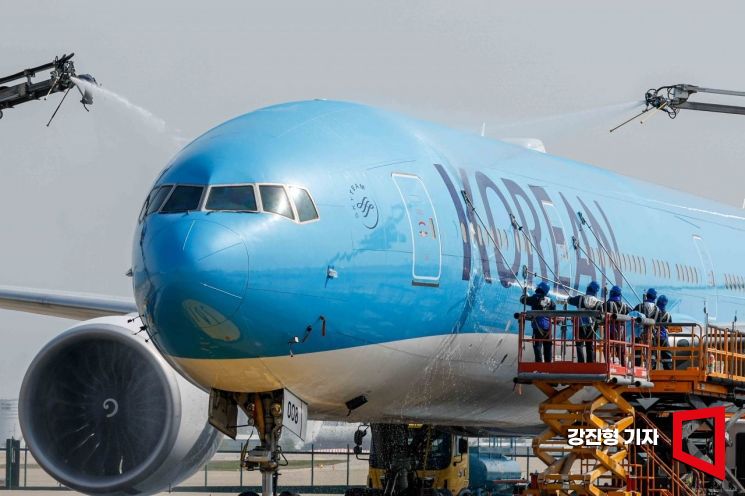 At the Korean Air aircraft maintenance hangar in Jung-gu, Incheon, Korean Air officials are cleaning an aircraft fuselage featuring the new CI. 2025.4.24. Photo by Kang Jinhyung
According to the airline industry on June 12, Korean Air is scheduled to submit its mileage integration plan to the KFTC later in the day. This submission is in response to the KFTC's request that the plan be provided within six months of the two companies' merger date, which was December 12 of last year.
A 1:1 integration ratio is considered most likely for flight mileage. This is because both airlines calculate mileage based on the International Air Transport Association (IATA) city-pair distance standard, resulting in little difference between the two. The same method was applied in previous global airline mergers, such as Delta Air Lines and Northwest Airlines in 2008, United Airlines and Continental Airlines in 2011, and more recently, Alaska Airlines and Hawaiian Airlines.
On the other hand, for partner mileage accumulated by consumers through credit card usage and similar means, different integration ratios are expected. This is because most mileage credit cards award 1 mile per 1,500 won spent for Korean Air, but 1 mile per 1,000 won spent for Asiana Airlines.
In December of last year, the National Assembly Research Service suggested a 1:0.9 integration ratio in its report titled "Measures to Secure Competitiveness in the Aviation Industry and Protect Consumers Following the Launch of the Integrated Airline." As of the end of the first quarter of this year, Korean Air's outstanding deferred mileage revenue stood at 2.6205 trillion won, while Asiana Airlines' was 951.9 billion won.
Industry observers predict that the KFTC's review process may be prolonged. If a 1:1 ratio is applied to partner mileage, long-time Korean Air customers may feel disadvantaged, while applying different ratios could lead to dissatisfaction among Asiana Airlines members.
A Korean Air official stated, "The specific details of the integration plan will be announced after the KFTC completes its review, so we cannot confirm them at this time."
© The Asia Business Daily(www.asiae.co.kr). All rights reserved.