Political Leadership Needed to Overcome Resistance from Interest Groups in Structural Reform
Maintain Easing Bias in Interest Rates, but Approach Magnitude and Timing with Caution
"We Must Break Away from the Past Practice of Allowing Excessive Real Estate Investment for Easy Economic Stimulus"
Institutional Measures Needed to Prevent Won-Denominated Stablecoins from Circumventing Foreign Exchange Market Regulations
"Bank of Korea Specialized AI to Be Introduced in the Second Half of the Year"... Built by Naver Cloud
"I hope that the newly launched administration will clearly prioritize structural reform tasks and demonstrate leadership in mediating social conflicts, turning the current crisis into an opportunity."
Lee Changyong, Governor of the Bank of Korea, emphasized this point during the 75th anniversary ceremony held at the Bank of Korea Annex in Jung-gu, Seoul, on the 12th. He said, "If we rely excessively on economic stimulus policies just because the situation is urgent, even greater side effects may emerge later." He stressed that the Lee Jaemyung administration must not only implement urgent stimulus measures for economic recovery, but also work on structural reforms to prevent a decline in growth potential and build an economic structure resilient to business cycle fluctuations.
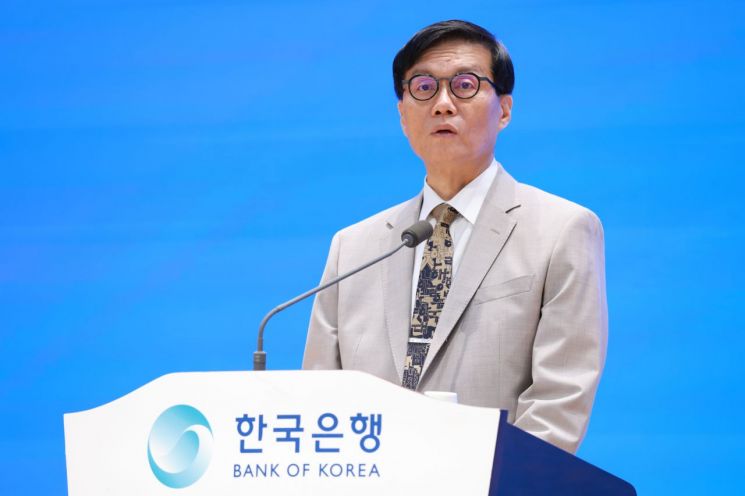 Lee Changyong, Governor of the Bank of Korea, is delivering the 75th anniversary commemorative speech at the Bank of Korea Annex in Jung-gu, Seoul, on the 12th. Bank of Korea
Structural reform is not hindered by ignorance... 'Political leadership' needed to overcome resistance from interest groups
The Bank of Korea presented its economic growth forecast for this year at 0.8% last month. Excluding the foreign exchange crisis, the global financial crisis, and the COVID-19 crisis, this is the lowest level in the past 30 years. Governor Lee remarked, "It is highly unusual to lower the annual growth forecast by as much as 0.7 percentage points in just three months," adding, "The Bank of Korea recognizes the gravity of this situation and believes that stimulus policies have become all the more urgent." However, he explained that in order to determine the appropriate level of stimulus, the current low growth rate must be viewed not only from a cyclical perspective but also from a structural one.
In the mid to late 2000s, Korea's potential growth rate was around 4%, but as low birth rates and population aging have become more pronounced, it has now fallen below 2%. However, due to high external dependence and an export structure concentrated in a few industries, the amplitude of business cycle fluctuations has not diminished. Governor Lee pointed out, "As a result, in the event of internal or external shocks, the probability of negative growth as of 2024 is about 14%, which is three times higher than a decade ago."
The Bank of Korea has diagnosed structural problems that lower Korea's potential growth rate and proposed solutions through its 'structural reform paper.' Previously, it suggested that the root causes of low birth rates and aging include the concentration of population in the Seoul metropolitan area and excessive competition for university entrance, proposing the cultivation of hub cities and a regional proportional selection system. To mitigate the impact of aging, it also presented measures such as continued employment for the elderly, improved care services, and ways to utilize home equity conversion mortgages after retirement. To address the vulnerability of an industrial structure highly dependent on exports and concentrated in certain items, the Bank also studied ways to strategically foster the 'knowledge service' industry.
Governor Lee noted, "In Europe, reports such as the 'Draghi Report' in September last year analyzed the causes of Europe’s declining competitiveness from a mid- to long-term perspective and proposed policy alternatives." However, he emphasized, "The reason structural reform has been slow in Europe is not because the necessity of reform highlighted in the Draghi Report was unknown, but because of the lack of political leadership to mediate interests between countries." He said, "Structural reform inevitably involves conflicts of interest, and in the process, there will inevitably be winners and losers. If there is insufficient coordination and social consensus, even good policies can be derailed by resistance from interest groups." He called on the new administration to demonstrate leadership.
"We must break away from the past practice of allowing excessive real estate investment for easy economic stimulus"
The Bank of Korea's monetary policy will also be closely coordinated with fiscal policy, as long as it does not undermine the central bank's independence. The current trend of lowering the base interest rate will continue for the time being. However, Governor Lee said that the specific scale and timing of rate cuts will be decided cautiously. He pointed out, "If the base rate is lowered excessively, there is a greater risk that it will lead to rising real estate prices in the Seoul metropolitan area rather than a recovery in the real economy." He noted that since March, apartment prices in Seoul have risen by about 7% on an annualized basis, and household loans from financial institutions have also been increasing. Governor Lee diagnosed, "We must break away from the past practice of allowing excessive real estate investment as an easy means of stimulating the economy."
He also reiterated the importance of the Bank of Korea's digital currency (wholesale CBDC), which is currently in the pre-commercial testing phase. Governor Lee said, "Although the current payment and settlement system, including credit cards and simple payment services, is operating efficiently, we cannot be complacent with current convenience." He added, "To usher in a new era of future finance that connects fragmented services such as banking, securities, simple payment, and insurance, a common digital currency platform that links all financial institutions is necessary. At the center of this are central bank digital currency and deposit tokens."
Governor Lee stressed the importance of a common settlement unit that all participants can trust. He again emphasized that the recently controversial 'won-denominated stablecoin' must be institutionally regulated so that it does not circumvent foreign exchange market controls, given its potential to substitute for legal tender.
The Bank of Korea will introduce its exclusive generative AI platform in the second half of this year. This is the first such initiative among public institutions, and the platform is being developed by Naver Cloud. Governor Lee said, "We are developing AI specialized for the Bank of Korea based on the domestically developed 'Sovereign AI.' Our goal is to implement it in the second half of this year." He added, "I hope this project will become a model case of public-private cooperation for the advancement of the domestic AI industry." The Bank will also carry out a 'network improvement pilot project,' moving away from the existing 'network separation policy.' Governor Lee explained, "Cloud computing is essential to fully utilize AI technology," and "In the process of implementing our own AI project, the Bank of Korea will cooperate with the government to carry out the network improvement pilot project as well."
© The Asia Business Daily(www.asiae.co.kr). All rights reserved.