A technology for environmentally friendly control of the large red leaf moth (also known as the royal red leaf moth), a pest that feeds on hibiscus leaves, has been developed and commercialized.
The National Institute of Forest Science announced on June 12 that it has successfully developed and commercialized a mating disruption agent by synthesizing and identifying the sex pheromone of the large red leaf moth.
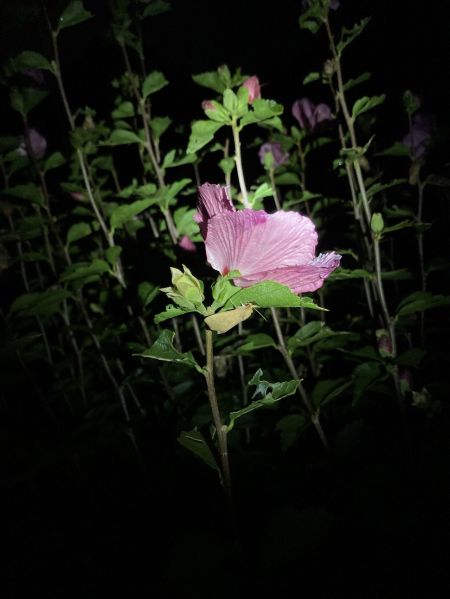 An adult large red leaf moth is hanging on a hibiscus leaf. Provided by the National Institute of Forest Science
The large red leaf moth is a pest that feeds on hibiscus leaves. The mating disruption agent works by artificially releasing large quantities of a substance identical to the pest's sex pheromone, preventing male moths from locating females and thereby controlling the pest population.
This method reduces the density of the second-generation population by interfering with the pest's mating and blocking reproduction. Using this approach, it is possible to suppress pest reproduction without the use of pesticides.
In particular, the mating disruption agent developed by the National Institute of Forest Science was shown in field validation tests to effectively block the attraction of males, resulting in a reduction of about 70% in leaf damage to hibiscus caused by larvae. This technology has been recognized for both its effectiveness and safety, leading to its registration as a patent and its approval as a material for organic farming.
The National Institute of Forest Science transferred this technology to AD Co., Ltd., a company specializing in environmentally friendly pest control, enabling the company to commercialize the mating disruption product. This marks the first domestic application of such technology to urban tree pests, opening up the possibility of its use in areas where pesticide application is difficult, such as city parks and roadside trees.
Currently, the National Institute of Forest Science is also continuing research on pest control for urban trees, including the peach clearwing moth, a pest of cherry trees, and the camellia leaf roller, a pest of camellia trees, in addition to hibiscus pests.
Kim Junheon, Ph.D., of the Forest Insect and Disease Research Division at the National Institute of Forest Science, stated, "In areas such as parks and roadside trees, where large numbers of people are exposed, there are restrictions on pesticide spraying. Therefore, it is important to develop environmentally friendly control methods such as mating disruption agents. With the development of an eco-friendly control agent for hibiscus pests, we hope that many people will be able to enjoy hibiscus without the risks associated with pesticides."
© The Asia Business Daily(www.asiae.co.kr). All rights reserved.