"Possible Application of Land Transaction Permit System"
Mayor Oh Sehoon Cites Foreign Real Estate Purchases as Example
Monitoring Housing Price Surges in Seongdong-gu and Mapo-gu
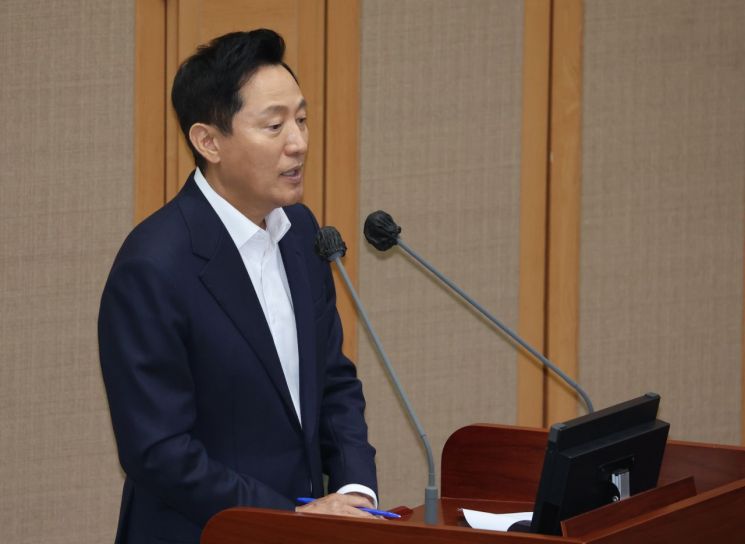 Seoul Mayor Oh Sehoon is attending the 331st regular session city administration questioning held at the Seoul Metropolitan Council in Jung-gu, Seoul on the 11th, responding to questions related to the land transaction permit system. Photo by Yonhap News
Seoul Mayor Oh Sehoon stated regarding the sharp rise in housing prices centered around the Hangang Belt, including Seongdong-gu and Mapo-gu, following the re-designation of the land transaction permit zones (LTPZ) in the three Gangnam districts and Yongsan-gu, that "the market situation must be closely monitored with considerable vigilance."
During the 331st regular session of the Seoul Metropolitan Council on June 11, Mayor Oh said, "Housing prices in Seongdong-gu are rising at a somewhat rapid pace, so we are closely watching the situation."
He added, "At the time of the LTPZ re-designation, we left room to monitor several autonomous districts, including Seongdong-gu and Mapo-gu, for about six months to determine whether additional measures might be necessary. While it is not yet a situation that warrants designation, we need to look into it more deeply." He also noted that while it is preferable not to use the land transaction permit system, it could be implemented if the market enters an emergency situation.
Previously, on March 24, the city designated all apartments in Seocho-gu, Gangnam-gu, Songpa-gu, and Yongsan-gu as LTPZs. The designation period is six months, until September 30, after which the city will decide whether to extend or lift the designation. In Seongdong-gu, which is not subject to the LTPZ, a balloon effect has emerged, leading to a series of record-high transactions. Last month, in Seongdong-gu's Seoul Forest I-Park River Foret, a 59-square-meter unit was sold for 2.27 billion won, and an 84-square-meter unit was sold for 3.49 billion won.
At the time of the LTPZ designation, the city and the government stated that they would take additional measures if the market did not stabilize despite the designation. They also announced that they would consider designating nearby areas such as Mapo-gu and Seongdong-gu, where a balloon effect could occur, as additional LTPZs.
Mayor Oh also mentioned that, in response to the recent increase in real estate purchases by foreigners, it is necessary to consider countermeasures, including the possibility of applying the LTPZ to foreigners.
He remarked, "According to statistical data, it is clear that there are many purchases from the United States and China, but there are no clear signs that these are entering as high-priced real estate speculation, so further study is needed."
He continued, "In implementing economic policy, we must put our citizens first. If real estate prices show abnormal surges and it is analyzed that foreign real estate acquisitions are having a certain impact, then some measures must clearly be taken."
Mayor Oh said, "Although legislative solutions are being sought at the National Assembly level, this will take considerable time, so we are researching what measures can be taken by the Seoul Metropolitan Government. As one example, implementing the LTPZ for foreigners could be considered."
He added, "We need to benchmark cases from Australia and Canada, which have implemented systems that significantly restrict real estate acquisitions by foreigners. However, since this could become a diplomatic issue, it should be introduced carefully and based on the principle of reciprocity."
According to the 'Statistics on Foreigners' Land and Housing Ownership as of the End of 2024' released by the Ministry of Land, Infrastructure and Transport, the number of homes owned by foreigners increased by 5,158 in just half a year, from 95,058 at the end of June last year to 100,216 at the end of December.
When breaking down foreign-owned homes by nationality, Chinese nationals owned the most with 56,301 homes (56.2%). The proportion of Chinese ownership has been steadily increasing, rising from 55.0% in June last year. Americans followed with 22,031 homes (22.0%), and Canadians with 6,315 homes (6.3%).
© The Asia Business Daily(www.asiae.co.kr). All rights reserved.