Expresses Commitment to Constitutional Amendment at First Anniversary Press Conference
Discussion on Forming Ethics Committee Immediately After New Floor Leadership Is Established
Pushes for Reforms Such as Restructuring Legislation and Judiciary Committee and Negotiating Bloc Quotas through Parliamentary Reform Committee
On June 11, National Assembly Speaker Woo Wonsik stated, "Constitutional amendment is a crucial task for the expansion of democracy," adding, "I will push for the formation of a special parliamentary committee on constitutional amendment and pursue the necessary legislation for the amendment process." Speaker Woo also announced plans to establish a special committee on parliamentary reform, vowing to "push forward aggressively" with reforms such as restructuring the Legislation and Judiciary Committee and the allocation of standing committees.
At a press conference marking his first anniversary in office held at Sarangjae in the National Assembly on June 11, Woo said, "Since the new president has a firm commitment, I will work to bring together discussions within and outside the National Assembly, including all political parties."
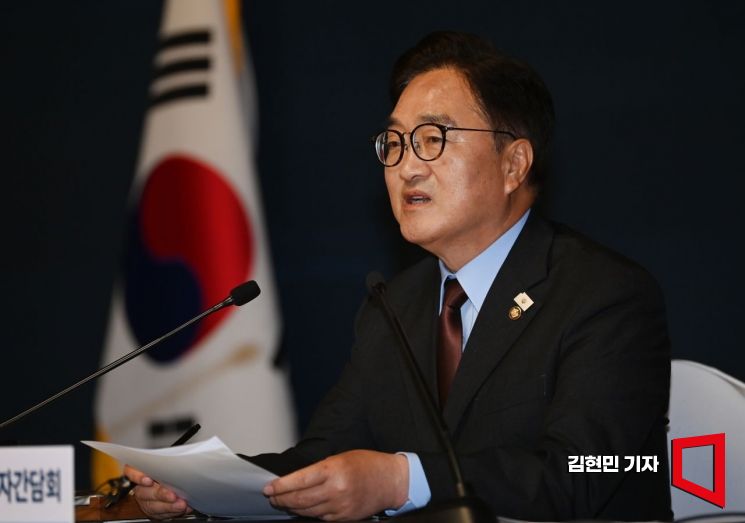 Woo Wonsik, Speaker of the National Assembly, is speaking at a press conference marking the first anniversary of his inauguration held at the National Assembly in Yeouido, Seoul on June 11, 2025. Photo by Kim Hyunmin
Previously, President Lee Jaemyung, during his presidential campaign on May 18, presented his vision for constitutional amendment via social media, focusing on introducing a four-year presidential term with one possible re-election and a runoff voting system. Regarding the timing, President Lee stated, "If discussions proceed quickly, we may be able to put the issue to a public vote during the 2026 local elections; even if delayed, we could do so during the 2028 general elections."
Speaker Woo plans to revive the momentum for constitutional amendment through the special committee. Constitutional amendment has been a major topic in politics since former President Yoon Sukyeol's 12·3 Martial Law, but the issue lost steam as the country entered an early presidential election phase.
Right after the removal of former President Yoon Sukyeol on April 6, Woo proposed, "Let us hold a national referendum for constitutional amendment together with the presidential election in this 'early presidential election.'" However, the Democratic Party expressed opposition, causing the initiative to lose traction. At the time, President Lee, then leader of the Democratic Party, said, "While developing democracy is important, at this moment, preventing the destruction of democracy is even more urgent and important." Subsequently, the political standoff intensified with the attempt by former Prime Minister Han Ducksoo to nominate a Constitutional Court justice, and as a result, the discussion on constitutional amendment lost momentum.
On June 11, Speaker Woo reiterated that "constitutional amendment is a crucial task for the expansion of democracy," and that he would "push for the formation of a special parliamentary committee on constitutional amendment and pursue the necessary legislation for the amendment process." He also announced plans to establish a special committee on parliamentary reform, vowing to "push forward aggressively" with reforms such as restructuring the Legislation and Judiciary Committee and the allocation of standing committees.
Speaker Woo also expressed his determination to push for parliamentary reform. In a Q&A session with reporters, he said, "One of the things that must be done during the remainder of my term is parliamentary reform," and added, "We need to discuss issues such as the review process of the Legislation and Judiciary Committee, remote plenary sessions, improvements to the personnel hearing process, and the method of allocating standing committees." He continued, "What can be accomplished now should be applied to the 22nd National Assembly, and if not, we should at least set things in motion so that the 23rd National Assembly can carry it forward. I intend to operate the special committee on parliamentary reform aggressively." Regarding the number of seats required for negotiating blocs, he said, "There is a need for relaxation," adding, "It is not easy to determine to what extent, but we will thoroughly review the issue of negotiating blocs between the ruling and opposition parties and discuss it in the special committee on parliamentary reform."
Speaker Woo also revealed plans to expedite the formation of the Special Committee on Ethics and other committees once the new floor leadership of both ruling and opposition parties is established. He said, "From the public's perspective, lawmakers should be disciplined and held accountable for their wrongdoings, but we have failed to establish the Ethics Committee, which is embarrassing," adding, "Now that the ruling and opposition parties have changed, there may be a possibility of reaching an agreement." He went on to say, "As Speaker, I believe this cannot be delayed any further, so I will strongly request an agreement, and if that does not work, I will mediate so that an agreement can be reached as soon as possible."
Speaker Woo reiterated his intention to expedite the formation of the Special Committee on Ethics and other committees once the new floor leadership of both parties is in place. He said, "From the public's perspective, lawmakers should be disciplined and held accountable for their wrongdoings, but we have failed to establish the Ethics Committee, which is embarrassing," adding, "Now that the ruling and opposition parties have changed, there may be a possibility of reaching an agreement." He continued, "As Speaker, I believe this cannot be delayed any further, so I will strongly request an agreement, and if that does not work, I will mediate so that an agreement can be reached as soon as possible."
At the press conference, Speaker Woo also outlined his agenda for the coming year. He described the current period as "the second phase of overcoming the crisis, in which the National Assembly and the government must cooperate closely to marshal the nation's capabilities," and pledged to "fulfill an active role and responsibility, starting with the urgent supplementary budget." In addition to constitutional amendment, Woo promised to strengthen the basic capabilities of the National Assembly and to push for the reorganization of the National Assembly's security and guard system. He also announced plans to promote a National Liberation Day Eve event at the parliamentary level and to create an Independence Memorial Plaza in front of the National Assembly Library to foster national identity and unity.
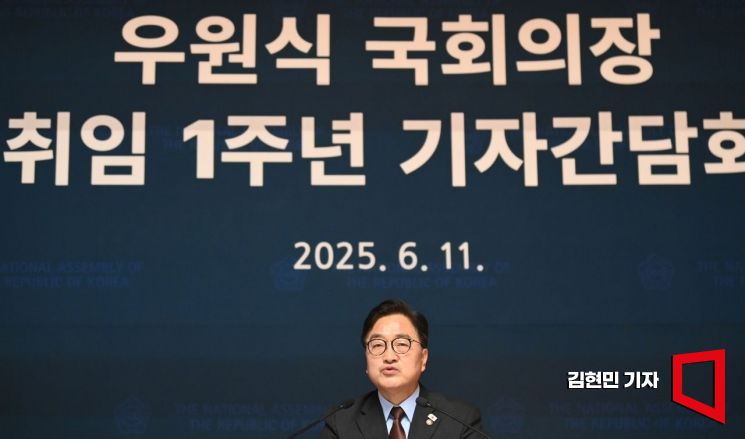 Woo Wonsik, Speaker of the National Assembly, is speaking at a press conference marking his first anniversary in office held at the National Assembly in Yeouido, Seoul, on June 11, 2025. Photo by Kim Hyunmin
Over the past year, Speaker Woo experienced both light and darkness amid extreme political confrontation. At the beginning of his term, he attempted to broker an agreement between the ruling and opposition parties on the so-called "four broadcasting laws," but his efforts ultimately failed.
On December 3 of last year, during the 12·3 Martial Law, Woo entered the National Assembly by climbing over the wall. Despite the urgency to lift martial law, he calmly followed all necessary procedures and conducted the parliamentary schedule, earning widespread public praise. During the first and second impeachment attempts against former President Yoon, he also presided over the plenary sessions with composure, solidifying his image as a politician who remains strong in times of crisis.
© The Asia Business Daily(www.asiae.co.kr). All rights reserved.













