Leading the Way in Offshore Wind Power, Renewable Energy, and Blue Carbon Initiatives
Pioneering the Spread of the "Jeonnam-Style Energy Transition" Model as a National Policy
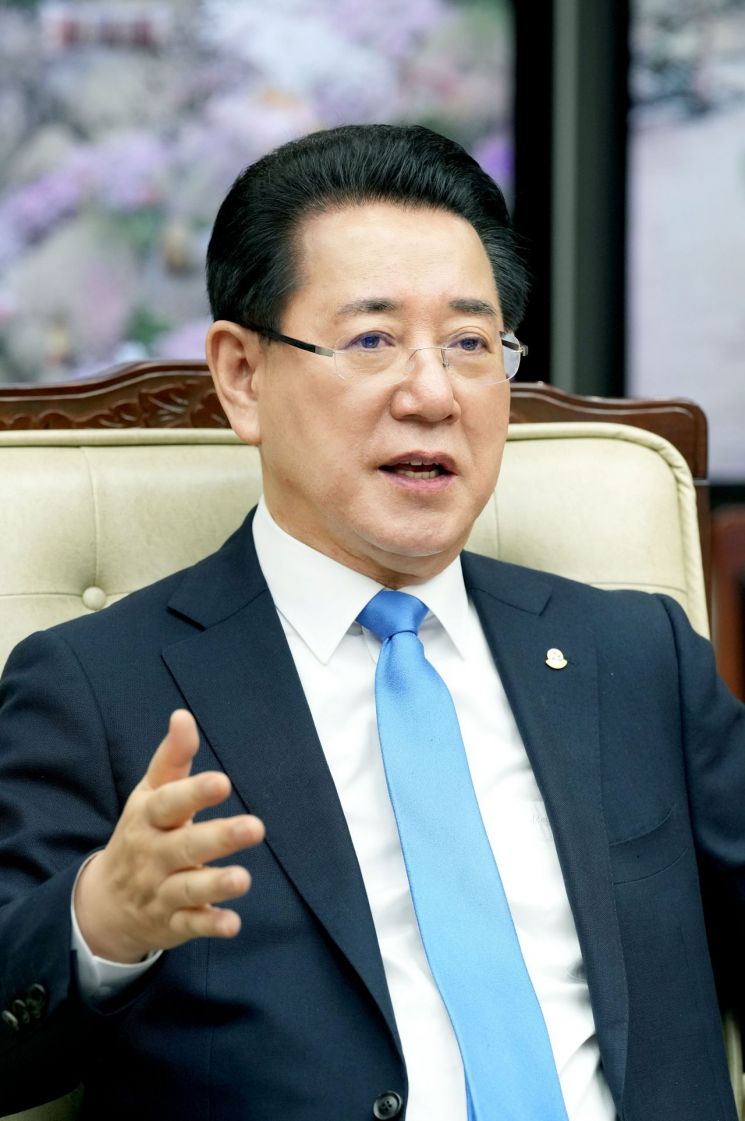
On June 11, Kim Youngrok, Governor of Jeollanam-do, commented on the new government's pledge to establish a "Ministry of Climate and Energy," stating, "This will be a decisive turning point for South Korea's energy transition," and emphasized, "It should be located in the Gwangju-Jeonnam Joint Innovation City, which is home to Korea Electric Power Corporation (KEPCO), Korea Power Exchange, and other energy institutions, to serve as the nation's energy capital."
In his official statement released that day, Governor Kim said, "At this critical time when the climate crisis is seriously threatening the survival of future generations, President Lee Jaemyung's pledge to establish a 'Ministry of Climate and Energy' will become a decisive turning point for South Korea's energy transition," reiterating his position.
Climate and energy policies have suffered from a lack of effectiveness due to siloed administration and fragmented responsibility structures among government ministries. For example, even renewable energy permits are handled separately by the Ministry of Trade, Industry and Energy, the Ministry of Environment, the Ministry of Oceans and Fisheries, the Ministry of Land, Infrastructure and Transport, and local governments. As a result, companies are hampered by uncertainty, residents are marginalized, and investments are delayed.
According to Governor Kim, the Ministry of Climate and Energy should integrate these fragmented structures and become the central axis of a national strategy that organically connects the climate crisis, industrial transition, and energy transition. He added that Jeollanam-do is committed to serving as a key partner in this effort.
In fact, Jeollanam-do is at the forefront of the climate crisis, struggling to find solutions to climate change in the face of global warming, rising sea levels, typhoons, and droughts.
The province is working to host the 33rd session of the Conference of the Parties (COP33) to the United Nations Framework Convention on Climate Change, which would declare South Korea's climate leadership to the world. It is also promoting projects such as the Yeosu National Industrial Complex and Myodo CCUS for national carbon neutrality, as well as the creation of a clean hydrogen cluster in the Yeosu-Gwangyang Bay Area.
Jeollanam-do is also establishing climate change response platforms in the agricultural and fisheries sectors, including the Agricultural and Food Climate Change Response Center, the National Subtropical Crop Demonstration Center, the National Marine Ecological Park for expanding marine carbon sinks, and the Blue Carbon Sea Forest.
In Naju, located in the Gwangju-Jeonnam Joint Innovation City, major energy public enterprises such as KEPCO, Korea Power Exchange, and KEPCO KDN are based, offering favorable conditions for collaboration.
The province is also making the energy future a reality by establishing the Asia-Pacific's largest 3.2GW resident-participation offshore wind power cluster, implementing agrivoltaics, launching the nation's first data center RE100 industrial complex, and planning a decentralized energy highway.
Despite challenging circumstances, Jeollanam-do has proactively developed and led new policy alternatives such as basic energy income, resident-participation renewable energy generation projects, and resident profit-sharing systems.
Governor Kim stated, "Jeollanam-do's renewable energy potential is 1,176GW, accounting for 16% of the national total of 7,333GW, making it the top province in the country. We are striving to find solutions to climate change on the front lines of the climate crisis, including global warming, rising sea levels, typhoons, and droughts," adding, "With such capabilities and determination, Jeollanam-do is the optimal location and an operational hub that can determine the success of the Ministry of Climate and Energy."
He continued, "Responding to the climate crisis and transitioning energy is no longer a matter of choice but a matter of national survival strategy. President Lee Jaemyung's pledge to establish the Ministry of Climate and Energy marks the starting point of a bold transition." He strongly expressed his intention to attract the ministry, saying, "Jeollanam-do, which has found answers on the front lines, will work closely with the central government to ensure that the voices of the region are reflected in the organizational design of the Ministry of Climate and Energy and will take the lead in spreading the Jeonnam-style energy transition model as a national policy."
© The Asia Business Daily(www.asiae.co.kr). All rights reserved.












