Higher Scores in Large Cities and Private Schools
The phenomenon of "N-susaeng dominance" was also observed in the 2025 College Scholastic Ability Test, which was held in November of last year.
According to the analysis of the 2025 CSAT scores released by the Korea Institute for Curriculum and Evaluation on June 8, the average standardized score in Korean for graduates, commonly referred to as N-susaeng, was 108.9 points in last year's CSAT, which is 13.1 points higher than the average for current third-year high school students (95.8 points).
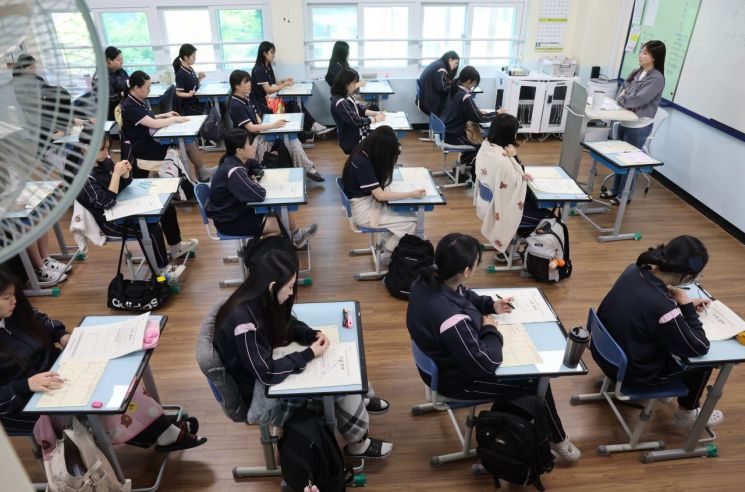 Students preparing for the June mock test of the 2026 College Scholastic Ability Test. Photo by Yonhap News
The average standardized score in mathematics was also higher for N-susaeng (108.4 points) than for third-year students (96.2 points), with a difference of 12.2 points.
For students who took the qualification exam, the average standardized scores were 99.2 points in Korean and 95.7 points in mathematics.
In English, which is graded on an absolute scale, the percentage of N-susaeng achieving Grade 1 (raw score of 90 or above) was 9.6%, which is twice the rate of third-year students (4.7%). The percentage of Grade 1 among qualification exam students was 5.1%.
The dominance of N-susaeng has continued since the introduction of the integrated CSAT in 2022. In the 2022 CSAT, the average standardized score for N-susaeng was 13.2 points higher in Korean and 12.3 points higher in mathematics compared to third-year students. In the 2023 CSAT, the gap was 12.9 points in Korean and 12.4 points in mathematics. In the 2024 CSAT, the gap was 12.8 points in Korean and 12.1 points in mathematics. The trend of N-susaeng scoring 12 to 13 points higher on average in Korean and mathematics has continued.
By school location, the average standardized scores in Korean and mathematics for schools in large cities (98.6 points and 98.8 points, respectively) were higher than those in medium and small cities (95.5 points and 95.8 points) and in rural areas (92.9 points and 93.6 points).
By region, schools in Seoul had the highest average standardized scores in both Korean and mathematics. The average standardized scores in Seoul were 101.7 points for both Korean and mathematics, making it the only region nationwide where the average exceeded 100 points.
Looking at the gap in average standardized scores between schools within each region, which reflects the academic achievement gap between schools, Daejeon had the smallest gap in Korean (28.6 points), while Gwangju had the smallest gap in mathematics (29.7 points).
Although Seoul had the highest average scores, the gap between schools in Seoul was the third largest in Korean at 53.1 points, following Chungnam (55.9 points) and Gyeonggi (54.8 points). In mathematics, Seoul had the largest gap nationwide at 59.1 points.
By gender, female students had a higher average standardized score in Korean (100.8 points) than male students (99.1 points), while male students had a higher average in mathematics (102.7 points) than female students (97.1 points). The percentage of students achieving Grade 1 in English was similar for female students (6.3%) and male students (6.1%).
Private schools had higher average standardized scores in Korean and mathematics than public schools by 4.2 points and 4.0 points, respectively. The percentage of students achieving Grade 1 in English was also higher at private schools (6.1%) compared to public schools (3.9%).
© The Asia Business Daily(www.asiae.co.kr). All rights reserved.












