Even $25 Billion Spent on the Golden Dome Can't Stop Drone Operations
"Trailer-Disguised Drones Pose a Real Threat to Strategic Assets"
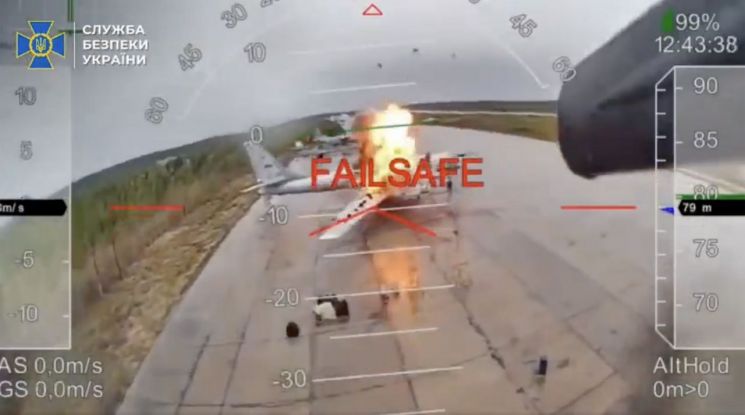
Ukraine's large-scale drone strike, known as the "Spider Web Operation," destroyed around 40 Russian military aircraft. Analysts have pointed out that not only Russia, but also the United States and other major military powers, remain vulnerable to such drone attacks.
On June 4 (local time), The Washington Post (WP) reported that the United States is increasingly susceptible to low-tech, low-cost attacks such as drone strikes.
Stacie Pettyjohn, a senior fellow at the Center for a New American Security (CNAS), stated, "The Department of Defense should be very concerned about this issue." She explained that attacks using drones hidden in containers or trucks, similar to Ukraine's tactics, have a very high likelihood of being carried out on U.S. territory or targeting U.S. Air Force and Navy bases overseas.
The importance of asymmetric capabilities has recently increased. For example, the Houthi rebels, supported by Iran, have seized control of the Red Sea shipping lanes using inexpensive missiles and drones. As a result, the United States has spent over $1 billion conducting retaliatory airstrikes. The drones used by Ukraine in this operation are particularly notable as asymmetric weapons because they are low-cost, highly accessible, and can be remotely controlled.
On June 1, Ukraine struck four Russian air bases on Russian soil with drones. The attack was carried out by smuggling drones near Russian military airfields using commercial trucks and then remotely operating them. According to the British daily The Telegraph and other sources, the attack damaged two A-50 early warning aircraft, which are central to Russia's air defense network, and targeted around 40 military aircraft in total. Foreign media have described this attack as shocking, comparing it to Japan's 1941 "Pearl Harbor attack."
As the war in Ukraine has continued for over three years, inexpensive drones are being used on the battlefield for a variety of purposes. Within the United States, there are criticisms that, despite massive defense spending, the response to drones remains inadequate.
Celeste Wallander, who served as Assistant Secretary of Defense for International Security Affairs in the Biden administration, said, "Drones can be used as part of infantry combat, as a form of artillery, or as intelligence assets to assess battlefield conditions." She emphasized, "What we did not realize until now is that drones can be used to threaten strategic weapons. The June 1 attack clearly demonstrated this point."
Jason Crow, a Democratic Congressman from Colorado, remarked, "The war in Ukraine has fundamentally changed the nature of warfare," and pointed out that the Department of Defense is still spending enormous sums on military programs that would have been relevant decades ago.
On May 20, former President Trump announced that he would deploy a next-generation missile defense system, the "Golden Dome," similar to Israel's Iron Dome, during his term. However, the initial cost alone is expected to be $25 billion, with total costs reaching $175 billion. Some estimates suggest that more than $2 trillion will be required over the next 20 years.
Military analyst Max Boot, in a recent article for the WP, argued that if China were to conduct drone operations against U.S. air bases, missile defense systems like the Golden Dome would not be able to stop them.
In the United States, incidents such as last year's drone sightings in New Jersey have led to federal regulatory revisions regarding areas where commercial drones can legally fly, as well as efforts to restrict the sale of Chinese-made drones. However, experts point out that these discussions view drones from a law enforcement perspective rather than as a matter of national security. Retired General Glen VanHerck, former commander of U.S. Northern Command, cited a December 2023 incident at Langley Air Force Base in Virginia, where an unmanned aerial vehicle flew over an F-22 Raptor fighter jet, highlighting how vulnerable the situation would have been if an attack had been attempted. He further noted that if Russia or China were to infiltrate the United States, develop drones domestically, or deploy container ships carrying drones to ports near critical infrastructure, detection would be impossible.
Jason Matheny, CEO of the RAND Corporation, stated, "Any country that possesses strategic bombers, strategic missiles and silos, or strategic nuclear submarines will see this attack and realize that drones disguised as trailers could pose a real threat to their own strategic assets."
© The Asia Business Daily(www.asiae.co.kr). All rights reserved.












