First Use of "Climate" in Ministry Name... Environmental Groups Express High Hopes
Energy Experts Warn: "Separating Energy and Industry Could Cause Side Effects"
Concerns Over Increased Public Burden from West Coast Energy Highway Construction
With Lee Jae-myung's victory in the 21st presidential election held on June 3, it is expected that discussions regarding government reorganization will become active with the launch of the new administration. In particular, attention is focused on whether the Ministry of Climate and Energy, which President Lee pledged during his campaign, will be established. Climate and environmental organizations have welcomed the potential creation of the Ministry of Climate and Energy, while also voicing concerns regarding the energy sector.
The most notable aspect of President Lee Jae-myung's energy policy pledges, announced with his confirmed election on June 4, is the establishment of the Ministry of Climate and Energy. The Democratic Party’s election campaign committee, which had previously taken a cautious stance on government reorganization, included a plan to reorganize the Ministry of Economy and Finance and establish the Ministry of Climate and Energy in its official campaign pledges released on May 28, just before the election. The new ministry is expected to serve as a control tower, overseeing the climate policies currently managed by the Ministry of Environment and the energy policies under the Ministry of Trade, Industry and Energy.
"Energy transition is crucial for carbon neutrality" vs "Separating energy and industry will have side effects"
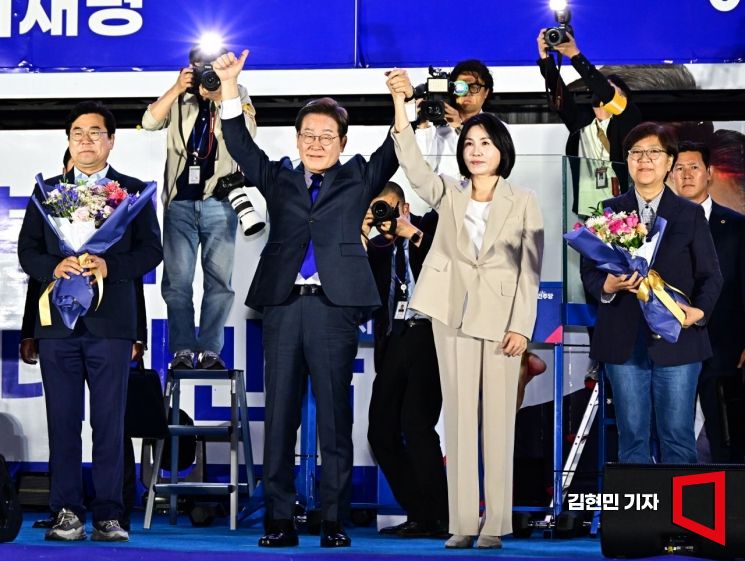 Lee Jae-myung, the Democratic Party presidential candidate who is certain to be elected as the 21st president, and his wife Kim Hye-kyung are greeting citizens at the national vote counting broadcast event held in front of the National Assembly in Yeouido, Seoul on June 4, 2025. Photo by Kim Hyun-min
The establishment of the Ministry of Climate and Energy was a campaign pledge of the Democratic Party in both the 20th presidential election and the 22nd general election. Democratic Party lawmaker Heo Seong-moo also proposed an amendment to the Government Organization Act centered on the creation of the new ministry in March. Analysts believe that President Lee Jae-myung included this pledge in response to the growing need for a strong control tower to address the climate crisis and achieve carbon neutrality.
On May 29, while still a candidate, President Lee Jae-myung expressed his commitment on Facebook, stating, "We will establish the Ministry of Climate and Energy to integrate the energy functions of the Ministry of Industry and the climate functions of the Ministry of Environment, thereby formulating and implementing comprehensive policies to address the climate crisis." He also emphasized, "Our country has been relatively slow in transitioning to renewable energy, weakening our industrial competitiveness, and the damage from climate crises such as floods, droughts, and wildfires has been concentrated on vulnerable and marginalized regions. To resolve this complex crisis, our policies must also be comprehensive and integrated."
Climate and environmental organizations have high expectations for the establishment of the Ministry of Climate and Energy, as it would be the first time a government ministry’s name includes the term "climate." Yoon Soon-jin, Co-Chair of the Energy Transition Forum and Professor at the Graduate School of Environmental Studies at Seoul National University, stated, "Without changes in the energy sector, which emits the most greenhouse gases, achieving carbon neutrality will be difficult. To respond to various international demands such as RE100 and the Carbon Border Adjustment Mechanism, the establishment of the Ministry of Climate and Energy is necessary." Professor Yoon added, "I expect the new ministry will not only focus on regulation but also comprehensively implement industrial promotion policies, such as expanding renewable energy."
However, experts in the traditional energy sector have expressed concerns about integrating energy policy, which is essential for industry and daily life, into a regulatory-focused climate policy ministry. Son Yang-hoon, Professor of Economics at Incheon National University, said, "Energy policy should focus on how to secure and supply energy needed for industry and daily life at affordable prices. If the ministry becomes regulatory in nature, various problems may arise." Professor Son noted, "For this reason, the United States separates the Environmental Protection Agency (EPA) and the Department of Energy (DOE)."
Yoo Seung-hoon, Professor of Future Energy Convergence at Seoul National University of Science and Technology, commented, "If the Ministry of Climate and Energy is established, policy consistency between climate and energy can be maintained, but separating industry and energy may cause problems, so careful consideration is required. If climate and energy are to be combined, it will be inevitable to create a large-scale ministry that also encompasses industry in order to maintain industrial competitiveness."
Internationally, European countries have been integrating climate and energy sectors, but not without experiencing setbacks. In 2008, the United Kingdom ambitiously established the Department of Energy and Climate Change, but as climate change policies became more regulatory-focused, industrial promotion was neglected. This led to side effects such as a shortage of power supply facilities, a surge in wholesale electricity prices, bankruptcies among electricity retailers, and weakened manufacturing competitiveness. Eventually, in 2016, the UK merged the department into the Department for Business, Energy and Industrial Strategy (BEIS). Later, as the need to strengthen energy security through nuclear and renewable energy grew, the UK established the Department for Energy Security and Net Zero (DESNZ) in 2023.
In Germany, the Federal Ministry for Economic Affairs and Energy (BMWi) was launched in 2013 and was expanded and upgraded to the Federal Ministry for Economic Affairs and Climate Action (BMWK) in 2021, with the minister elevated to deputy chancellor. However, since the center-right Christian Democratic Union (CDU) and Christian Social Union (CSU) coalition government took office in February, there have been moves to once again separate the economic and climate sectors.
"Energy highway will increase public burden... Energy mix needed to resolve social conflict"
With the launch of the Lee Jae-myung administration, the construction of the West Coast Energy Highway is also expected to accelerate. The West Coast Energy Highway project aims to transmit renewable energy, such as offshore wind power produced in the Honam region, to the Seoul metropolitan area by constructing an offshore high-voltage direct current (HVDC) transmission network. The project will be carried out in three phases: phase one by 2031, phase two by 2036, and phase three by 2038. President Lee has set a goal to complete the project ahead of schedule by 2030.
Professor Son Yang-hoon expressed concern, stating, "Offshore wind power itself requires enormous investment, and if electricity is transmitted offshore via the energy highway, the cost will skyrocket. Ultimately, electricity rates will have to be raised, or the cost will have to be covered by taxpayers."
President Lee Jae-myung has gone a step further, pledging to establish a "U-shaped Renewable Energy Belt" connecting the seas off Incheon, the southwestern and southern coasts, and the eastern coast of North Gyeongsang Province by 2040.
With expectations that the Lee Jae-myung administration will expand renewable energy policies such as solar and wind power, attention is also focused on what stance it will take regarding nuclear power. In a TV debate before the election, President Lee stated, "Nuclear power is fundamentally risky and has issues with sustainability. We should utilize nuclear power, but not excessively, and transition to renewable energy," emphasizing the need for an "energy mix." Professor Yoo Seung-hoon commented, "In the new administration, I hope that, in line with President Lee Jae-myung's pledges, we will pursue a rational energy mix suited to our national circumstances to reduce social conflict."
New administration to bid for COP33... Carbon neutrality committee to become a public participation body
In addition, President Lee Jae-myung announced in his campaign pledges that he would amend the Framework Act on Carbon Neutrality, which was ruled unconstitutional. In August last year, the Constitutional Court judged it unconstitutional that the government, while setting a goal of carbon neutrality by 2050 to address the climate crisis, had not established long-term greenhouse gas reduction targets. The Framework Act on Carbon Neutrality and its enforcement decree set a goal of reducing greenhouse gases by 40% from 2018 levels by 2030, but do not set reduction targets for the period after that.
The new administration also plans to bid to host the 22nd Conference of the Parties (COP33) to the United Nations Framework Convention on Climate Change in 2028. The pledges also include expanding the proportion of paid allocations in the emissions trading system, enacting a "Special Act on Fostering Climate Tech Businesses" to significantly increase the budget for climate tech research and development (R&D), and enacting the Carbon Neutral Industry Act to strengthen support for carbon-neutral industries such as electric vehicles, renewable energy, and green hydrogen.
President Lee Jae-myung also announced plans to transform the "Presidential Committee on Carbon Neutrality and Green Growth 2050," which currently serves as the control tower for carbon neutrality policy, into a public participation body for a "just transition."
© The Asia Business Daily(www.asiae.co.kr). All rights reserved.












