Report: "Climate Change and the Global Increase in Heatwaves"
South Korea's Average Temperature Rises by 1.2 Degrees Over 30 Years
An analysis has found that, due to climate change, South Korea experienced an additional 12 days of "extreme heatwaves" over the past year.
On May 29 (local time), Climate Central, a U.S.-based nonprofit organization dedicated to climate change research, released a report titled "Climate Change and the Global Increase in Heatwaves." The report, published jointly with the Red Cross Red Crescent Climate Centre and World Weather Attribution (WWA), analyzed the impact of climate change on the increase in heatwave days across 247 countries worldwide over the past year, from May of last year.
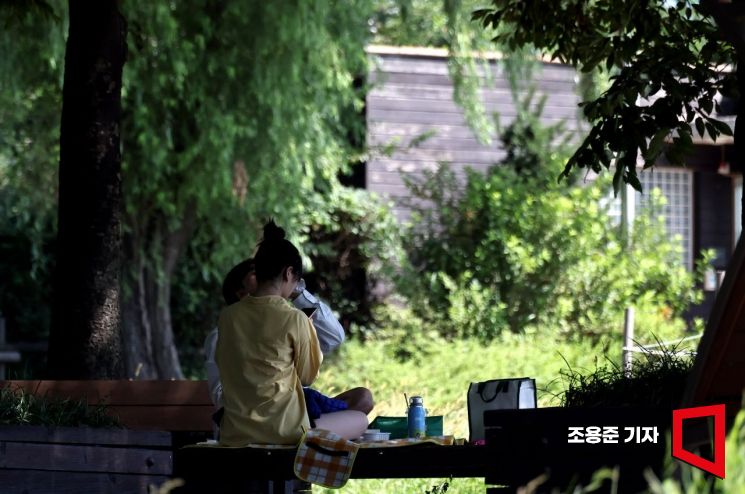 Last August, when the heatwave continued, citizens visiting Haneul Park in Sangam-dong, Seoul, were resting in the shade. Photo by Jo Yongjun
The report defined the baseline for a heatwave as temperatures within the top 10% of those observed in each region from 1991 to 2020, and classified any day exceeding this threshold as a "heatwave day" for each country. The researchers then estimated, using numerical analysis models, how many heatwave days would have occurred if climate change had not taken place, and used this as a reference. During the analysis period, South Korea recorded 76 days that met the heatwave criteria. The researchers estimated that, without climate change, South Korea would have experienced 64 heatwave days?12 fewer than the actual number.
The analysis also found that, due to the effects of climate change, South Korea's average temperature increased by 1.2 degrees Celsius compared to the 30-year average. The report explained that every country in the world experienced an increase in heatwave days due to climate change. In 195 countries, the number of heatwave days more than doubled. The population of countries where the number of additional heatwave days exceeded 30 reached 4 billion, nearly half of the global population.
There were 67 instances of "consecutive heatwaves" worldwide. A consecutive heatwave is defined as a situation in which a new regional high temperature record is set, or abnormally high temperatures occur over a wide area for three or more consecutive days, regardless of the season. By this definition, South Korea also experienced six consecutive heatwaves.
In the report, the researchers stated, "The heatwaves of recent years would have been virtually impossible without human-induced climate change," adding, "While floods and typhoons often make headlines, heatwaves are actually the most deadly weather anomaly." They continued, "Thousands of people die each year from heat-related illnesses, and there are many heat-related deaths that go unreported."
Meanwhile, according to the World Health Organization (WHO) and the World Meteorological Organization (WMO), approximately 490,000 people worldwide died from heat-related illnesses each year between 2000 and 2019. Of these deaths, 45% occurred in Asia and 36% in Europe. In 2023, a severe heatwave caused by climate change led to a sharp increase in heat-related deaths, particularly in Europe. At that time, about 37,000 people died from high temperatures in Europe, marking the second-highest figure since 2015.
© The Asia Business Daily(www.asiae.co.kr). All rights reserved.











